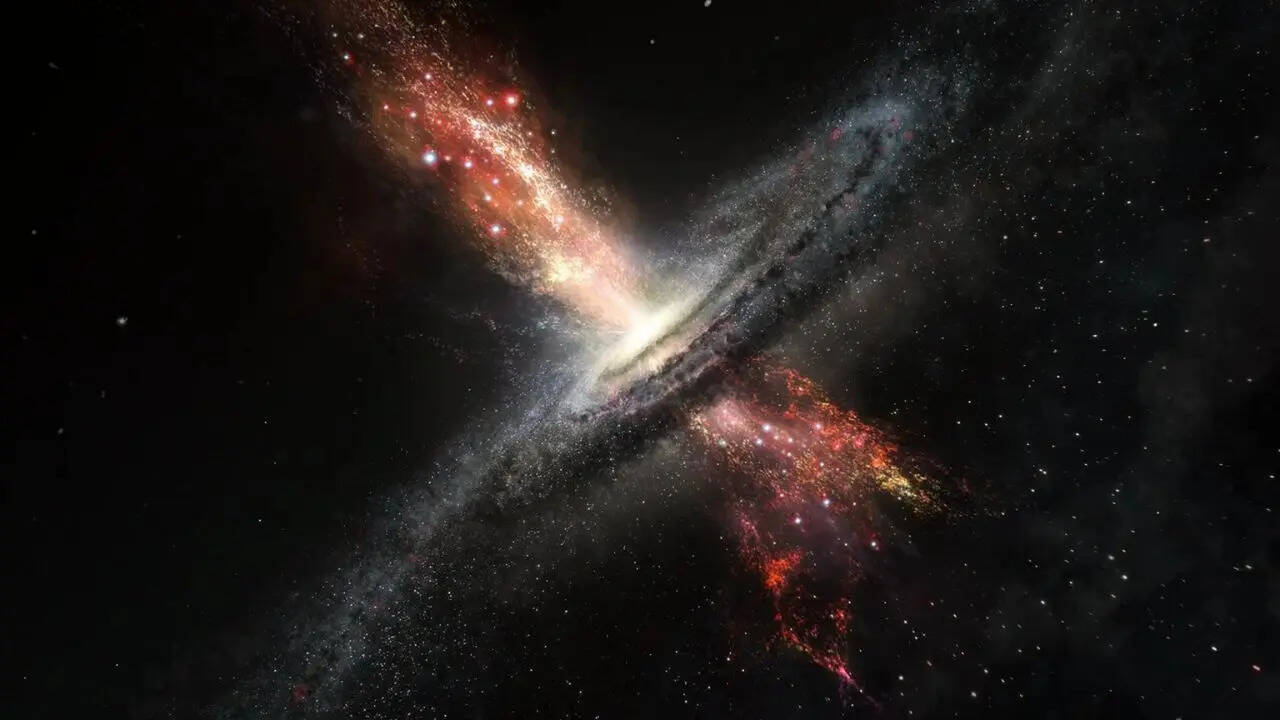
Everything you've been told about the center of our galaxy might be wrong. For decades, the scientific community has treated Sagittarius A*—that massive gravitational beast at the heart of the Milky Way—as a settled fact. It’s a supermassive black hole. That’s the consensus. But a growing body of research suggests we might be staring at a giant ball of dark matter instead.
Recent studies into the motion of stars and the behavior of gas clouds near the galactic center are shaking the foundation of modern astrophysics. If this theory holds water, it doesn't just change how we see our home galaxy. It flips our understanding of gravity and particle physics on its head.
The Problem With Sagittarius A*
Mainstream science says Sagittarius A* is a supermassive black hole with roughly four million times the mass of our Sun. We’ve seen the images from the Event Horizon Telescope. We’ve tracked stars like S2 as they whip around an invisible point at breakneck speeds. It looks like a black hole. It acts like a black hole.
But there are gaps.
Black holes are supposed to be messy eaters. When gas falls toward them, it heats up and glows across the spectrum. Sagittarius A* is strangely quiet. It’s millions of times dimmer than it should be given the amount of material floating around it. While physicists have come up with excuses—like "inefficient accretion"—some researchers think the answer is simpler. Maybe there's no event horizon because there's no black hole.
Enter the Darkino Theory
A group of scientists, including those affiliated with the International Center for Relativistic Astrophysics, has proposed a radical alternative. They suggest the galactic center is home to a dense concentration of "darkinos." These are hypothetical dark matter particles—specifically fermions—that can clump together without collapsing into a singularity.
Unlike a black hole, which is a point of infinite density, this dark matter core would be a "fuzzy" ball of particles. It would have the same mass as the predicted black hole, which explains why the orbits of nearby stars look the same. However, it wouldn't have a hard "point of no return" or an event horizon.
This model actually solves a massive headache in astronomy: the G2 gas cloud mystery. In 2014, a gas cloud named G2 passed incredibly close to Sagittarius A*. Everyone expected it to be ripped apart and swallowed in a firework display of X-rays. Instead, it survived. It stretched out a bit, then went on its merry way like nothing happened. A black hole's tidal forces should have shredded it. A dense but spread-out ball of dark matter? That provides a much softer gravitational interaction. It fits the data better than the standard model does.
Why We Cling to Black Holes
It’s hard to let go of a good story. The black hole narrative is clean. It’s backed by Einstein’s General Relativity. But we have to remember that dark matter makes up about 85% of the matter in the universe, and we still don't know what it is.
If dark matter can form these dense cores, it explains why galaxies formed so quickly after the Big Bang. Standard black hole growth is slow. You have to feed them. But if dark matter can just "clump" into these massive structures early on, they become the seeds for everything else.
This isn't just some fringe "flat earth" style denial. This is high-level mathematical modeling. These dark matter cores, or "darkinos," obey the laws of quantum statistics. When they get packed tightly enough, they reach a critical mass. In smaller galaxies, they stay as a stable ball. In massive galaxies, they might eventually collapse into a real black hole. The theory suggests the Milky Way might just be in that sweet spot where the core hasn't collapsed yet.
The Evidence is Hiding in Plain Sight
Look at the S-stars. These are the celestial high-divers that orbit the center of our galaxy. For years, we've used their orbits to "prove" the black hole exists. But researchers found that the dark matter core model predicts these orbits with the same—and sometimes better—precision than the Schwarzschild black hole model.
Then there's the "pointiness" of the galactic center. Black holes are point masses. Dark matter cores have a profile. As our telescopes get better, we should be able to see the difference in how light bends around the center. The Event Horizon Telescope’s famous orange "donut" image was a massive milestone, but even that image is a reconstruction. It’s an interpretation of data. If you change the underlying assumptions from "black hole" to "dark matter concentration," the image still works.
What This Means for You
You might think this is all academic. Who cares if it’s a black hole or a dark matter ball?
You should care because it changes our understanding of our place in the universe. If the "black hole" at the center of our galaxy isn't real, then the dark matter we've been hunting for decades isn't just "out there" in the fringes of space. It’s right here. It’s the anchor of our entire neighborhood.
It also suggests that our current laws of physics are incomplete. We are essentially living in a house where we don't know what the foundation is made of. If dark matter can mimic a black hole, how many other "facts" in astronomy are actually just placeholders for things we don't understand yet?
How to Follow This Story
This isn't a "wait and see for 50 years" situation. The data is coming in now. If you want to stay ahead of this, keep an eye on the following developments:
- EHT Refinements: The Event Horizon Telescope team is constantly updating their algorithms. Look for any mentions of "sub-structure" or "non-singular" features in future images of Sagittarius A*.
- The GRAVITY Instrument: This tool on the Very Large Telescope in Chile is tracking stars with insane precision. If a star’s orbit deviates even slightly from what a point-mass black hole predicts, the dark matter theory wins.
- Deep Space Decays: If the center is dark matter, we might eventually detect decay signals—gamma rays or neutrinos—that a black hole wouldn't produce.
Stop assuming the center of the galaxy is a bottomless pit. It might just be the most massive collection of invisible particles ever discovered. Start looking at the "quietness" of our galactic center as a clue rather than a fluke. The more we look, the more it seems like Einstein's masterpiece has a dark matter shadow he never saw coming.
The next time you look at a photo of that glowing orange ring, don't see an abyss. See a puzzle that's still waiting for a real solution. Check the latest pre-prints on ArXiv under "galactic center dark matter" to see the math for yourself. The consensus is cracking, and the truth is way more interesting than a simple hole in space.