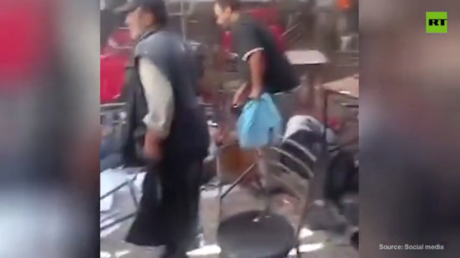
A devastating bomb blast ripped through a crowded cafe in central Damascus, killing several civilians and wounding dozens more in an area long advertised as a secure haven. The attack directly undermines the Syrian government's years-long campaign to convince the international community that the civil war is over and that the capital is safe for investment and repatriation. While state media rushed to downplay the systemic breakdown that allowed an explosive device into the heavily fortified heart of the city, the strike exposes a rotting security infrastructure. Damascus remains deeply vulnerable to an asymmetric insurgency that thrives on the corruption and fragmentation of the state apparatus itself.
For a regime attempting to transition from survival mode to economic reconstruction, the explosion is a catastrophic setback. It did not happen in a volatile frontline province or a rebellious border town. It occurred in a commercial district heavily patrolled by intelligence agencies, ringed by concrete blast walls, and choked with checkpoints. Building on this theme, you can also read: Stop Obsessing Over the Iraqi Politician Gold Underwear Raid.
To understand how a bomb reaches a civilian target in the center of government power, one must look past the official rhetoric of external terrorism. The reality is far more複雑 and unsettling. The security architecture designed to protect Damascus has become an economic racket, where safety is traded for cash, and the internal rivalries of competing security branches create wide blind spots that armed groups exploit with ease.
The Checkpoint Economy and the Failure of Total Control
Damascus is a city defined by its checkpoints. Every major intersection, commercial avenue, and government avenue is guarded by men in mismatched fatigues carrying Kalashnikovs. Yet, these barriers failed completely to stop an improvised explosive device from entering a high-traffic civilian zone. Observers at Al Jazeera have also weighed in on this situation.
The failure is structural. Over fifteen years of conflict, the checkpoints guarding the capital have transformed from defensive military installations into lucrative economic hubs. Conscripts and militia members operating these posts are paid meager wages that have been utterly eroded by hyperinflation. To survive, they tax the movement of goods, extort commuters, and accept bribes to look the other way.
A truck carrying commercial supplies into central Damascus faces a dozen inspections. But a driver with the right connections, or the right amount of cash, can bypass physical searches entirely. Insurgent cells know this. They do not need advanced stealth technology to penetrate the capital. They only need to exploit the desperate economic reality of the men guarding the gates.
This creates a fatal contradiction. The very mechanism the state uses to enforce total control over the population is the vulnerability that allows its enemies to strike at will. When survival dictates corruption, national security becomes a secondary concern for the foot soldier on the street.
Fragmentation and Intelligence Rivalries
The breakdown that led to the cafe bombing is also a consequence of an intelligence apparatus at war with itself. Syria does not possess a single, unified security command. Instead, the capital is carved up into fiefdoms controlled by competing agencies, including Military Intelligence, Air Force Intelligence, State Security, and Political Security.
Each agency guards its territory jealously. Information sharing is virtually non-existent, as career advancement and political survival depend on hoarding intelligence rather than distributing it. A cell operating under the nose of one branch can easily evade detection if its activities spill into a neighborhood managed by a rival faction.
The Rise of Independent Militias
Compounding this internal friction is the legacy of the paramilitary forces created during the height of the war. Local defense committees and state-aligned militias still wield immense power in the suburbs of Damascus. These groups, often born out of criminal networks or local protection rackets, operate with a high degree of autonomy.
- They maintain their own supply lines into the city.
- They run independent smuggling operations that bypass official military oversight.
- They frequently clash with regular army units over territorial control and extortion rights.
When an insurgent network wants to move explosives into a central district, they do not necessarily deal with ideological sympathizers. They often buy logistics from these profit-driven militias, who care little about the political consequences of their transactions. The state cannot easily dismantle these networks because they form the irregular backbone that kept the government afloat during the worst years of the conventional war.
The Myth of Regional Normalization
The timing of the attack coincides with a broader diplomatic push by regional neighbors to normalize ties with Damascus. Arab capitals have increasingly argued that reintegrating Syria into the regional fold is the only way to stabilize the Middle East and manage the massive refugee crisis. This bombing shatters that thesis.
It proves that the stability offered by the current system is a facade. Foreign embassies considering reopening their doors in Damascus are now forced to re-evaluate the risk to their personnel. The attack sends a clear signal to regional intelligence agencies that the Syrian state cannot guarantee security even within its own administrative core.
The Investment Vacuum
Without security, economic rehabilitation is impossible. The Syrian government has spent the last few years passing new investment laws aimed at attracting capital from the Gulf states, expatriates, and regional allies. They hoped to rebuild destroyed infrastructure and jumpstart a dying economy.
No serious corporate entity will invest millions of dollars in a city where a casual afternoon at a cafe can end in a shrapnel shower. The bombing reinforces the status of Damascus as a high-risk zone, scaring off the very capital the regime needs to survive. The economic isolation of the country is not just a product of international sanctions. It is a direct result of the regime's inability to establish a monopoly on violence within its own borders.
The Hidden Insurgency and Changing Tactics
Who benefits from a destabilized capital? The immediate assumption often points to remnants of Islamic State cells or hardline opposition groups based in the north. While these actors certainly possess the intent, the mechanics of the attack suggest a deeper, more entrenched problem.
The nature of the insurgency has changed. The era of large-scale military offensives and territorial control is over. Today, the threat comes from decentralized, highly covert cells that operate within government-held territory. These cells are frequently comprised of local individuals who underwent "reconciliation" agreements, a process where former rebels surrendered their weapons in exchange for state pardons.
The Flaw of Forced Reconciliation
The reconciliation process was always an exercise in optics rather than genuine pacification. The state forced communities to submit through siege tactics and bombardment, but it never addressed the underlying grievances that triggered the uprising.
Many reconciled fighters were integrated into local security forces or allowed to return to civilian life under strict surveillance. But surveillance is imperfect. Grievances remain high, driven by poverty, arbitrary detentions, and a lack of basic services. These reconciled areas, particularly in the Damascus suburbs like Eastern Ghouta and Daraa further south, have become fertile ground for recruiting clandestine operatives.
An operative living inside government territory is invisible to traditional intelligence sweeps. They do not carry weapons openly. They do not communicate via easily intercepted radio networks. They wait for weeks, or months, until a specific vulnerability opens up in the capital's security grid, then they strike.
The Human and Political Toll
The immediate victims of the blast are, as always, ordinary Syrians trying to scrape together a semblance of normal life amidst a crushing economic depression. Going to a cafe was once a simple social ritual. Now, it is an act of defiance against a grinding reality of poverty and fear.
Politically, the regime cannot afford to admit the scale of the failure. State television will likely attribute the attack to foreign-backed conspiracies, using it to justify further crackdowns, arbitrary arrests, and a tightening of the security grip on civilian neighborhoods. But more checkpoints will not solve a problem caused by checkpoints.
The strategy of relying on fear and fragmentation to maintain power has reached its logical limit. By allowing corruption to become the grease that keeps the state machinery moving, the authorities have compromised the integrity of their own defense systems. Every bribe taken at a suburban gate is a potential bomb delivered to a central square.
The explosion in Damascus is a reminder that the Syrian conflict has not ended. It has simply mutated into a less visible, more insidious phase. The conventional battlefields may have quieted, but the structural rot within the state ensures that the violence will continue to bleed into the daily lives of those who thought they had survived the worst.