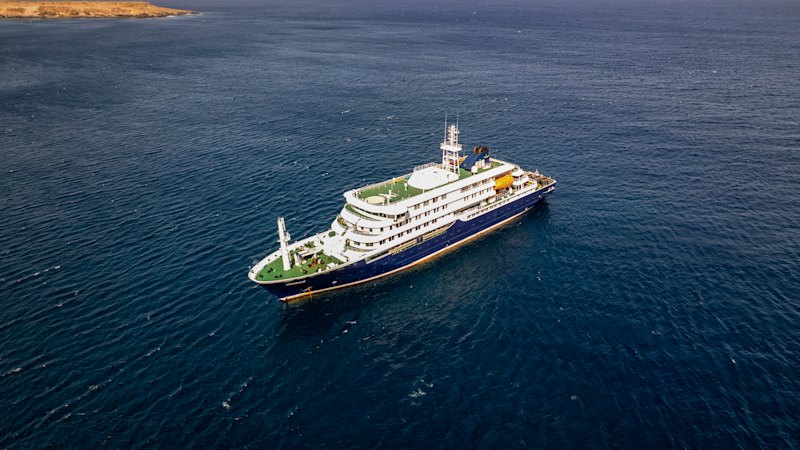
Mass media loves a floating morgue. When news breaks that three people died during a suspected virus outbreak on a cruise ship, the narrative is written before the gangway even touches the pier. The headlines scream about "petri dishes," "unregulated luxury," and "silent killers on the high seas." They want you to believe that stepping onto a ship is a game of Russian roulette with a norovirus cylinder.
They are lying to you. Or, more accurately, they are peddling a lazy consensus that ignores how biology, logistics, and data actually function in 2026.
If you think three deaths on a ship carrying 4,000 people is a sign of a systemic safety failure, you don't understand the math of human mortality. You’ve been conditioned to view cruise ships as closed-loop anomalies, when in reality, they are the most transparent health environments on the planet. While the public pearl-clutches over a localized outbreak, they ignore the fact that the office building they work in or the school their kids attend is statistically more dangerous and far less monitored.
The Mathematical Illiteracy of Outbreak Reporting
Let’s look at the "three deaths" that triggered the latest wave of panic. On any given week in a city of 5,000 people—the rough population of a modern mega-ship—people die. They die of heart failure, strokes, and complications from pre-existing conditions. When a virus is present, every death is immediately attributed to that virus by the court of public opinion.
The competitor's coverage implies a causal link without a single autopsy report or epidemiological confirmation. This is "Post Hoc Ergo Propter Hoc" reasoning at its finest: After this, therefore because of this.
In a typical land-based retirement community or high-density urban housing complex, three deaths in a week wouldn't even make the local neighborhood newsletter. But put those people on a ship with a buffet, and suddenly it’s a national security crisis.
The reality? Cruise lines are required by the CDC’s Vessel Sanitation Program (VSP) to report every single instance of gastrointestinal illness if it hits a mere 3% of the passenger population. Find me a hotel, a resort, or a convention center on land that operates under that level of scrutiny. You can’t, because they don't exist. You are safer on a ship during an "outbreak" because the crew actually knows exactly who is sick. Your local grocery store has no such data.
Your Obsession with Sanitization is Making You Sick
The industry’s response to these headlines is usually to double down on "enhanced cleaning protocols." This is theater. It is hygiene signaling designed to soothe the nerves of people who haven't read a biology textbook since 1998.
We have spent years nuking every surface with high-concentration bleach and quaternary ammonium compounds. What has it bought us? It has created an ecological vacuum that is ripe for the most resilient strains of norovirus and sapovirus to colonize.
By hyper-sanitizing common areas, we aren't just killing the bad stuff; we are removing the microbial competition that keeps pathogens in check. I have watched crews scrub railings every fifteen minutes while passengers continue to touch their faces, rub their eyes, and pick at their food with unwashed hands.
The "Petri Dish" metaphor is actually backward. A petri dish is a sterile environment designed to grow a specific organism. A cruise ship is a massive, diverse ecosystem. When you try to turn a ship into a sterile lab, you don't stop the virus; you just ensure that when a virus does arrive, it has no competition.
The Hidden Truth About "Index Case" Zero
The competitor article blames "ventilation" and "communal dining." This is a fundamental misunderstanding of norovirus—the usual suspect in these cases. Norovirus is not primarily airborne. It is a fecal-oral specialist.
The "outbreak" didn't start because the ship was dirty. It started because a passenger—let’s call him Passenger Zero—knew they were sick before they boarded and chose to lie on their health questionnaire.
Why do they lie? Because the industry has created a financial incentive for bio-terrorism. If you tell the cruise line you’ve been vomiting for 24 hours, you lose your $3,000 vacation (unless you bought the right insurance). So, you pop some Pepto-Bismol, walk through the terminal, and proceed to contaminate the first elevator button you touch.
The "three deaths" aren't a failure of the ship’s engineering. They are a failure of human ethics. Yet, the media never grills the passengers. They grill the corporation because corporations have deeper pockets and better logos for the B-roll footage.
Stop Asking if the Ship is Safe
The "People Also Ask" section of your brain is likely firing off questions like: Which cruise line has the fewest outbreaks? or Is it safe to eat the buffet?
These are the wrong questions. They assume that safety is a commodity provided by the cruise line. It isn't. Safety is a personal metric of risk management that you are currently failing.
If you want to survive a cruise outbreak, stop looking at the crew and start looking at your fellow passengers.
- The Buffet is Not the Problem, the Spoons Are. The food is usually held at temperatures that would kill most pathogens. The problem is the 500 people who touched the serving spoon before you. Use a napkin to hold the spoon. Better yet, eat at the à la carte restaurants where the "human touchpoints" are minimized.
- Elevators are Biohazards. An elevator is a small, unventilated box where people cough and touch buttons. Take the stairs. You’ll burn off the baked Alaska and avoid the aerosolized droplets of a thousand strangers.
- The "Hand Sanitizer" Lie. Most hand sanitizers are alcohol-based. Norovirus is a non-enveloped virus. Do you know what alcohol does to norovirus? Practically nothing. It’s like throwing a pebble at a tank. If you aren't washing your hands with soap and water for twenty seconds, you are just making your hands smell like cheap gin while the virus hitches a ride to your mouth.
The Industry Insider’s Cold Hard Truth
I’ve spent two decades in and around maritime logistics. I’ve seen ships quarantined in the North Sea and I’ve seen them sail through the Caribbean with half the crew incapacitated.
The dirty secret? The cruise lines want these outbreaks to be public.
Every time a "horror ship" makes the news, it gives the industry a mandate to increase automation. They want to replace human servers with robots. They want to eliminate the buffet entirely. They want to track your movement via "smart" medallions to see exactly who you stood next to for more than ten minutes.
They are using your fear of a 0.06% mortality event to pivot toward a surveillance-heavy, labor-light business model. By falling for the "death ship" narrative, you are voting for the end of the traditional cruise experience.
The Moral Hazard of Modern Travel
We have become a society that demands zero risk while taking zero responsibility. We want to travel to the corners of the earth, interact with thousands of strangers, and expect a sterile, hospital-grade outcome.
Those three people who died? It is a tragedy. But it is also a statistical inevitability in a world where we pretend that aging and illness stop at the shoreline. To suggest the ship is to blame is to suggest that we should never congregate in groups again.
If you are terrified of a virus, stay home. If you board a ship, accept that you are entering a high-density human experiment. The ship isn't the threat. The person standing behind you in the disembarkation line—the one who just "cleared their throat" and touched the handrail—is the threat.
Stop blaming the vessel for the flaws of the cargo. The ship is just steel and salt water. The virus is us.