The forest smells of wet earth, crushed fern, and woodsmoke long before you see the first shadow move through the canopy.
High in the misty hills of southwestern Uganda, where Bwindi Impenetrable National Park clings to steep volcanic ridges, a single dry cough can carry more weight than a falling tree. Most people hear a cough and reach for a lozenge. They think of dry air, pollen, or a cold caught on a cramped bus ride.
Listen closely in Bwindi, though, and your chest tightens.
A gorilla coughs. Then another. Soon, trackers following a family group notice lethargy—a silverback lingering behind on a damp morning, an infant clinging tighter than usual, eyes dull with fever. To a casual observer, it looks like a bad week in the mountains. To a wildlife veterinarian, it can look like a quiet countdown.
Because the line between a human sniffle and a primate crisis is thinner than a blade of elephant grass.
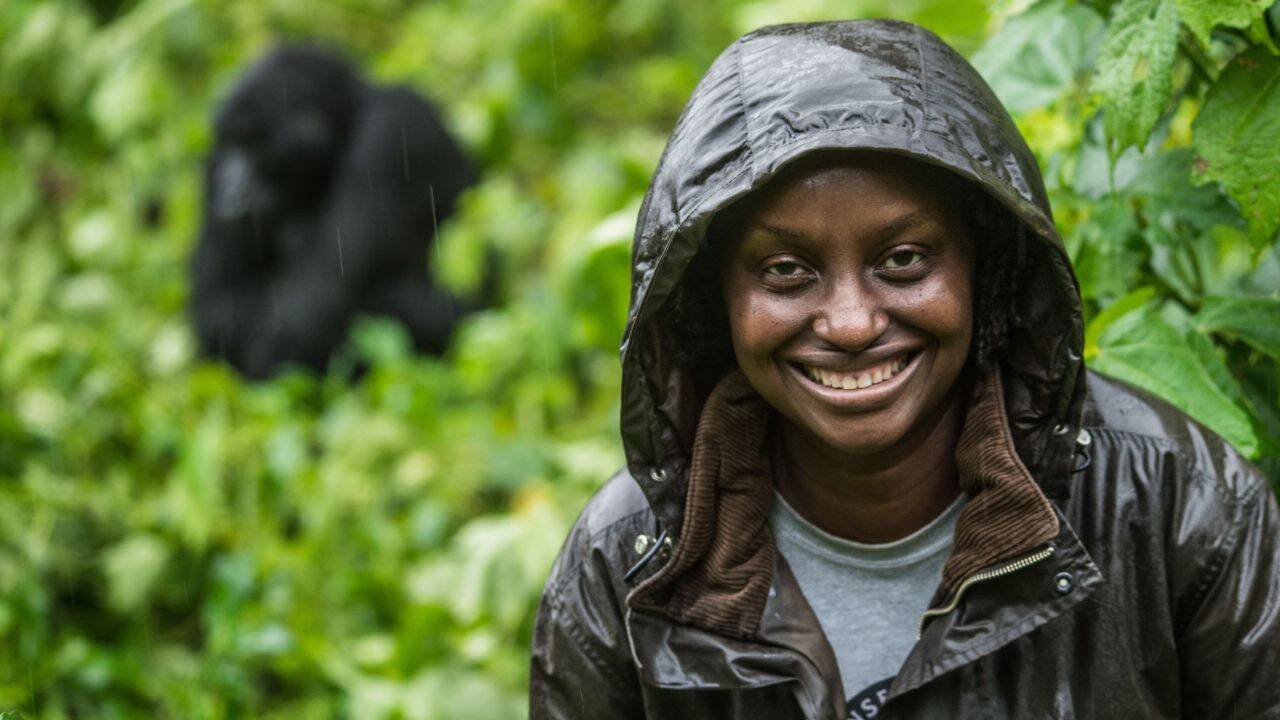
This is where Dr. Gladys Kalema-Zikusoka stepped into history. Not as a distant bureaucrat behind a desk in Kampala, nor as a tourist snapping photos with a telephoto lens, but as Uganda’s first wildlife veterinarian—a young woman walking into green, untamed terrain where there was no manual waiting for her.
The Girl Who Loved Animals Before There Was a Map
Every origin story needs a spark, though real sparks rarely look dramatic at first. Sometimes they look like a child watching birds and small creatures in a backyard in Kampala, asking questions adults don't always have time to answer.
Gladys grew up with a fascination for animals that refused to fade into a phase. By the time she was twelve, she had already set her sights on becoming a veterinarian. At the time, veterinary medicine in Uganda was overwhelmingly associated with livestock—cattle, goats, poultry—the animals that fed families and anchored rural livelihoods. Caring for wild animals wasn't a standard career track waiting at the end of a degree. It was a blank space on the page.
Studying veterinary medicine at Makerere University and later pursuing further training abroad in wildlife health meant stepping outside familiar expectations. Becoming Uganda’s first wildlife veterinarian wasn't just about earning credentials. It was about proving that wild creatures—from mountain gorillas in Bwindi to chimpanzees, lions, and antelopes across the country's parks—deserved dedicated medical science, and that protecting their health was inseparable from protecting people.
I have spent enough time in humid, high-altitude forests to know how quickly romantic notions of "untamed nature" evaporate. Mud soaks through your boots in ten minutes. Nettles sting your wrists when you grab a branch to keep from sliding down a ravine. Leeches find any exposed inch of skin without asking permission.
Real conservation isn't a postcard. It is sweat, steep climbs, aching calves, and paying attention to tiny details when everything around you is huge and loud.
When Gladys began working with mountain gorillas in Bwindi, she wasn't just looking at majestic animals in a mist-shrouded sanctuary. She was looking at a species under severe pressure—poaching, habitat loss, and a threat far harder to spot with binoculars than a wire snare: infectious disease.
A Hypothetical Morning on the Ridge
To understand why a single sick gorilla matters far beyond Bwindi, let's walk through a hypothetical scenario based on real conservation challenges in the region. (Note: This composite scenario is fictionalized for illustration, grounded in documented wildlife-health dynamics.)
Picture a crisp Tuesday in late dry season. A small group of visitors hikes up a steep slope to spend an hour with a habituated gorilla family. Everyone has been briefed on rules, yet trails are narrow, branches whip back, and a sneeze or a poorly disposed tissue can happen in a fraction of a second.
Two days later, a tracker named Bosco—a fictional stand-in for the dedicated local trackers who know individual gorillas by face, knuckle-print, and temperament—notices a juvenile sitting apart from the group. The young gorilla isn't playing. Its breathing sounds shallow.
If a human respiratory virus—something as ordinary to us as a common cold or flu—crosses over into wild gorillas, their bodies may not handle it the way ours do. Gorillas share roughly ninety-eight percent of their DNA with humans. That closeness is breathtaking when you lock eyes with a silverback. It is terrifying when you realize how easily a microbe built for human airways can find a welcoming home in theirs.
A sickness that leaves a human feeling miserable for four days can tear through a small, vulnerable gorilla population with devastating speed. And when gorillas get sick, the story doesn't end in the trees.
Think of health like a braided rope rather than a single straight line. One strand is wildlife. Another strand is domestic livestock. Another strand is human communities living right along the park boundary, farming small plots of land, fetching water, walking the same footpaths. Pull hard on one strand, and the tension travels through the whole braid.
If disease moves from people to gorillas, it can also move from wildlife to livestock or back to people. Scabies, intestinal parasites, respiratory infections—health in places like Bwindi is shared whether we acknowledge it or not.
Why Conservation Without Compassion Fails
Here is a hard truth that many outsiders miss when they talk about saving wildlife: you cannot scold hungry or struggling neighbors into loving a protected forest.
If a farmer's crops are raided, or if a family struggles with basic healthcare and clean water, telling them to revere an endangered species from afar rings hollow. Early on, Gladys recognized that wildlife health and human wellbeing couldn't be treated as separate silos.
Out of that insight grew Conservation Through Public Health (CTPH), the organization she founded to bridge wildlife conservation, public health, and community livelihoods around Bwindi and other protected areas.
Let's pause and admit how counterintuitive this feels at first. If your job is saving gorillas, why spend time on family planning, hygiene, sanitation, or community health workers?
Simple. Because healthy communities and healthy wildlife rise or fall together.
When local families have access to basic healthcare, clean water, and education, pressure on surrounding ecosystems eases, and the risk of disease transmission across the human-wildlife interface drops. When local people are partners rather than obstacles, conservation stops feeling like an outside imposition and starts feeling like shared stewardship.
I'll be candid: sometimes the sheer scale of these overlapping problems—poverty, disease outbreaks, shrinking habitats, climate shifts—can feel overwhelming, even scary. There are moments when every solution looks too small for the size of the challenge. Anyone who tells you conservation is neat and easy hasn't spent long listening to the people living on the front lines.
Yet small, steady actions compound over time. A trained village health volunteer. A cleaner water source. A tracker who spots early signs of illness and alerts the vet team before a cough becomes a crisis.
The Invisible Stakes of One Health
Scientists and doctors often call this interconnected approach One Health. Strip away the academic jargon, and the idea is remarkably intuitive.
Imagine a crowded apartment building with one shared heating and ventilation system. If the air filter in one unit clogs or mold takes hold in a damp corner, you don't pretend the rest of the building lives in a separate universe. You fix the shared system, because everyone breathes the same air.
Earth is that building. Forests, farms, towns, rivers, wild animals, and human travelers are all connected by movement and biology.
Every time humans clear more forest, travel farther and faster, or live in closer quarters with wild and domestic animals, opportunities for pathogens to jump species increase. Most spillover events never make headlines. A few change history.
Dr. Gladys Kalema-Zikusoka's career matters not merely because she broke a first-of-its-kind barrier in Uganda—though breaking barriers matters deeply when young girls and boys need proof that paths like hers exist. Her work matters because she saw the invisible thread connecting a sick animal in a mountain forest to the wider web of life.
She didn't treat wildlife medicine as a solitary adventure in the bush. She connected veterinary science with community health, livelihood support, and policy. That combination turned a pioneering title into a practical model for living alongside wild animals without turning them into museum pieces or casualties.
What Comes Next in the Mist
People often ask what everyday travelers or distant readers can actually do when a story is set thousands of miles away in southwestern Uganda.
Start with humility.
If you ever visit a national park where primates live, take rules about distance, masks, and illness seriously—even if you feel "fine" or think a mild scratchy throat is nothing. Respect local guides and trackers; their knowledge of the forest and its animals is hard-won and irreplaceable. Support conservation efforts that invest in local communities alongside wildlife protection, because lasting sanctuaries are built with neighbors, not walls.
And carry the deeper lesson home with you. Health isn't a private bubble you carry around inside your own skin. It is a shared current running between people, animals, and the places we inhabit.
Back in Bwindi, the mist rolls over the ridges at dusk, softening the sharp edges of the hills and turning towering trees into dark silhouettes. Somewhere in the dark leaves, a family settles in for the night—warm fur pressed close against the mountain chill, breathing in the cool damp air.
A single breath can carry risk.
A single breath can also carry life.