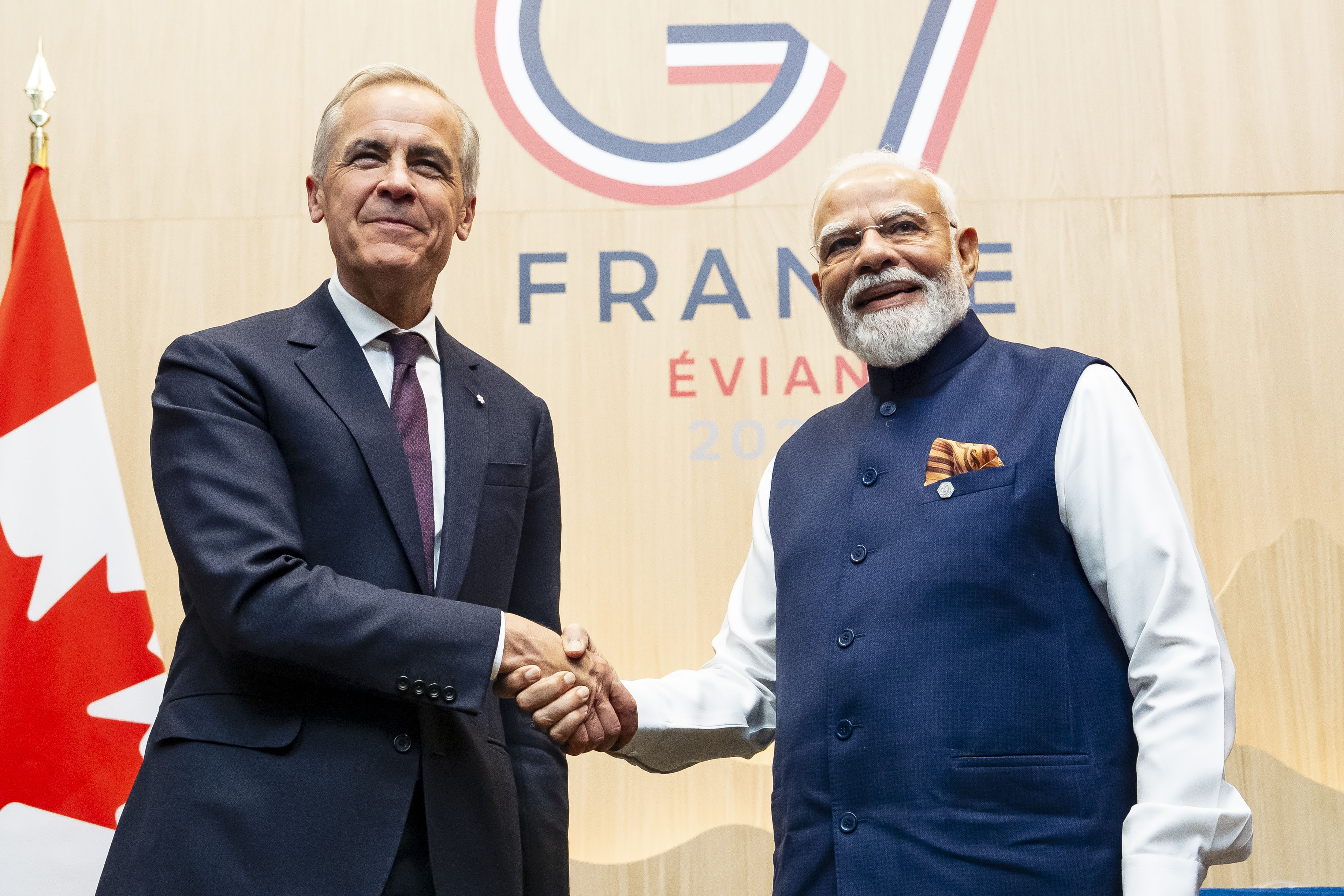
Canadian Prime Minister Mark Carney has extended an official invitation to Indian Prime Minister Narendra Modi for a bilateral visit to Canada later this year, using the sidelines of the G7 Summit in Evian, France, to finalize a sweeping geopolitical pivot. The announcement, coupled with an agreement to launch formal negotiations on a General Security of Information Agreement, marks the definitive end of Ottawa's multi-year diplomatic freeze with New Delhi. By prioritizing a Comprehensive Economic Partnership Agreement (CEPA) aimed at doubling bilateral trade by 2030, Carney is signaling that Canada's economic survival amid sharpening global trade walls outweighs unresolved national security grievances.
The strategy is a stark departure from the previous Liberal administration under Justin Trudeau. For nearly two years, Canada-India relations existed in a state of deep suspension following explosive allegations of extrajudicial assassinations and transnational repression on Canadian soil. High commissioners were expelled, visas were frozen, and diplomatic channels fell silent. Meanwhile, you can explore similar stories here: Why the G7 and India are Rushing to Stop the Next Ebola Outbreak Before It Starts.
Now, the math has changed. Faced with an aggressive trade environment and unpredictable tariff threats from the United States, Carney is treating India not as a diplomatic adversary, but as an indispensable economic life raft.
The Trade Mandate Overriding the RCMP
The diplomatic calculus driving this reset is rooted entirely in economic diversification. Canada's traditional reliance on the American market has become a structural vulnerability. To hedge against this, the Carney government is executing a rapid reorientation toward the massive consumer bases of the Indo-Pacific. To see the complete picture, we recommend the excellent report by NPR.
India, the world's fifth-largest economy, represents the ultimate prize in this strategy. The targeted CEPA trade pact, which both leaders aim to conclude before the upcoming G20 Summit in Miami, could inject billions into the Canadian economy. The primary beneficiaries sit in western Canada's agricultural sectors and Ontario's technology hubs, where access to Indian markets has been restricted by retaliatory tariffs and regulatory red tape.
Yet, this economic alignment requires a deliberate, uncomfortable softening of Ottawa's public stance on national security.
The Prime Minister’s Office readout of the Evian meeting omitted any explicit mention of foreign interference or the Royal Canadian Mounted Police (RCMP) investigations into Indian state actors. Instead, the bureaucratic language was scrubbed clean, focusing entirely on "law enforcement cooperation" and the new information-sharing framework.
This transactional shift has provoked intense domestic backlash. Diaspora organizations, including the World Sikh Organization, have publicly condemned the invitation, labeling the diplomatic normalization a betrayal of Canadian sovereignty. The tension is clear. While Canadian intelligence agencies continue to classify India as a primary source of foreign interference alongside China and Russia, the political executive has decided that the country cannot afford to isolate a market of 1.4 billion people.
The Mechanics of the Information Pact
The proposed General Security of Information Agreement is the mechanism being used to bridge this deep trust deficit. It is a highly specialized legal framework designed to govern how two nations handle and protect classified defense and intelligence data.
In theory, the agreement establishes strict protocols for sharing operational intelligence.
- It creates standard security clearances recognized by both jurisdictions.
- It outlines legal penalties if shared information is leaked to third parties.
- It provides a formal channel for law enforcement agencies to exchange data on organized crime and counter-terrorism.
In practice, the pact serves as a political shield for both leaders. For Modi, signing a security agreement with Canada refutes the narrative that New Delhi operates as a rogue actor outside international norms. For Carney, it allows his administration to argue to a skeptical domestic audience that national security concerns are being systematically managed through official channels rather than ignored.
However, intelligence veterans view the arrangement with deep skepticism. Sharing intelligence requires foundational trust. If the Canadian Security Intelligence Service (CSIS) believes its counterparts in New Delhi have actively targeted Canadian citizens, an information-sharing agreement will not magically open the taps of actionable intelligence. It is far more likely to function as a highly restricted, heavily sanitized diplomatic checklist.
A Parallel Pivot on the Global Stage
Carney's aggressive pragmatism isn't limited to India. His strategy involves a broader, high-stakes rebalancing of Canada's global relationships that has caught the attention of world leaders.
On the eve of his bilateral meeting with Modi, microphones at the Evian summit caught Carney in an unscripted conversation with U.S. President Donald Trump regarding automotive trade. Carney was overheard defending Canada's newly implemented import cap, which permits up to 49,000 Chinese-made vehicles into the Canadian market annually. The policy is a direct result of Carney's trip to Beijing earlier this year, where he negotiated a reduction of Canada's tariff rate on Chinese electric vehicles from 100 percent down to 6.1 percent.
This hot-mic moment exposes the delicate tightrope Canada is walking. On one side, Carney is trying to appease a protectionist Washington by showing he can manage and limit Chinese economic penetration. On the other side, he is actively cutting deals with Beijing and New Delhi to ensure Canadian resources, critical minerals, and agricultural products have viable alternative destinations if the U.S. market constricts.
It is a mercenary approach to foreign policy. The idealistic, values-first diplomacy that defined Ottawa's rhetoric for a decade has been replaced by a cold assessment of supply chains, market share, and GDP growth.
The Friction Awaiting Modi in Canada
When Modi lands in Canada later this year for what will be his first standalone bilateral visit to the country since 2015, the diplomatic pageantry will match the economic stakes. But the ground beneath the red carpet remains volatile.
The political risks for Carney are immediate. The corporate sector and trade negotiators are eager to finalize the CEPA deal, but the domestic political cost could be severe. Massive protests are already being organized by diaspora communities across British Columbia and Alberta, ensuring that Modi's visit will be met with visible, highly publicized dissent.
Furthermore, the opposition parties in Ottawa are quietly preparing to exploit the contrast between the government’s economic ambitions and its national security mandates. Carney will face intense parliamentary scrutiny over what exactly Canada conceded to bring New Delhi back to the negotiating table.
This is the reality of middle-power diplomacy in a fractured world. Canada cannot alter the geopolitical behavior of a rising superpower like India, nor can it ignore the necessity of its market. The upcoming bilateral summit will not resolve the underlying suspicion between Ottawa and New Delhi. It will simply demonstrate that in the modern global economy, capital flows where sentiment cannot follow.