Sunday in the city has long been defined by a specific visual geography. On this one day of the week, the thousands of women who keep households running—cooking, cleaning, and raising the next generation—emerge from private apartments to reclaim a sliver of public space. For decades, this meant cardboard mats in Victoria Park, communal meals on footbridges, and the rhythmic sound of Tagalog or Bahasa filling the gaps between skyscrapers. But the walls are closing in. What used to be a vibrant, if makeshift, social fabric is being shredded by a combination of aggressive urban management, hostile architecture, and a systemic refusal to treat domestic workers as residents with actual rights to the city.
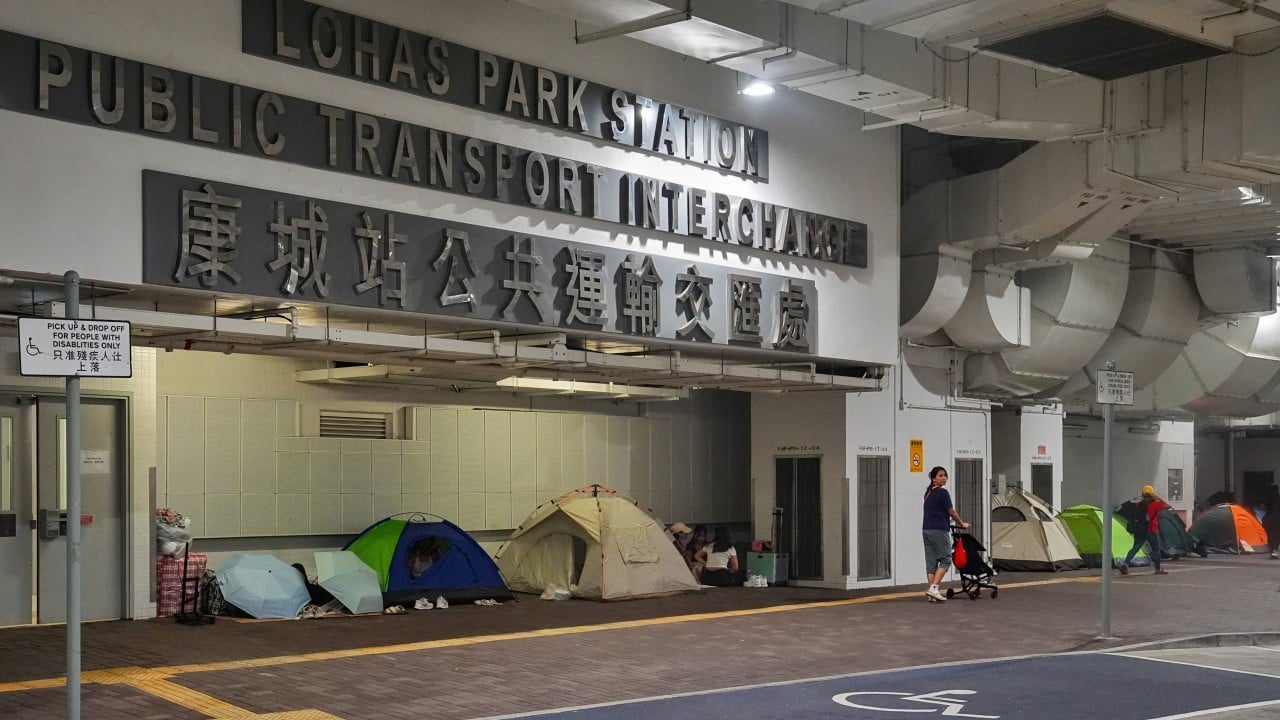
The latest flashpoint isn't a park or a square. It is the grim, exhaust-filled interior of bus termini. Driven out of green spaces by "maintenance" fencing and "keep-off-the-grass" signs that appear with suspicious timing every weekend, hundreds of helpers are now pitching tents in the middle of transportation hubs. They are trading fresh air for diesel fumes because the alternative is having no place to sit at all. This isn't a choice. It is a desperate adaptation to a city that wants their labor but finds their presence an eyesore.
The Engineering of Exclusion
The shift from parks to bus stations isn't an accident of urban planning. It is the result of a deliberate strategy known as hostile architecture. If you look closely at the benches in modern plazas, you will see armrests placed in the middle to prevent reclining. You will see planters positioned specifically to break up large flat surfaces where groups might gather. In many districts, the "cleaning schedules" for public squares are shifted specifically to Sunday mornings, involving high-pressure hoses that keep the ground wet and unusable for hours.
When these women move to the bus termini, they are moving to the only places where the security guards have less jurisdiction. A bus terminal is a transient space. It is loud, dirty, and hot. Yet, the sight of pop-up tents tucked between concrete pillars is becoming the new normal. These tents provide more than just shade; they provide the only four walls these women will see all week that they don't have to clean. In a city where "living-in" is a legal requirement for domestic workers, the lack of private space is a chronic psychological burden. The tent is a portable room, a temporary escape from a workplace they can never truly leave.
The Myth of Public Space
We talk about parks as "the lungs of the city," but lungs are meant to be shared. In reality, the management of these spaces has become increasingly exclusionary. When local residents complain about "crowding" on Sundays, the government often responds by cordoning off areas for "turf recovery." Curiously, these recovery periods rarely seem to disrupt the high-traffic events or commercial pop-ups that pay for the privilege of being there.
The domestic worker is in a unique legal limbo. She is essential, yet invisible. She is a "guest" who can never become a permanent resident, regardless of how many decades she spends contributing to the economy. This status is reflected in how she is treated in the streets. When she sits on a piece of cardboard, she is seen as an obstruction. When a tourist or a local professional sits on a folding chair at a sidewalk cafe, they are "vibrant." This double standard is the foundation of the current crisis.
Economic Value Versus Social Cost
The math of the domestic labor industry is staggering. Without this workforce, the city's labor participation rate for women would collapse. The economy gains billions in productivity because professional parents can outsource childcare and housework. Yet, the city reinvests almost nothing into the social infrastructure required for the people providing that labor.
There are no dedicated community centers for domestic workers that can handle the sheer volume of the Sunday exodus. The existing "drop-in" centers are often run by NGOs with limited budgets and even more limited floor space. By failing to provide designated, high-quality social spaces, the government effectively forces a massive population into the streets and then punishes them for being there. It is a cycle of negligence followed by enforcement.
The Health Implications of Exhaust and Heat
Spending twelve hours a day, once a week, in a bus terminus is a significant health risk. The concentration of particulate matter (PM2.5) and nitrogen dioxide in these semi-enclosed transport hubs often exceeds safety guidelines. These women are breathing in concentrated toxins while they eat and rest.
Furthermore, the "heat island" effect in concrete-heavy transit areas can make the temperature feel several degrees hotter than in a shaded park. As summers become longer and more intense, the move from parks to termini isn't just a matter of discomfort; it is a matter of physical safety. We are witnessing the creation of a new class of environmental injustice, where the most vulnerable workers are pushed into the most polluted corners of the urban landscape.
The Failure of Current Solutions
Government departments often point to "itinerant" use of space as a reason for strict enforcement. They claim that the tents block pedestrian flow or create fire hazards. While safety is a legitimate concern, the "solution" is almost always displacement rather than accommodation.
If the pedestrian flow is blocked, the answer isn't to ban the workers; it is to widen the walkways or provide better alternatives. We have seen the rapid construction of massive quarantine facilities and temporary bridges when the commercial need arises. The technology and the space exist. The political will does not.
Instead of building more shopping malls or luxury high-rises, urban planners must consider "social infrastructure" for the marginalized. This could look like:
- Multi-purpose community halls that open specifically on weekends.
- The conversion of underutilized school grounds into Sunday social hubs.
- Tax incentives for private venues to host domestic worker associations.
The Legal Cage
The "Live-in Rule" is the invisible tether that makes the Sunday crisis so acute. Because workers are legally mandated to live with their employers, they are never truly "off the clock" during the week. The "day off" is not just a break from work; it is a temporary liberation from a surveillance state within a private home. Many workers report that even on their rest days, they are asked to "just do one quick thing" before they leave or after they return.
This makes the quality of the Sunday space even more critical. If they cannot find peace in the park, and they cannot find peace at "home," they exist in a state of perpetual displacement. The bus terminus tent is the final stand of someone who has run out of options.
A City Divided by Cardboard and Concrete
There is a profound irony in watching a city market itself as a "world-class" hub while its essential workers eat lunch on the floor of a garage. It reveals a crack in the facade of modern urbanity. We are built on a foundation of labor that we refuse to acknowledge or accommodate.
The "tent cities" in the bus termini are a visual protest, even if they aren't intended to be. They are a physical manifestation of a housing and space crisis that the city prefers to ignore. Every tent pitched on a Sunday is a reminder that the current model is broken. We have created a system where the people we trust with our children and our homes are not trusted with a patch of grass.
The solution isn't more security guards or more fences. The solution is a fundamental shift in how we define a "resident." If someone lives, works, and spends their income in this city, they deserve a place in it—not just a place to work, but a place to be. As long as we continue to treat public space as a luxury for the few rather than a right for the many, the tents will continue to multiply in the shadows of our transport hubs.
The bus terminus is not a park. It never will be. But until the city decides that these women are worth more than the soot they are forced to sit in, it is the only home they have. The silence of the authorities on this matter is not a lack of awareness; it is a policy of exclusion by design. We are watching the slow-motion eviction of an entire class from the public square.
Stop looking at the tents as a nuisance. Start looking at them as a symptom of a city that has lost its way. The real crisis isn't that there are people in the bus station; the crisis is that we have made our parks so hostile that a diesel-soaked concrete pillar is an improvement.