Heat.
That is the first thing you notice when you stand near the boundary fence. Not the hum of the turbines or the low, vibrating thrum of electricity moving through miles of heavy cable. Just the relentless, heavy heat radiating off South Florida's flat expanse, baking the marshland until the air ripples like water.
Most people picture an industrial powerhouse as a monument to sterility. We imagine towering smokestacks, immaculate concrete slabs, and a total absence of life. We build these monoliths to conquer nature, carving out footprints of steel in the middle of nowhere to feed our insatiable hunger for light, air conditioning, and power.
Turkey Point Nuclear Generating Station is different.
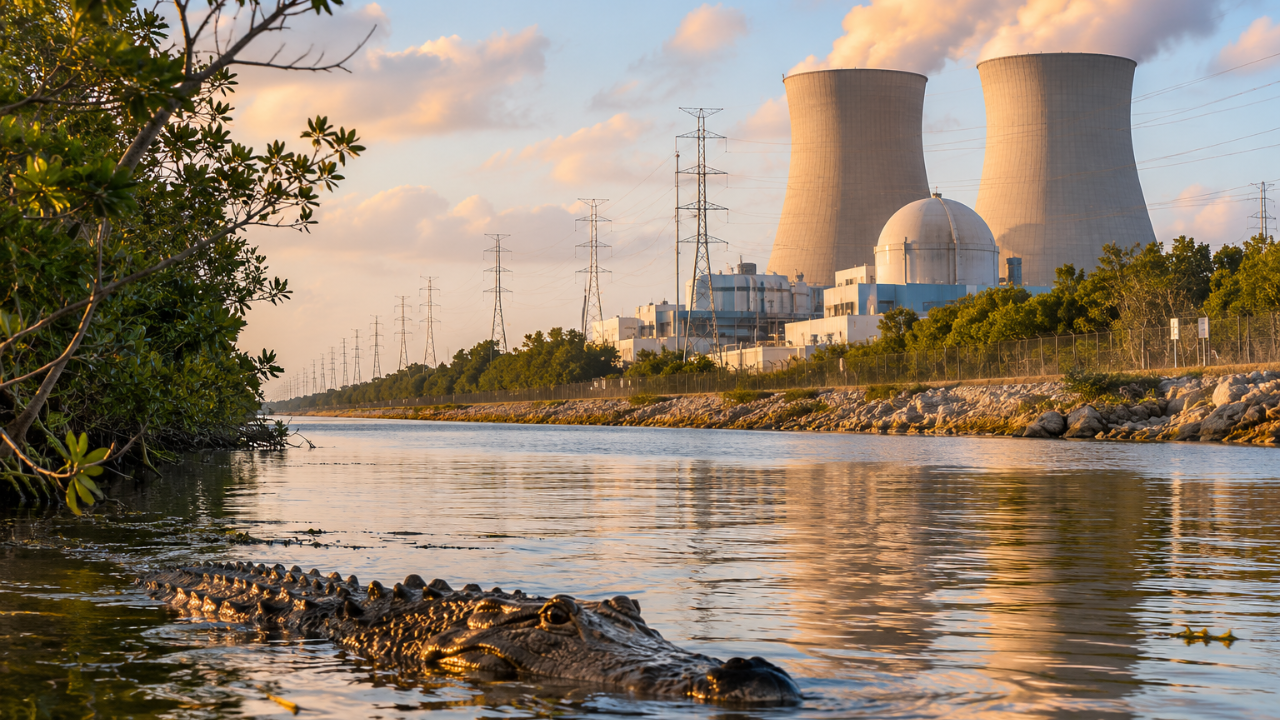
Drive down the access roads, past the security checkpoints where armed guards verify your credentials with practiced weariness, and you will find yourself surrounded by something entirely unexpected. Cooling canals stretch out across nearly six thousand acres like a grid of liquid highways. They are vast, man-made, and unnaturally warm.
And they are crawling with American crocodiles.
To understand why a creature that survived the Cretaceous extinction event decided to set up housekeeping next to a nuclear reactor, you have to throw out everything you think you know about wildlife conservation. We like our nature wild. We like it framed by pristine national parks, untouched by human machinery, and safely distant from our industrial grid.
Nature, it turns out, does not read our script.
Picture a mother crocodile in the early nineteen-seventies. The species is on the absolute brink of collapse. Barely a few hundred individuals remain in the entire United States, pushed into the mud by unchecked development, hunting, and the slow, suffocating sprawl of civilization. Every inch of available marshland is being paved over, drained, or turned into suburban lawn.
Then, Florida Power and Light digs a massive labyrinth of cooling canals to absorb the thermal runoff from their newly built nuclear units. Water cycles through the system, warms up, and cools down as it travels through the long, shallow channels.
To a cold-blooded reptile whose ancestors watched dinosaurs fall from the sky, those warm-water canals look less like an industrial hazard and more like a five-star resort.
By the time federal protections under the Endangered Species Act finally kick in during 1973, these prehistoric survivors have already quietly moved in. They do not care about the nuclear containment domes towering in the distance. They care about the miles of undisturbed shoreline, the elevated canal berms that make perfect, dry nesting mounds, and the complete absence of human tourists.
Irony is a quiet thing. While environmental activists are chaining themselves to trees elsewhere, fighting corporate sprawl, a population of endangered apex predators is quietly thriving behind a security perimeter patrolled by men with assault rifles.
We often talk about industry and ecology as mortal enemies. One must destroy the other. That is the narrative we buy, packaged neatly in dire warnings and grim statistics. But reality is messier.
Consider what happens when humans step back, even accidentally.
The security fence around Turkey Point is not an ecological sanctuary by design. It is a security measure. No public access means no poachers, no off-road vehicles tearing up nests, and no curious onlookers disturbing the hatchlings during their most vulnerable months. The strict prohibition against human trespassers creates an accidental fortress.
Biologists monitoring the site discovered something astonishing within a few decades. What started as a handful of rogue reptiles seeking a warm bath ballooned into one of the most successful breeding populations of American crocodiles in North America. Today, hundreds of these creatures call the canal system home. They slide silently into the warm water as patrol trucks roll by, entirely indifferent to the atomic energy humming just out of sight.
There is a profound lesson hidden in the muck of those cooling canals, and it challenges our most deeply held assumptions about progress.
We assume that to save the wild, we must banish ourselves. We draw hard lines on a map, declaring one side human and the other natural, as if we are somehow distinct from the earth we walk on. Yet the crocodile does not draw lines. It looks at a massive industrial footprint, weighs the variables of warmth, safety, and food availability, and makes a pragmatic choice.
It adapts.
Of course, living side by side with nuclear fission comes with its own surreal complications. Maintaining miles of cooling canals requires heavy equipment, dredging, and constant industrial maintenance. Workers driving bulldozers and maintenance carts learned decades ago to check beneath their vehicles before turning the ignition.
Imagine sitting in the cab of a ten-ton excavator at dawn, wiping the sweat from your forehead, and looking out over a dashboard covered in safety checklists. Then, you step down into the mud and realize a twelve-foot reptile with jaws capable of crushing bone is sunning itself six feet from your rear tracks.
The workers adapted too. They don't hunt them. They don't hate them. They respect them with the casual, matter-of-fact caution of people who share a dangerous workspace with heavy machinery and lethal wildlife alike. They watch out for nests. They pause maintenance when a female claims a particularly strategic embankment for her eggs.
This is what real coexistence looks like. It is not pretty. It does not smell like pine needles and mountain air. It smells like brackish water, sunscreen, and the heavy, metallic tang of electricity.
Critics will point out, correctly, that these canals are not natural ecosystems. They are engineered solutions to an industrial problem. The water temperature is artificially elevated. The banks are geometric lines cut by earthmovers. It is a modified landscape, altered forever by our demand for carbon-free baseload energy.
Yet purity is a luxury the modern world can rarely afford.
The American crocodile did not wait for us to restore the Everglades to pristine colonial perfection. It took advantage of the warmth we discarded. It used our concrete berms when its natural nesting grounds were swallowed by coastal development.
History is full of these uncomfortable alignments. We build monuments to our ingenuity, only to discover that we have inadvertently built arks for the very things we are destroying.
When you look at the numbers, the transformation is staggering. The population grew from a precarious handful to a thriving colony of hundreds, providing vital genetic stock that helped pull the entire species back from the edge of extinction down in the Florida keys and beyond.
The nuclear plant didn't set out to be a wildlife refuge. It set out to generate electricity for millions of homes. But in the tangled web of ecological consequence, intention matters far less than outcome.
Stand at the edge of that perimeter fence as the sun begins to drop toward the horizon, painting the flat Florida sky in streaks of bruised purple and burning orange. The air is thick, heavy with the scent of salt and mud. Somewhere out in the labyrinth of warm water, a heavy tail sweeps the surface, leaving a long, silent ripple in the dark.
The reactor hums. The crocodiles wait.
We built these walls to keep the world out, but inside, we accidentally let the wild back in.
And as the night closes over the marshes, the cooling water continues to circulate, carrying heat through the dark, keeping an ancient lineage alive in the most improbable place on earth.