The fog over the Strait of Gibraltar rarely arrives as a gentle mist. It rolls in heavy, smelling of salt, wet earth, and the faint, sweet exhaust of fishing boats idling in the dark. If you stand on the Moroccan side of the border fence near Fnideq, listening past the distant hum of traffic toward the muffled roar of the Atlantic colliding with the Mediterranean, you can feel the gravity of the geography.
Just a few hundred yards away lies Ceuta.
To a mapmaker, Ceuta is a polygon—a sliver of Spanish soil clinging to the northern coast of Africa, surrounded entirely by Moroccan territory and the blue expanse of the sea. To the men, women, and teenagers huddled in the pine-dotted hills behind the border, Ceuta is not a territory. It is an open door. It is a passport to a European classroom, a hospital bed with medicine, a construction job that pays in euros, and a quiet promise whispered across continents that life can be something other than an endless series of closed doors.
Then come the flashlights.
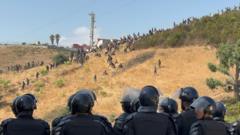
Reports confirm that Moroccan security forces recently detained dozens of migrants attempting to cross into this Spanish enclave. Standard news coverage packages this event neatly: numbers, dates, geopolitical friction between Rabat and Madrid, a brief mention of border security protocols. The statistics roll past like ticker tape. Dozens detained. Fences scaled. Tear gas deployed. Border patrols reinforced.
Numbers are cold. They are designed to let us look away without staining our conscience.
Let us change the lens. Let us walk into the dark.
The Anatomy of an Impossible Choice
Imagine standing on a rocky slope at two in the morning. Your clothes are stiff with dried mud from a journey that started six months ago in sub-Saharan Africa. Your shoes—if you still have a pair—are held together by rubber bands and hope. You have crossed deserts where water tasted like copper and survived extortion checkpoints where your life was worth less than a pocketful of dinars.
Now, the fence is in front of you.
It is not a simple chain-link barrier. Modern border infrastructure is an engineering marvel born of fear and architectural calculation. In Ceuta, the perimeter consists of parallel fences reaching six meters high, laced with barbed wire, topped with anti-climbing mesh, and monitored by thermal-imaging cameras, radar, and motion sensors. It is a wall designed to repel an army, yet it is approached nightly by human beings whose only weapon is desperation.
When we talk about migration enforcement, we rarely talk about the arithmetic of desperation. No one risks fractured limbs, police batons, and deportation on a casual Tuesday. They do so because the alternative—staying put—feels like a slow-motion suffocation.
Consider a hypothetical young man we will call Idrissa. He is twenty-two, hailing from a small village outside Bamako. In his hometown, the soil has turned to dust, the local economy withered under erratic rainfall, and his family relies on remittances that rarely arrive. Idrissa is not looking for luxury. He is looking for survival. When he watches distorted videos on a cracked smartphone screen showing young men who made it across the border in Ceuta, playing football on a Spanish beach, his brain edits out the suffering. It seizes on the proof of possibility.
Human beings are wired to chase possibility, no matter the odds. It is the exact same evolutionary spark that drove explorers across uncharted oceans. Only today, the ocean is a heavily fortified land border, and the explorers are treated as threats to be contained.
The Ground Reality of the Borderlands
The recent detentions in Fnideq and around the perimeter of Ceuta are part of a long, grinding rhythm of containment. Morocco occupies a complex and unenviable position in global migration dynamics. Stationed as the literal gateway between the African continent and European Union territory, Rabat acts as a vital security partner for Brussels. Billions of euros in aid, equipment, and political capital flow south to help seal the borders.
From a diplomatic standpoint, the partnership works. Security forces patrol the rugged hills, intercept small boats attempting maritime crossings, and sweep through makeshift forest camps before large-scale rushes can take shape.
From a human standpoint, it is a human-rights tightrope walk played out in real-time.
When security forces sweep through the hills, belongings are scattered. Backpacks containing school notebooks, faded photographs of mothers and sisters, spare socks, and small savings vanish into the dust. The detentions are swift. Buses arrive. People are loaded in and transported southward, away from the coast, dropped off in unfamiliar cities hundreds of miles away.
And yet, within days, many return.
This is the part of the equation that policymakers continually underestimate. You cannot deter a person who has already lost everything by threatening them with hardship. Hardship is their current address.
I spoke once with a aid worker who spent years operating makeshift medical tents near northern Morocco. She described the psychological state of those attempting the crossing not as reckless, but as hyper-focused.
"They aren't running away from home anymore," she told me, her voice dropping to a quiet register. "They are running toward an idea. When you are running toward an idea, physical pain becomes background noise. Fences are just metal. Police are just obstacles. The only thing that terrifies them is stopping."
The Invisible Stakes
Why should a reader sitting thousands of miles away care about a predawn detention sweep outside a minor Spanish enclave on the North African coast?
Because Ceuta is a pressure valve for a globalized world out of balance.
The events in Morocco are symptoms of a much larger, global friction: the collision between a demographic and economic gradient so steep it defies gravity. On one side of the Mediterranean, aging populations face labor shortages, declining birth rates, and a desperate need for dynamic, young workers. On the other side, youthful populations face surging populations, unstable governance, and economies crippled by historical inequalities and climate stress.
When thousands of young people converge on a six-meter fence, they are acting as the physical manifestation of this imbalance. They are gravity itself, pulling toward equilibrium.
When security forces push them back, they are attempting to hold back the tide with a broom. It is a temporary fix for a permanent structural failure. Every detention reported in the news cycle represents a momentary pause in a movement that will not stop until the underlying pressures are addressed.
We watch these events unfold through the safety of our screens. We scroll past the headlines while drinking morning coffee. We categorize the people in the photos as "migrants," reducing them to a political football tossed between parliaments in Rabat, Madrid, and Brussels.
We forget that every single person in that group has a name, a mother who worries, a favorite meal, a distinct laugh, and a broken heart.
The Final Approach
As dawn breaks over the strait, the lights of Ceuta begin to flicker out against the brightening blue of the sea. The patrol cars finish their rounds. The dust settles on the red dirt roads outside Fnideq.
In the brush behind the ridge, hidden from the thermal lenses of the border cameras, a small group of figures emerges from the pines. They are bruised, exhausted, and hungry. They count heads in whispers. Someone shares a warm sip of water from a dented plastic bottle.
They look up at the ridge, past the razor wire, toward the pale silhouette of Europe on the horizon.
They do not speak. They do not need to. They begin to walk forward, one slow, deliberate step at a time, into the rising sun.