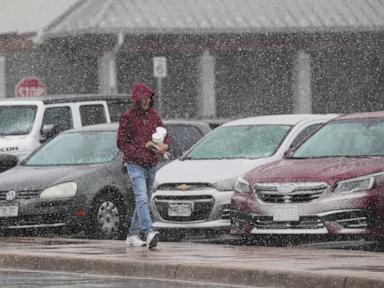
Stop Panicking Over Spring Snow
The local news cycle in Colorado follows a predictable, exhausting script. As soon as a low-pressure system swirls over the Four Corners, the sirens go off. Meteorologists start using "bombogenesis" like they’re narrating a Michael Bay film. Everyone rushes to the grocery store to buy milk they don't need.
The competitor narrative is simple: Colorado is "bracing" for a "significant" storm that will "paralyze" the Front Range.
This is a fundamental misunderstanding of high-altitude living.
Calling a May snowstorm in Colorado "unprecedented" or "dangerous" is like calling a heatwave in Phoenix a tragedy. It’s the baseline. The real story isn't the snow; it's the fragile, urbanized psychology of people who moved to a mountain state and expect San Diego weather. We aren't bracing for a storm. We are suffering through a collective bout of amnesia.
The Myth of the Late Season Surprise
The "lazy consensus" suggests that snow in May is an anomaly. Data from the National Weather Service in Boulder tells a different story. For Denver, April is historically the second-snowiest month of the year, and May often cracks the top five.
When an article says the state is "bracing," it implies we are victims of a freak atmospheric event. We aren’t. We are participants in a predictable cycle.
Imagine a scenario where a sea captain is surprised by the tide. You’d fire him. Yet, every year, Colorado municipal leaders and transportation departments act as if 10 inches of heavy, wet slush is a black swan event.
The "damage" cited in these breathless reports—downed power lines and broken tree limbs—isn't an act of God. It’s an act of negligence. We plant non-native, deciduous trees that haven't dropped their leaves yet, then act shocked when the surface area of those leaves catches $500$ pounds of snow and snaps the trunk. We build a power grid that relies on overhead lines in a region known for upslope storms.
The snow isn't the problem. Our refusal to adapt to the geography is.
The Moisture Fallacy
Every time a storm hits, the media pivots to the "silver lining": we need the moisture.
This is a dangerous half-truth. While the Colorado River Basin and our local reservoirs rely on snowpack, a massive late-spring dump on the Front Range often does more harm than good for the actual ecosystem.
- Flash Runoff: When you get two feet of heavy snow in May, it doesn't soak in gradually. The ground is already thawing. The sun comes out the next day—because it’s Colorado—and hits the snow with high UV intensity. You get immediate, violent runoff that causes erosion rather than deep soil saturation.
- The False Sense of Security: A big May storm leads to policy laziness. Local governments see a high snowpack percentage and ease up on water conservation efforts. One storm doesn't fix a multi-decade aridification trend.
If we actually cared about the "moisture," we’d be talking about gray-water recycling and xeriscaping, not celebrating a storm that’s going to turn into a muddy mess in 48 hours.
The Cost of the Panic Economy
I’ve spent twenty years watching how these "weather alerts" drain the local economy. It’s a manufactured crisis that costs millions in lost productivity.
- Retail Chaos: The "pre-storm surge" at big-box retailers creates artificial supply chain ripples.
- Over-Salting: Municipalities dump thousands of tons of magnesium chloride on the roads to appease a terrified public. This runoff destroys the local watershed and eats the undercarriages of the very cars they claim to be "protecting."
- The Insurance Trap: We see a spike in insurance claims for "storm damage" that is often just deferred maintenance. That tree that fell on your roof? It was dead three years ago. The snow just finished the job.
We are subsidizing a lack of preparedness with high-octane fear.
Why Your "Winter Survival Kit" Is a Joke
The standard advice is to stay home and hunker down. This is the "lazy consensus" at its peak.
If you live in the Intermountain West, a snowstorm shouldn't stop your life. The reason it does is that we have prioritized "luxury" vehicles over actual utility. A subcompact SUV with "all-season" tires is not a winter vehicle. It’s a marketing gimmick.
True preparedness isn't about having a flashlight and a can of beans. It's about mechanical reality.
The Friction Equation
The physics of a Colorado storm are unforgiving. We deal with "heavy" snow—high water content. This creates a layer of slush that acts as a lubricant between your tires and the asphalt.
$$F = \mu N$$
Where $F$ is the force of friction, $\mu$ is the coefficient of friction, and $N$ is the normal force. In a spring storm, $\mu$ approaches zero on standard tires. No amount of "all-wheel drive" matters if your tires have the grip of a hockey puck.
If you want to talk about "bracing" for a storm, talk about mandatory winter tire laws like they have in parts of Europe and Quebec. But we won't do that. It’s easier to write a scary headline than to suggest people actually invest in the right gear for the environment they chose to live in.
Stop Blaming the Clouds
The competitor's article wants you to feel small and vulnerable. It wants you to refresh the page for the latest "inch count" in Highlands Ranch.
I’m telling you to ignore it.
The snow is coming. It will melt by Tuesday. The power will flick back on once we stop planting trees that don't belong here. The only thing "significant" about this storm is the amount of digital ink wasted on it.
If you can’t handle a foot of snow in May, you don't have a weather problem. You have a geography problem. Move to Kansas. The land is flat, the weather is boring, and you won't have to "brace" for anything other than a light breeze and your own regret.
The mountains don't care about your commute. Stop acting like their standard operations are a personal attack.
Buy better tires. Prune your trees. Grow up.