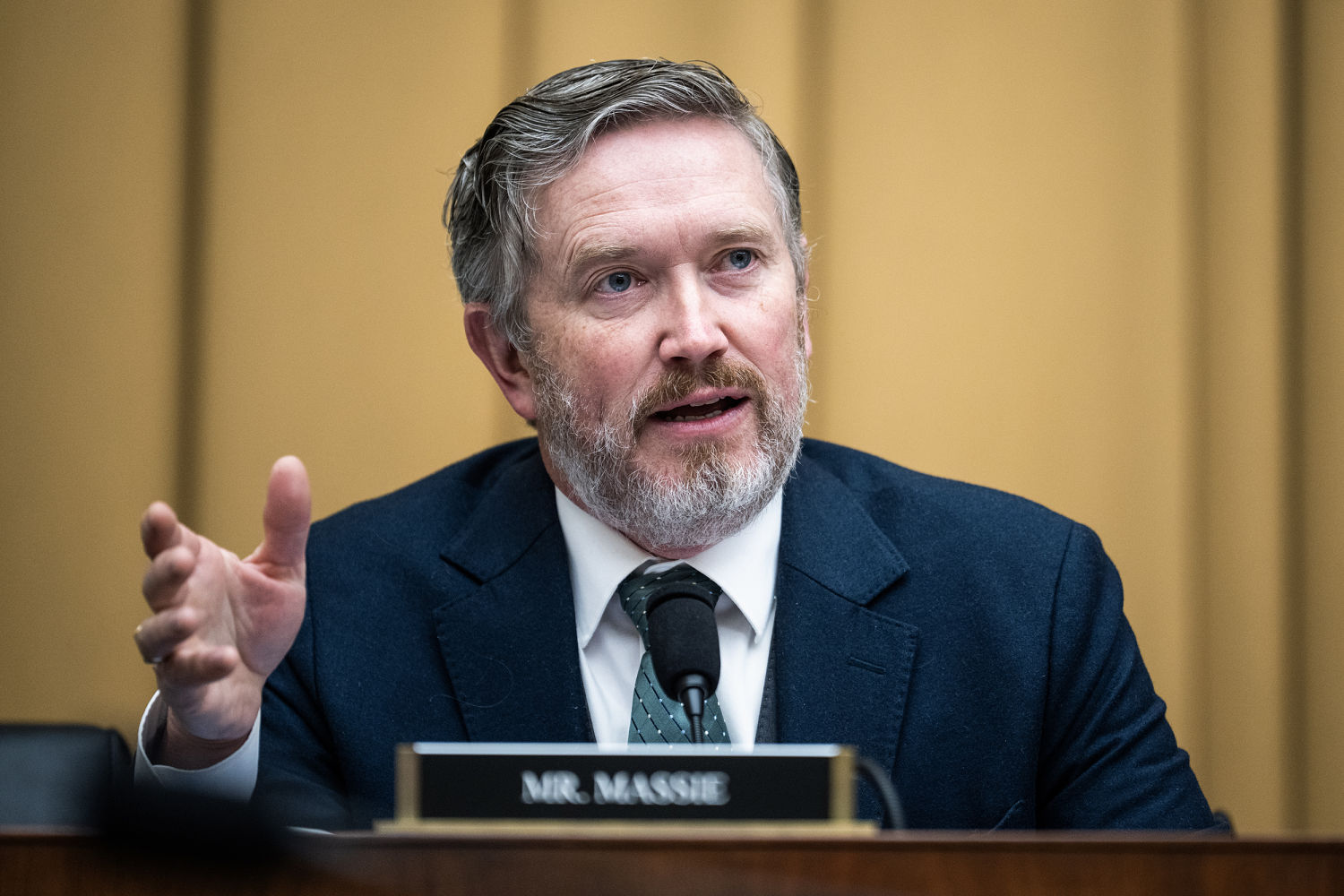
Donald Trump and Thomas Massie are currently locked in a struggle that is less about policy and more about the fundamental definition of a Republican. To the casual observer, they look like allies: both rail against the "deep state," both mock the traditional GOP establishment, and both treat the national debt as a looming apocalypse. But in the hills of northern Kentucky, a multi-million-dollar proxy war has revealed a jagged fault line. Trump demands a party built on personal loyalty and populist strength, while Massie is betting his career on a rigid, almost mechanical adherence to the Constitution that leaves no room for a king.
This is not a minor spat between a president and a backbencher. It is a fundamental stress test for the American Right.
The Mechanics of the Feud
The current friction reached a boiling point in early 2026, but the roots go back to the early days of the pandemic. In March 2020, Massie nearly single-handedly forced hundreds of members of Congress to return to Washington during a lockdown to vote on a massive stimulus package. He argued that the Constitution required a physical quorum for such a monumental expenditure. Trump, then in the White House and eager to sign the bill, famously labeled Massie a "third-rate grandstander" and called for his expulsion from the party.
Massie didn't blink. He won his next primary by 70 points.
By 2024, the two had reached a tenuous peace, with Trump even endorsing Massie. But that truce shattered when Massie backed Ron DeSantis in the presidential primary and, more critically, began relentlessly attacking the administration’s refusal to release the full "Epstein files." For Massie, the lack of transparency is a systemic failure of the executive branch. For Trump, Massie’s vocal criticism of his hand-picked officials—like Attorney General Pam Bondi—is a betrayal of the movement.
Brand Versus Brand
Trump’s political brand is built on transactional loyalty. It is a top-down structure where the leader defines the priorities, and the rank-and-file provide the muscle to execute them. If Trump says a spending bill is "beautiful," his supporters are expected to vote for it. If he says a foreign conflict requires American intervention, the "America First" banner is expected to follow his lead.
Massie’s brand is built on ideological isolationism. He operates as a "no" machine, frequently acting as the sole Republican vote against foreign aid, military interventions, and even ceremonial resolutions. His logic is often more mathematical than political. He views the federal government through the lens of his MIT-trained engineering background: if the system isn't authorized by the original blueprint (the Constitution) and isn't funded by existing revenue, it should not exist.
This creates a paradox. While Trump uses populist energy to bypass institutions, Massie uses the letters of the law to block them. In 2026, this has manifested in a brutal primary challenge. Trump has thrown his full weight behind Ed Gallrein, a former Navy SEAL and farmer who explicitly campaigns on being a "team player" for the Trump agenda.
The Money and the Machines
The fight is no longer just a war of words on social media. It has become an expensive laboratory for Republican donors. Conservative groups and pro-Israel organizations, frustrated by Massie’s consistent votes against aid to Israel and his skepticism of the Iron Dome, have poured over $5 million into the district.
The spending highlights an overlooked factor in modern GOP politics: the "Massie Model" is a nightmare for party whips. In a House of Representatives where the Republican majority is razor-thin, a single member who refuses to negotiate makes governing nearly impossible. Massie’s refusal to take corporate PAC money means he cannot be pressured by leadership through the usual financial channels. He answers only to a specific brand of libertarian-leaning voter in northern Kentucky who views "compromise" as a four-letter word.
Why the Result Matters
If Gallrein defeats Massie in the upcoming primary, it signals the final professionalization of the MAGA movement. It would prove that ideological purity—even of the most conservative variety—is no shield against a lack of personal loyalty to the leader. It would mean the "Big Tent" of the GOP has shrunk to the size of a single podium.
However, if Massie survives, it proves there is a durable, independent lane in the Republican Party that is immune to presidential decrees. Massie’s constituents aren't necessarily anti-Trump; many of them likely voted for Trump twice. But they represent a segment of the electorate that values a "constitutional watchdog" over a "loyal soldier." They like the fact that their representative makes both parties uncomfortable.
The Constitutionalist Trap
The risk for Massie is that his "lonely no" votes can look like obstruction for the sake of obstruction. By voting against resolutions that affirm Israel's right to exist or condemning foreign dictators, he hands his opponents easy ammunition. They don't have to argue the fine points of Article I powers; they just have to show a picture of him standing alone against a popular sentiment.
Trump understands this better than anyone. He doesn't fight Massie on the merits of the Epstein Files Transparency Act or the intricacies of the gold standard. He fights him on the grounds of "teamwork." To Trump, Massie is a gear that refuses to turn with the rest of the machine. To Massie, the machine is broken, and he is the only one with the schematic to fix it.
The outcome in Kentucky will determine if the Republican party is still a collection of ideas or if it has truly become a cult of personality. There is no middle ground in this race. You either believe the Representative’s primary duty is to the President’s agenda, or you believe it is to a 237-year-old piece of parchment.
The voters in Hebron and Covington are about to decide which brand of "Republican" actually owns the future.