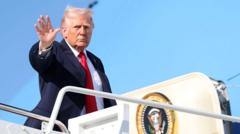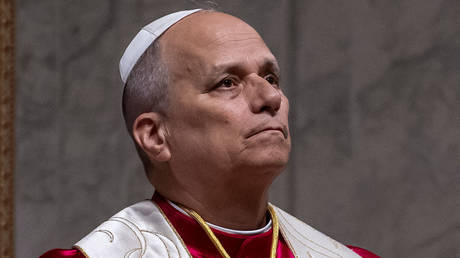
Donald Trump has crossed a theological line that most politicians treat as electrified. By branding Pope Leo XIV as "weak" and "terrible" on foreign policy, Trump isn’t just firing off another late-night post; he is initiating a fundamental restructuring of how the American right interacts with global moral authority. This isn't the first time a president has sparred with Rome, but the nature of this particular escalation signals a total decoupling of the Republican platform from traditional Vatican social doctrine.
The immediate spark was the Pope’s blunt condemnation of the administration's stance on the escalating conflict in Iran and the ongoing mass deportation efforts in the United States. While the competitor’s headline suggests a simple personality clash, the reality is a high-stakes collision between two competing visions of civilization. One views the world through the lens of strict national borders and military dominance; the other operates on a 2,000-year-old mandate of universal human dignity that ignores passports entirely.
The Myth of the Vatican Wall
One of the most persistent rhetorical weapons in Trump’s arsenal is the "Vatican Wall" argument. His "border czar" and various surrogates have repeatedly pointed to the medieval stone fortifications surrounding Vatican City as a "gotcha" for papal hypocrisy. It is a compelling soundbite for a television audience, but it ignores the physical reality of the site.
The walls of the Vatican were built in the 9th century to defend against Saracen pirates. They do not function as a modern border crossing. St. Peter’s Square, the most significant entrance to the city-state, is open to the public 24 hours a day, guarded only by the Swiss Guard and Italian police who facilitate—rather than block—the flow of thousands of people. Using these ancient stones as a justification for a 2,000-mile steel barrier in the Chihuahua Desert is a category error that highlights the intellectual gap between the two sides.
Breaking the American Catholic Vote
For decades, the GOP relied on a "common ground" strategy with the Catholic Church, focusing almost exclusively on abortion. As long as the party remained pro-life, the Vatican’s more "liberal" views on the death penalty, social safety nets, and environmental protection were largely ignored by the American clergy.
That era is over. Pope Leo XIV, the first American-born pontiff, understands the nuances of the U.S. political machine better than his predecessors. He isn't speaking from a distant, Euro-centric perspective. He is speaking to his own backyard. By calling the administration’s deportation plans a "disgrace" and an "affront to dignity," he is forcing American Catholics to choose between their partisan identity and their sacramental one.
The numbers suggest a fracturing. While older, more traditionalist Catholics remain firmly in the Trump camp, a growing segment of Hispanic Catholics—now a massive demographic engine of the Church in the U.S.—sees the Pope's words as a direct defense of their families. Trump’s attack on the Pope is an attempt to preemptively discredit the messenger before the messenger can further erode his support among these voters.
The Iran Factor and the Nuclear Button
The rhetoric shifted from immigration to existential threat when Trump recently hinted at "ending a civilization" in Iran. This triggered what Vatican experts call the "nuclear button" for the Holy See. Typically, the Pope speaks in broad, diplomatic generalities. However, the threat of total cultural or national erasure prompted Leo XIV to urge citizens to contact their elected officials directly.
This was a move of desperation. The Vatican maintains diplomatic relations with Iran and views itself as a neutral mediator in the Middle East. When the U.S. President frames a conflict in "religious" or "civilizational" terms, he enters the Pope’s jurisdiction. The Pope’s response is not about being a "very liberal" leader, as Trump claims; it is about preventing a global conflict that the Church believes would be an "unjust war" under its own long-standing doctrine.
A Rivalry of Sovereignty
Ultimately, this is a conflict between two men who both claim a form of absolute authority. Trump views himself as the ultimate arbiter of American interests, while the Pope views himself as the Vicar of Christ with a mandate that transcends the White House.
When Trump calls the Pope "terrible," he is attempting to domesticate the papacy. He wants to treat the leader of 1.4 billion people like a local political rival or a cable news pundit. But the Vatican plays a much longer game. Presidents come and go every four or eight years. The Holy See measures time in centuries. By attacking the Pope, Trump may satisfy his base in the short term, but he is also alienating the one institution that has the longevity to outlast any political movement.
The strategy is high-risk. If Trump successfully paints the Pope as a "partisan hack," he secures his grip on a certain segment of the religious right. But if he fails, he risks a permanent schism with the largest organized religious body in the world—a body that has seen empires rise and fall and remains standing long after the emperors are gone.
Check your voter registration and pay attention to how your local parish leaders respond to this rhetoric; the silence from the pulpit can be just as telling as the shouting from the rally stage.