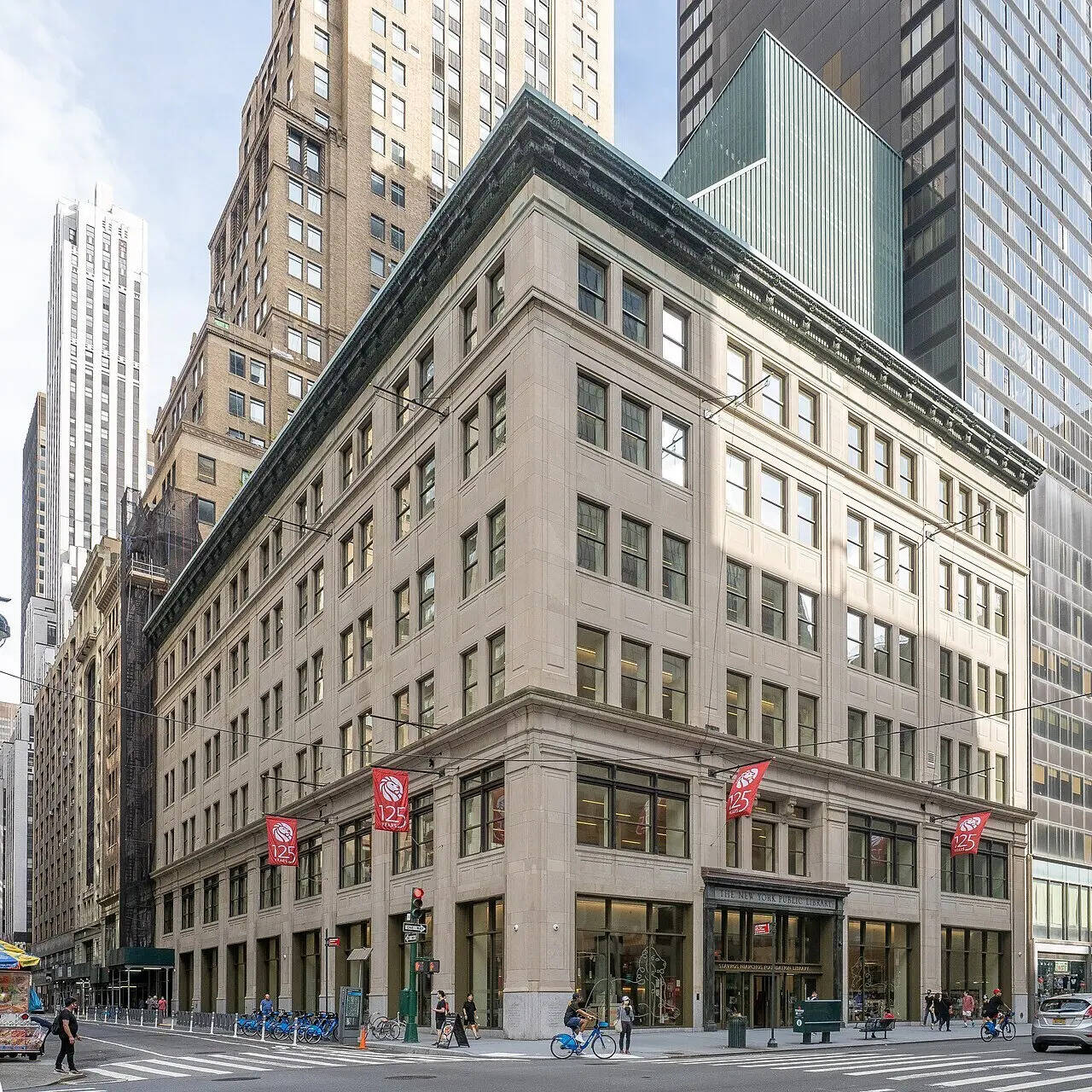
The renovation of the Stavros Niarchos Foundation Library (SNFL) represents a $55 million capital allocation strategy designed to solve a fundamental mismatch between 20th-century institutional architecture and 21st-century urban utility. When a public facility sustains higher foot traffic than most commercial retail hubs, the traditional "storage-first" library model collapses under the weight of its own inefficiency. Modern civic infrastructure succeeds not by warehousing physical assets, but by maximizing the Interaction Density of its square footage. This shift from a collection-centric model to a user-centric "civic living room" is governed by three primary structural drivers: volumetric efficiency, programmed flexibility, and the integration of high-utility "third space" amenities.
The Friction of Legacy Institutional Design
The predecessor to the SNFL, the Mid-Manhattan Library, functioned as a high-density storage facility that prioritized the preservation of physical media over the facilitation of human labor. This created a significant Utility Gap. In a legacy environment, floor plates are often obstructed by fixed stacks, poor sightlines, and inadequate power distribution. The economic cost of this design is measured in underutilized space and high friction for the user.
A successful renovation must address the Law of Diminishing Physical Returns in library science. As digital circulation increases, the marginal value of on-site shelf space decreases. By moving 4 million volumes to off-site high-density storage beneath Bryant Park, the project reclaimed vertical volume for human activity. This wasn't merely a move toward digitization; it was an exercise in Spatial Arbitrage, trading low-value storage area for high-value collaborative environments.
The Longcomb Strategy: Volumetric Optimization
The architectural intervention at SNFL uses a "Longcomb" structural logic to organize the facility's 180,000 square feet. This framework categorizes space into distinct functional zones that align with modern work-life integration.
- The Browsing Enclosure: A concentrated, high-visibility area for physical media that maintains the library's core identity without monopolizing the floor plan.
- The Social Infrastructure: Open-plan seating that mimics co-working environments, recognizing that the modern patron requires a "Third Space" that bridges the gap between home and the office.
- The Learning Center: Specialized zones for vocational training and ESOL classes, which convert the library from a passive resource into an active human-capital incubator.
The efficiency of this model is found in its Programmatic Elasticity. By using modular furniture and open floor plates, the institution can reconfigure its layout based on real-time usage data. This reduces the risk of structural obsolescence, ensuring the $55 million investment remains viable across a 30-to-50-year lifecycle.
The Revenue and Social Value Calculus
Public projects of this scale are often criticized for their price tags, yet a rigorous analysis reveals a compelling Social Return on Investment (SROI). Unlike private developments, the value of a public library is measured through indirect economic stimulants:
- Workforce Readiness: Providing 11,000 square feet of dedicated adult learning space directly impacts local employment statistics and tax bases.
- The Proximity Effect: High-traffic civic hubs act as anchors for local retail ecosystems. The presence of a destination-grade library increases foot traffic for surrounding businesses.
- The Digital Equity Bridge: In a city where high-speed internet is a prerequisite for basic civic participation, the provision of free, high-bandwidth infrastructure serves as a critical subsidy for lower-income populations.
The inclusion of a rooftop terrace—the only free, public rooftop in Midtown—is not a decorative luxury but a strategic asset. It serves as a Value Magnet, drawing in a diverse demographic that might otherwise perceive a library as an antiquated institution. This broadened user base increases the political and social capital required to secure ongoing operational funding.
Technical Infrastructure and Vertical Logic
The internal mechanics of the SNFL renovation rely on a vertical hierarchy of noise and activity. The ground floor serves as the high-velocity "Discovery Zone," while higher floors transition into deeper focus areas. This gradient is supported by a significant overhaul of the building's Technical Nervous System.
The primary bottleneck in legacy buildings is almost always power and connectivity. To future-proof the SNFL, engineers had to integrate a high-density grid of electrical outlets and data ports without compromising the aesthetic of the "civic living room." This was achieved through raised floor systems and integrated furniture solutions. The result is a facility that can support thousands of concurrent devices—a requirement that was non-existent when the original structure was built in 1914 as a department store.
The Risks of the Civic Living Room Model
Transitioning to a high-utility public space introduces specific operational risks that must be managed through design and policy.
- Maintenance Intensity: High-traffic environments with soft seating and premium finishes require significantly higher maintenance budgets than traditional book stacks.
- The Security-Privacy Paradox: Creating an open, welcoming environment while ensuring the safety of thousands of daily visitors requires sophisticated, often invisible, security protocols.
- Resource Displacement: There is an inherent tension between the needs of the traditional "quiet researcher" and the "collaborative worker." If the design leans too far toward the latter, the library risks losing its status as a sanctuary for deep work.
To mitigate these risks, the SNFL utilizes acoustic zoning. Perforated wood ceilings and specialized flooring materials absorb ambient noise, allowing for high-density occupancy without the chaotic acoustic profile of a commercial transit hub.
Strategic Realignment of Urban Assets
The success of the SNFL blueprint lies in its rejection of the library as a static monument. Instead, it treats the building as a dynamic platform for service delivery. The $55 million spent is an investment in the Civic Tech Stack, where the physical building is the hardware and the various programs (career services, media labs, quiet study) are the software.
Municipalities looking to replicate this success must first audit their existing portfolios for Latent Spatial Value. Many public buildings are "space-rich but utility-poor." The goal is not to build more square footage, but to increase the "Utility per Square Foot" through aggressive de-cluttering of physical assets and the integration of multipurpose zones.
The definitive play for urban planners is to move away from specialized, single-use buildings. The SNFL proves that the highest-performing civic assets are those that function as a hybrid of a classroom, an office, a gallery, and a park. By consolidating these functions into a single, high-performance node, cities can reduce the overhead of their physical footprints while simultaneously increasing the quality of life for their citizens. Future capital projects should be judged not by the number of volumes they hold, but by the number of successful human interactions they facilitate per hour of operation.