Power grids are old. They break down when wind and solar farms flood them with unpredictable jolts of energy. Traditional monitors miss the microscopic magnetic fluctuations that signal a coming collapse.
China is trying to fix this by embedding atomic-scale physics directly into high-voltage power lines.
Researchers at the University of Science and Technology of China, alongside the State Grid Corporation, built a specialized tool known as the quantum current transformer. It looks like a ring and uses diamond sensors to read magnetic fields with extreme precision.
Blackouts start small. A minor voltage wobble cascades across regions until entire cities go dark. Traditional sensors react too slowly to stop the chain reaction. Quantum states inside nitrogen-vacancy centers react instantly to tiny environmental shifts.
This technology spots danger before it spreads.
The Physics Behind the Diamond Ring
Diamond isn't just for jewelry. Pure carbon crystal lattices can trap defects where a nitrogen atom replaces a carbon atom next to an empty space. These spots are called nitrogen-vacancy centers.
They possess unique quantum properties. Their electron spins are hyper-sensitive to magnetic and electric fields.
When you wrap these diamond sensors inside a toroidal magnetic shielding loop, you get a device that measures alternating current non-invasively. Lab tests show it achieves a maximum measurement accuracy of 0.05 percent over a linear range of zero to one thousand amperes.
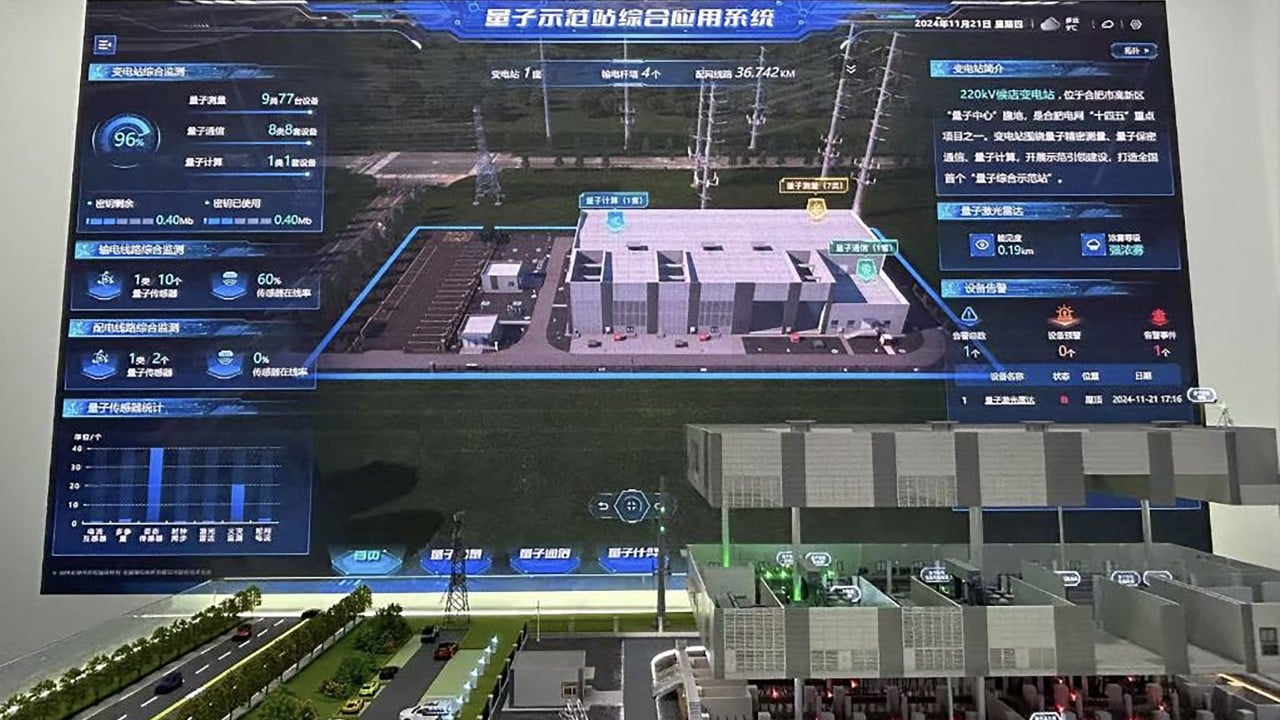
Engineers deployed this quantum current transformer inside a 110-kilovolt substation in Hefei, Anhui province. It tracked alternating current in real time without breaking a sweat.
This isn't theory anymore. It is hardware bolted onto live infrastructure.
Why Traditional Grid Monitoring Fails Now
Old monitoring systems rely on electrical transformers that measure current through induction. They work fine for steady coal or gas plants.
Renewable energy changes the math. Solar panels and wind turbines produce variable power. Clouds roll in. Wind speeds drop. The grid experiences rapid frequency shifts.
Older sensors miss high-frequency noise or microcurrent anomalies. They average things out. That delay causes cascading failures.
When power lines carry ultra-high-voltage direct current across thousands of miles, tracking minor fluctuations becomes a massive engineering nightmare. China Southern Power Grid tackled this by certifying an ultra-high-voltage quantum sensor in Liuzhou.
That sensor handles extreme temperatures from minus 40 degrees Celsius to 85 degrees Celsius. It measures everything from tiny milliamperes to tens of thousands of amps.
Scaling Up the World's Largest Grid
China operates the biggest electricity network on Earth. Keeping it stable requires immense engineering oversight.
When demand spikes from heavy industry or data centers, the margins shrink. Add millions of electric vehicles charging overnight, and the system strains further.
By integrating quantum sensors with automated isolation systems, engineers aim to shorten fault response times down to fractions of a second. When a line trips, the network isolates the damaged segment instantly instead of letting the failure ripple outward.
Other nations face similar aging grid problems. Europe experienced major grid synchronisation failures. Old infrastructure struggles to handle the green energy transition.
Quantum sensing offers a blueprint for upgrading existing hardware. You don't always need to tear down old transmission towers. Sometimes you just need better eyes inside the system.
Watch how these field tests scale over the next few years. If diamond sensors keep proving reliable under heavy loads, expect other global utility providers to copy the architecture.
China's Super Grid Just Solved Blackouts. The U.S. Isn't Even Trying.
This video provides an in-depth look at how China's high-voltage grid infrastructure operates and why it is rapidly outpacing legacy systems in the West.