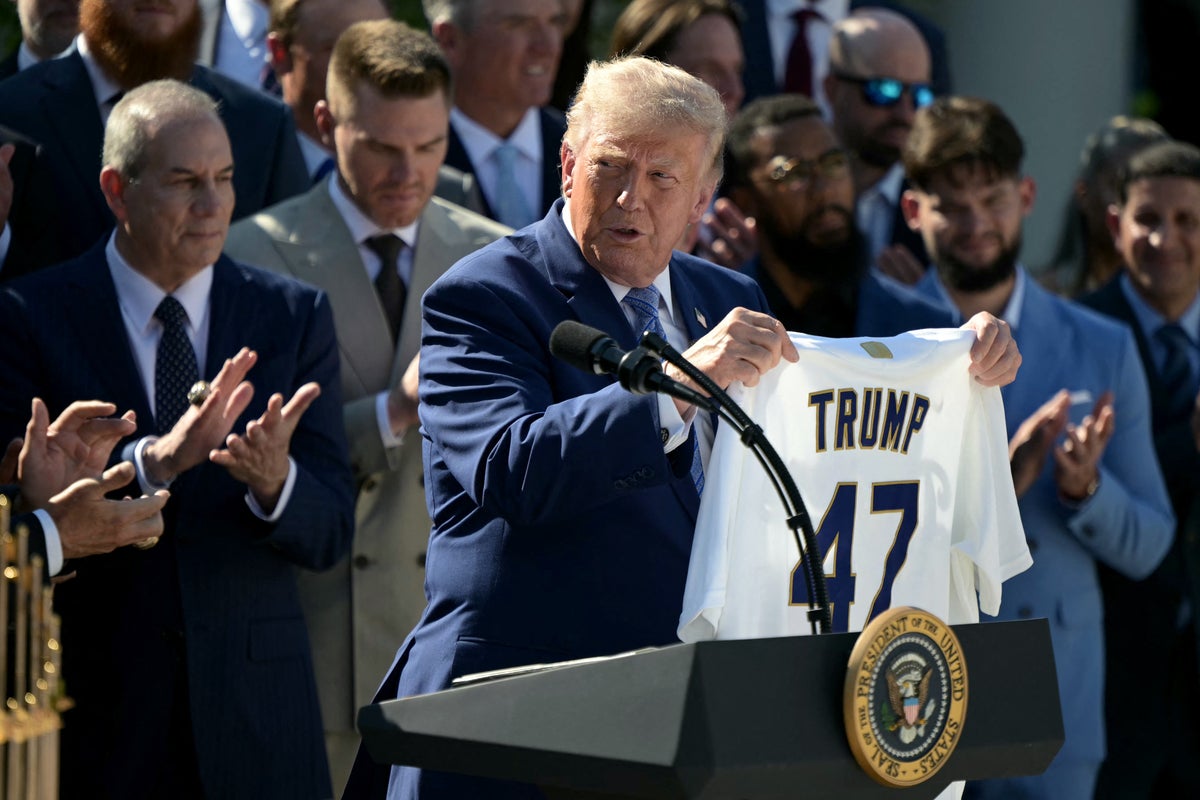
The East Room of the White House smells faintly of floor wax, polished mahogany, and heavy wool suits under soft, blinding television lights. Outside, Washington hums with its endless political machinery. Inside, a group of men who spent their summer wearing cleats, grass-stained jerseys, and rosin-dusted caps stand awkward and towering in tailored suits.
They are the Los Angeles Dodgers. Fresh off a grueling baseball season that ended under the flash of blue confetti and roar of millions, they have traded the dirt of Dodger Stadium for the marble halls of American power.
Donald Trump steps to the lectern. He looks at the roster of athletes lined up behind him, smiles, and offers a characteristically corporate compliment. He calls the franchise "one of the great brands."
It is a striking phrase. Brand. Not just team, not just champions, not just a fraternity of men who spent seven months throwing leather balls at ninety-five miles per hour. A brand. In three syllables, the modern intersection of sports, politics, and American mythology stands exposed.
The Ritual of the Golden Handshake
Championship visits to the White House were not always televised spectacles. They began quietly, almost as an afterthought.
In 1865, Andrew Johnson hosted the Brooklyn Atlantics and the Washington Nationals—amateur clubs playing a fledgling game on muddy pastures. Decades later, Harry Truman hosted teams with little fanfare. By the time Ronald Reagan turned the camera lenses toward the Rose Garden, the ritual transformed. It became a required scene in the theater of American leadership.
When a president hosts a champion, two distinct currencies are exchanged: legitimacy and glory.
For the politician, standing beside world-class athletes offers a reflection of unblemished victory. Politics is messy. It is defined by compromise, narrow margins, and persistent cynicism. Sports, by contrast, yield absolute answers. There is a scoreboard. There is a winner. By standing next to the men holding the trophy, power absorbs a small fraction of that undisputed triumph.
For the athletes, the trip offers something else: an entrance into history. A player might earn thirty million dollars a year, but walking through the North Portico offers a different kind of immortality.
Yet the room is rarely simple.
The Invisible Wire
Imagine standing in that line on the stage.
You are an outfielder. You spent your childhood in Tennessee or the Dominican Republic, chasing a baseball until your knuckles bled. You care about pitch selection, hamstring recovery, and winning games for your teammates. Suddenly, because you hit a slider into the right-field bleachers in October, you are placed on a political chessboard.
Cameras capture every twitch of your face. If you smile too brightly, half your fanbase back home accuses you of endorsing an administration. If you look somber, the other half accuses you of disrespecting the office. If you choose not to attend at all, your absence becomes the headline, overshadowing the thousands of hours of training that brought you to the peak of your sport.
This tension is not hypothetical. Over the last decade, championship visits turned into battlegrounds of cultural alignment. Some players stayed home. Others attended with quiet hesitation. A few embraced the moment fully.
Dave Roberts, the Dodgers' manager, stood near the podium as praise was delivered. Roberts, a man whose entire career has been built on navigating high-stress clubhouse dynamics and public scrutiny, understands the delicate balance. A manager’s job is to shield his players. On the field, that means managing bullpens and defensive shifts. In the East Room, it means maintaining unity while the outside world attempts to fracture the team into political factions.
The Dodgers had been here before. They visited the executive mansion following their 2020 championship victory under a different administration. Returning now creates a unique timeline—a franchise bridging political eras purely through their ability to win baseball games.
Beyond the Corporate Label
Calling the Los Angeles Dodgers a "great brand" is factually accurate, even if it feels cold to the romantic fan.
The Dodger brand is iconic. The interlocking "LA" on the royal blue cap is recognized from Tokyo to Mexico City. The franchise generates hundreds of millions of dollars in revenue, commands massive television deals, and signs global superstars to historic contracts.
"It's one of the great brands in all of sports, anywhere in the world," Trump remarked during the ceremony, framing the team's success through the lens of executive victory and global reach.
To view a team strictly as a business asset misses the beating heart of what makes people care.
Brands do not make forty-thousand people scream in unison on a Tuesday night in July. Brands do not make a grandfather cry in his living room when a sixty-year championship drought finally breaks.
A baseball team is a living organism built on human fragility. It is pitcher Walker Buehler fighting back from multiple elbow surgeries to throw strike three in the ninth inning. It is Freddie Freeman playing through excruciating pain, turning a crippled ankle into a swing that echoed through postseason history. It is the thousands of stadium workers, hot dog vendors, and parking attendants whose livelihoods rise and fall with every home stand.
When sports are reduced to simple commercial terminology on a political podium, it highlights the divide between how leaders view success and how fans experience it. To the boardroom and the Oval Office, the Dodgers represent enterprise, power, and prestige. To the kid sitting in the top deck at Chavez Ravine, the Dodgers represent hope.
The Long Ride Back to Chavez Ravine
The ceremony ends. The applause dies down. The cameras click off, and the bright lights cool into dark metal housings.
The players file out of the East Room, loosening their ties as soon as they clear the heavy oak doors. Outside, the team bus waits to take them back to the airport. In forty-eight hours, they will trade their formal wear back for gray road uniforms. They will be back in a dugout, smelling pine tar and sweat, listening to the crack of bats and the sharp pop of leather.
Politics will continue its relentless, noisy churn in the capital. The speeches will fade into news archives. The photos will be framed and hung on office walls or stored away in private collections.
What remains is the game itself.
The White House visit is a brief, surreal pause in a long season—a moment where sports and power glance at each other in a polished mirror. But power is temporary, political terms end, and administrations change.
The game endures. The dirt on the diamond remains unchanged whether a president calls you a national treasure or a commercial success. When the lights go down in Washington, the Dodgers fly west, back to the sun-drenched grass of Los Angeles, where the only score that matters is written in chalk and dust.