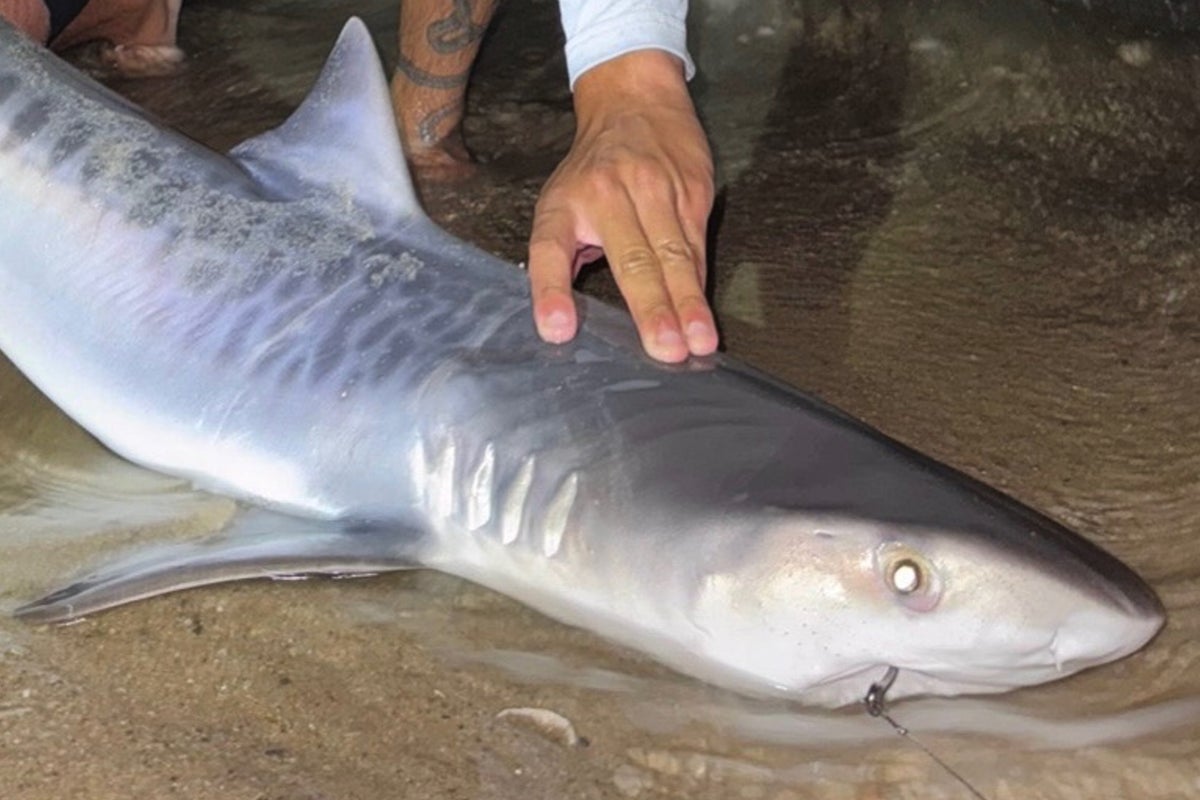
Picture yourself surf-casting on a chilly July night in Massachusetts, hoping for a routine brown shark. Instead, you reel in a five-foot apex predator whose true home is thousands of miles away in the tropical Caribbean. That exact shock hit local anglers Nate and Nelson Rouette on a beach in Falmouth. They weren't expecting to rewrite marine biology textbooks when they headed out after dark.
Yet, that is precisely what happened.
The Midnight Surprise on Cape Cod
Nate Rouette knew something was different the second he spotted the distinct horizontal stripes running down the creature's flank. He yelled out to his brother in total disbelief. They had just hauled in a juvenile tiger shark, a species scientifically known as Galeocerdo cuvier.
Tiger sharks belong in warm, tropical, and subtropical waters. Finding one casually swimming off Cape Cod is like finding a palm tree in Antarctica. Mature tiger sharks can grow past 15 feet and weigh over 1,400 pounds. While the specimen the brothers caught was a young five-footer, its presence thousands of miles north of its comfort zone raises serious questions about our shifting oceans.
What Marine Biologists Say About the Move North
Marine experts aren't panicking just yet, but they are paying close attention. John Chisholm, an adjunct scientist at the New England Aquarium's Anderson Cabot Center for Ocean Life, points straight to rising global sea temperatures.
The Atlantic Ocean off New England is getting warmer. Because of this heating trend, waters that used to be a thermal barrier for tropical species are now rolling out the welcome mat.
Young tiger sharks showing up in northern latitudes used to be an extreme anomaly. Now? Biologists are starting to investigate whether areas like Cape Cod are turning into temporary nurseries. When the water warms up and the food supply follows, marine life adapts quickly.
A Wider Trend of Ocean Migration
Tiger sharks aren't the only ones packing their bags for a northern relocation. If you look at the broader picture of New England waters, radical changes are happening everywhere.
Great white sharks have become a permanent fixture off the coast of Cape Cod, largely driven by surging seal populations. Even smaller commercial species like black sea bass are creeping further north year after year.
Ecosystems are incredibly dynamic. When temperatures shift even a fraction of a degree on average, entire migration routes get rewritten. For local anglers, it means you never really know what's biting on the other end of the line anymore.
After documenting their rare catch, the Rouette brothers safely released the young tiger shark back into the Atlantic. It swam off into the dark surf, leaving behind a stark reminder that our marine environments are transforming faster than most people realize.
Tiger Shark Catch on Cape Cod
This video provides a closer look at surf-casting for massive tiger sharks and highlights the sheer scale and power of these apex predators when they are encountered near coastal beaches.

.png?itok=1mb05mKJ)

