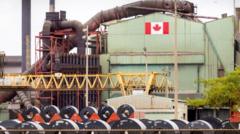
Everybody loves a good nationalist chest-thumping contest. When headlines scream about dollar-for-dollar retaliatory tariffs hitting up to 50 percent, the political theater plays well on evening broadcasts. Politicians get to wear the jersey of the home team, citizens wave flags, and everyone pretends that hurting your neighbor's export ledger is a masterclass in economic defense.
It is economic illiteracy disguised as strength.
I have spent two decades watching supply chains get squeezed by bureaucratic vanity projects. I have seen mid-market manufacturers bleed margin because politicians wanted a soundbite for the six o'clock news. The lazy consensus surrounding these sweeping levies suggests that tit-for-tat protectionism protects domestic industries.
It does not. It taxes your own citizens to punish foreign voters who do not care about your domestic political cycle.
The Broken Math of Retaliatory Duties
Let us look at the mechanics of what happens when Ottawa slaps heavy duties on incoming goods to match American pressure. The narrative tells you that foreign corporations absorb the cost. The reality is far more brutal.
Supply chains are hyper-integrated webs. When you penalize an input component coming across the border, you are not punishing a distant corporate monolith. You are taxing the domestic assembler, the local fabricator, and the retail consumer who now has to pay more for finished goods.
- Input costs spike instantly for domestic assembly lines.
- Margins compress to zero for companies tied to fixed-price contracts.
- Consumers absorb the inflation through higher retail pricing on everyday necessities.
When a tariff reaches 50 percent, it stops being a negotiation tool and starts acting as an internal embargo. You are cutting off your own nose to spite a trade partner's face. The targeted country simply shifts its excess capacity elsewhere, while your domestic businesses scramble to find alternative inputs that do not exist or cost twice as much to manufacture locally.
Why the Popular Questions Are Flawed
Every time trade tensions flare, the public asks the wrong questions. They wonder how fast retaliatory measures will force a foreign government back to the negotiating table.
That is the wrong framework entirely.
The better question is how many domestic companies will go bankrupt before political egos are satisfied. The answer is usually enough to permanently alter local industrial capacity.
Let us examine the common queries floating around trade desks right now.
Will tariffs protect local jobs?
Short term, they protect a legacy sector by artificially inflating prices. Long term, they destroy downstream employment. When operational costs double because of punitive import taxes, companies either automate faster, relocate operations to jurisdictions with sensible trade policies, or simply close their doors. Protectionism creates a sanctuary for inefficiency.
Do tariffs act as effective bargaining chips?
Only if the target country views the threatened sector as existential. If the targeted goods represent a fraction of their total export volume, they will gladly watch your economy absorb higher input costs while they diversify their markets. You end up trading long-term economic competitiveness for a temporary headline.
The Uncomfortable Truth About Trade War Realities
My contrarian stance has a downside, and I am honest enough to admit it. Standing completely aside while another nation imposes unfair trade practices feels like surrender. Doing nothing feels weak.
Political survival demands action. Governments cannot sit on their hands while domestic sectors face aggressive foreign maneuvers.
Yet, choosing a bad action just to look busy is worse than doing nothing. If Ottawa wants to counter predatory trade policies, blanket tax hikes on imported goods are the clunkiest weapon in the shed. Targeted domestic subsidies, strategic R&D investment, and workforce modernization build actual long-term resilience. Taxing your own industrial base into submission does not.
Imagine a scenario where a manufacturing plant in Ontario relies on specialized American steel components that have no domestic equivalent. A fifty percent tariff hits those imports. The plant cannot magically spin up a local foundry overnight. They pay the tax, pass the increase down the line, and watch their export competitiveness vanish into thin air.
That is not strategy. That is economic self-sabotage wrapped in a flag.
Stop cheering for policies that make your groceries more expensive and your business operations impossible to forecast. Protectionism is a tax on your own future.
Cancel the tariffs. Fix the infrastructure. Build a competitive economy that does not need to hide behind a tollbooth to survive.