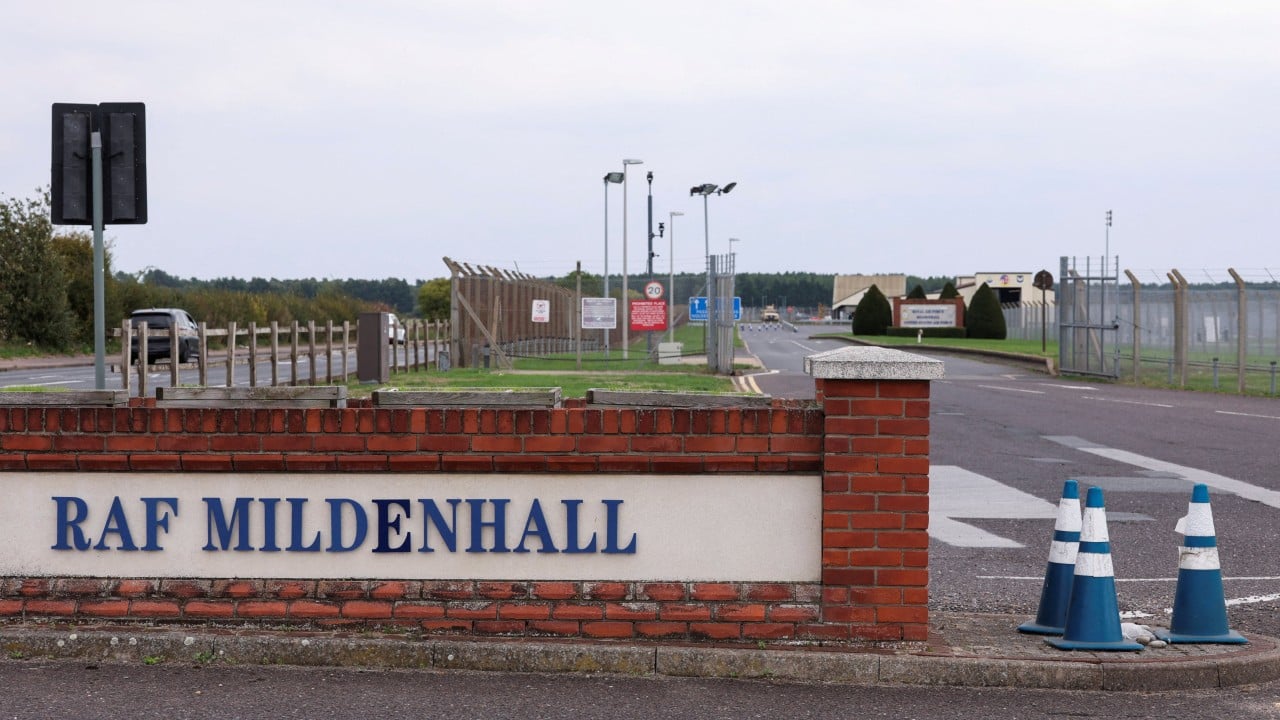
Every time a heavy bomber leaves a tarmac in the United Kingdom, armchair generals on cable news start hyperventilating about retreat.
The current panic over reports that the United States pulled military aircraft from a second British airbase following Iranian threats is textbook defense-media malpractice. It takes a routine, cold-blooded exercise in modern force protection and turns it into a soap opera about American weakness. If you read the mainstream coverage, you would think the Pentagon packed its bags in the dead of night because Tehran rattled a saber.
That narrative is backwards.
Moving high-value airframes out of static, predictable European hubs is not a sign of fear. It is the exact operational doctrine the US Air Force spent the last decade building. When an adversary acquires long-range ballistic missiles and one-way attack drones, sitting parked on a well-mapped ramp in Suffolk or Gloucestershire is not projection of power. It is offering free target practice.
The Lazy Consensus of Static Deterrence
Most defense reporting still operates on a Cold War mental model. In that world, deterrence meant parking rows of gleaming B-52s, F-15s, or refueling tankers on massive, permanent bases and letting satellite photos do the talking. Bigger footprint meant stronger message. Leaving meant losing.
That logic died the moment cheap precision munitions proliferated across the Middle East and beyond.
I have spent years watching defense planners tear their hair out over how slowly public commentary adapts to basic geometry and physics. A static airbase is a fixed coordinate. Its runway length, fuel farm locations, maintenance hangars, and taxiways are visible on commercial satellite imagery to anyone with an internet connection. When you leave billion-dollar aircraft sitting wingtip-to-wingtip on a fixed coordinate within range of asymmetric threats—or exposed to sabotage and proxy drone networks—you are not deterring anybody. You are creating a single point of failure.
The competitor coverage frames this withdrawal as a defensive crouch triggered by Iranian threats. Look closer at what actually happens when Air Forces disperse.
- Survivability increases overnight. An aircraft in the air or operating from an unannounced forward location cannot be targeted by a pre-programmed coordinate strike.
- Enemy intelligence loops break. Adversarial reconnaissance has to restart the entire find-fix-track-target-engage chain from scratch.
- Logistics become the real weapon. Moving jets across theaters forces adversaries to guess whether a departure means de-escalation or an imminent strike package staging from somewhere else entirely.
Calling a tactical dispersal a "withdrawal" is like watching a boxer step off the center line to avoid a telegraphed haymaker and declaring that he forfeited the match.
Agile Combat Employment Is Not a Euphemism for Running Away
If you want to understand why US aircraft move out of major UK installations like RAF Fairford or RAF Mildenhall during periods of heightened tension, stop reading sensationalist headlines and start reading Air Force Doctrine Note 1-21.
The military calls it Agile Combat Employment, or ACE.
The core premise of ACE is brutal in its simplicity: massive main operating bases are indefensible against modern saturation attacks. Instead of hunkering down behind layered air defenses and hoping nothing leaks through, air forces break their formations into smaller, mobile teams that hop rapidly between austere airfields, commercial strips, and dispersed locations.
Let us define what a Bomber Task Force or rotational deployment actually is, because commentators routinely confuse rotational presence with permanent basing. The US does not permanently station heavy strategic bombers in the United Kingdom. It rotates them in for weeks or months at a time to train with NATO allies, test theater logistics, and signal readiness. When those jets rotate out—or relocate earlier than expected because threat assessments shift—the mission did not fail. The shell game simply entered its next phase.
Think about the economics of modern warfare. An Iranian-designed Shahed-series drone costs tens of thousands of dollars. A ballistic missile costs a few million. A single B-2 Spirit or F-35A sitting exposed on a ramp costs upwards of $80 million to $2 billion, plus decades of irreplaceable pilot training and maintenance infrastructure.
Keeping those assets parked at a high-profile UK base after explicit threats emerge violates the first rule of asymmetric warfare: never trade a queen for a pawn.
The Real Reason UK Bases Make Juicy Propaganda Targets
British airbases carry immense symbolic weight, which is precisely why adversaries threaten them and why headlines obsess over them. Installations like RAF Lakenheath, Mildenhall, and Fairford are the crown jewels of transatlantic airpower. They sit on sovereign British soil, deeply intertwined with UK defense infrastructure, hosting critical intelligence, refueling, and strike capabilities.
For Tehran, threatening US assets in Europe accomplishes two goals without firing a single shot:
- It tests allied political cohesion. Nothing rattles European parliaments faster than the suggestion that hosting American jets makes local towns legitimate military targets.
- It manufactures domestic victory narratives. State media in Tehran can point to a departing American transport or tanker wing and claim Western imperialists fled in terror.
When Western media outlets echo that exact framing—reporting that the US "withdrew" because of Iranian threats—they hand adversaries a free information-operations win. They validate the idea that rhetorical coercion forces American hardware out of Europe.
Imagine a scenario where the Pentagon ignored credible threat intelligence just to look tough for the morning papers. Suppose a handful of low-cost drones launched from a clandestine vessel in the North Sea or smuggled near a British perimeter damaged two KC-135 Stratotankers on the tarmac. The same pundits calling today's move a retreat would immediately scream about catastrophic intelligence failures and unforgivable negligence.
In military operations, optics are for peacetime. Survivability is for crisis.
Are US Airbases in the UK Actually Vulnerable to Iran?
People constantly ask whether Iran can physically hit targets in the United Kingdom. If you judge solely by conventional ballistic missile range charts, the answer looks like a simple no. Tehran's operational ballistic missile arsenal tops out around 2,000 to 2,500 kilometers—enough to blanket the Middle East and reach parts of southeastern Europe, but short of the roughly 4,000 kilometers separating western Iran from southern England.
Asking about ballistic missile range, however, is asking the wrong question entirely.
Modern threat assessments do not stop at state-launched ballistic arcs. Security planners look at three very different vectors when evaluating risk to European airfields:
- Maritime-launched asymmetric systems. Converted commercial vessels carrying containerized drone launchers or short-range cruise missiles can operate in international waters far closer to European coastlines than Tehran's borders.
- Clandestine proxy networks. Intelligence services across the UK and continental Europe have repeatedly disrupted surveillance and sabotage plots targeting infrastructure, dissidents, and defense sites. Small quadcopters launched from a van three miles outside a base perimeter require zero intercontinental rocketry.
- Cyber and electronic disruption. Targeting fuel distribution, air traffic control, or local power grids around a major hub degrades sortie generation without a single explosion.
To be completely candid about the downside of rapid dispersal: it is exhausting, expensive, and hard on airframes. Moving maintenance crews, munitions, specialized test equipment, and fuel bladders across multiple locations chews through spare parts and burns out personnel. Smaller, dispersed airfields rarely have the hardened shelters, deep fuel reserves, or climate-controlled bays of a primary UK base. Every time the Air Force executes a rapid relocation, readiness metrics take a short-term hit from sheer wear and tear.
That friction is the price of staying alive in a contested environment. Pretending a base is invulnerable just because it sits in Oxfordshire is how militaries sleepwalk into disaster.
What Force Posture Actually Looks Like When Escalation Looms
If you want to know whether the US is actually backing down from a confrontation, stop counting parked airplanes on British runways and start watching the indicators that actually matter.
Look at aerial refueling tracks. Tankers are the lifeblood of global strike operations. When bombers or fighters leave a fixed European base, do the KC-135s and KC-46s go home to the continental United States, or do they quietly reposition to quieter airfields in southern Europe, the Mediterranean, or the Indian Ocean?
Look at naval aviation and submarine movements. Aircraft carriers do not have fixed runway coordinates. Guided-missile submarines carrying over a hundred Tomahawk cruise missiles each do not show up on commercial flight-tracking apps.
Look at dispersed sortie generation. A bomber taking off from Whiteman Air Force Base in Missouri or Diego Garcia can strike targets anywhere on earth with mid-air refueling, never touching a British runway at all. In fact, operating directly from the continental United States or hardened remote outposts eliminates the diplomatic friction of asking host nations for overflight and strike permissions during a fast-moving crisis.
Let us compare what amateur observers think a withdrawal looks like versus what military logisticians actually see on the ground:
| Metric | The Media Narrative ("Retreat") | The Operational Reality ("Dispersal") |
|---|---|---|
| Aircraft Departure | Proof of intimidation and political weakness | Removal of high-value targets from known coordinates |
| Empty Ramps in the UK | Loss of European deterrence capability | Elimination of single-point-of-failure vulnerabilities |
| Shift to Other Hubs | Uncoordinated scrambling under pressure | Execution of Agile Combat Employment protocols |
| Reduced Public Visibility | Abandonment of regional allies | Denial of real-time intelligence to adversarial trackers |
This distinction separates people who study warfare from people who merely watch flight trackers on social media. Public flight-tracking websites like ADS-B Exchange and Flightradar24 have turned millions of casual observers into amateur intelligence analysts. That transparency is great for accountability, but terrible for context. You can see a transport plane leave RAF Mildenhall with its transponder on. You cannot see the subsurface assets moving silently beneath the waves, nor can you see the strike packages operating with transponders off across secure corridors.
The Danger of Performative Toughness
The worst mistakes in military history happen when commanders make operational decisions to satisfy domestic political theater.
Leaving aircraft on an exposed tarmac just to prove you are not scared of an enemy threat is performative toughness. It prioritizes headlines over combat power. Great powers do not win conflicts by standing still in the open to show how brave they are; they win by controlling tempo, preserving their most lethal assets, and dictating where and when engagements occur.
General Charles Q. Brown Jr. and successive Air Force Chiefs of Staff have hammered this exact point in strategic guidance documents for years: the era of uncontested sanctuary at overseas bases is over. Every overseas airfield is now a potential target from day one of a crisis. Adapting to that reality means treating major bases as temporary springboards rather than permanent parking lots.
When you see headlines screaming about US aircraft pulling back from a second UK airbase, read past the panic. Ask where the tankers went. Ask what moved into the Mediterranean. Ask why an adversary would ever want those jets sitting neatly in a row on a well-mapped British runway in the first place.
If your enemy wants you to stay put so they know exactly where to aim, leaving the room isn't retreat—it's denying them the shot.


