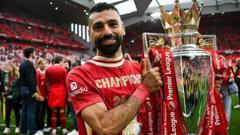
The Anfield vacuum is already beginning to form. While sentimentalists frame Mohamed Salah’s impending departure through the lens of nostalgia, the cold reality of the situation is rooted in a brutal collision of aging curves and private equity logic. Liverpool Football Club is not just losing a winger who has averaged more than twenty goals a season for seven consecutive years. They are losing the last structural pillar of the Jurgen Klopp era, and they are doing so because the numbers on the balance sheet no longer align with the numbers on the pitch.
Salah is not leaving because he is finished. He is leaving because he remains too good for the wage-suppression model that Fenway Sports Group (FSG) has spent a decade perfecting. In the hyper-competitive world of elite football, loyalty is a marketing gimmick used to sell shirts, but renewal is the only thing that keeps a club from sliding into the mid-table obscurity that defined Liverpool’s 1990s. The tension between Salah’s desire for a contract that reflects his status as a global icon and FSG’s refusal to pay for past performance has created an impasse that only ends one way.
The Financial Architecture of a Departure
To understand why Salah is walking away, you have to look past the highlights and into the wage bill. FSG operates on a strictly disciplined model where the Value Over Replacement Player (VORP) is calculated with ruthless efficiency. At 32, Salah is entering a phase where most elite attackers experience a sharp decline in explosive speed and recovery times. However, Salah has defied the standard biological clock, maintaining a level of fitness that suggests he could play at the top level well into his late thirties.
This creates a paradox. Salah wants a multi-year deal worth north of £350,000 per week. From his perspective, he is the most consistent goal contributor in the history of the Premier League. From the perspective of a risk-averse ownership group, paying that sum to a player in his mid-thirties is a gamble they are rarely willing to take. They saw what happened at Manchester United with late-stage contracts given to aging stars, and they are terrified of being stuck with an unmovable asset on a massive salary.
The Saudi Pro League looms over this entire negotiation like a predatory bird. For Salah, the Middle East offers more than just a paycheck; it offers a chance to be the undisputed face of a regional sporting revolution. For Liverpool, a massive transfer fee would have been the preferred outcome a year ago. Now, they face the prospect of losing him for nothing, a scenario that represents a massive failure of asset management for a club that prides itself on being the smartest in the room.
Beyond the Goals the Tactical Void
Replacing Salah is a mathematical impossibility. You can buy a fast winger, and you can buy a clinical finisher, but you cannot easily buy a player who demands a double-team every time he touches the ball. When Salah is on the pitch, he distorts the opposition’s defensive shape. Left-backs are pinned deep, and central defenders are forced to lean toward the right channel. This creates the space that players like Alexis Mac Allister and Dominik Szoboszlai need to operate.
Without Salah, Liverpool’s entire offensive geometry changes. We are seeing the beginning of a shift toward a more collectivist approach under Arne Slot. The "Heavy Metal Football" of the past is being replaced by a more controlled, possession-based system. In this new world, the reliance on a single superstar to provide thirty goal involvements a season is seen as a vulnerability rather than a strength. Slot is tasked with building a team where the goals are shared, but history shows that title-winning teams almost always have a twenty-goal-a-season talisman. Liverpool is betting that they can find that output in the aggregate.
It is a risky bet. The Premier League is increasingly a league of individual brilliance. When a game is locked at 0-0 in the 85th minute, systems often fail. That is when you need the player who can manufacture a goal out of a half-chance. Salah has done that more consistently than anyone in Liverpool's modern history.
The Cultural Weight of the Egyptian King
There is a socio-political dimension to Salah’s tenure that is often overlooked by tactical analysts. He is arguably the most influential cultural figure in the Arab world, a man who has bridged gaps and dismantled stereotypes simply by being excellent. His presence at Liverpool transformed the club into a global brand in markets where they previously struggled to compete with the likes of Real Madrid or Manchester United.
When he leaves, Liverpool loses that direct pipeline to millions of fans in the MENA region. This isn't just about football; it’s about global reach. The club’s commercial department is undoubtedly scrambling to find a way to mitigate the loss of "The Salah Effect." You don't just replace a player who has his own waxwork at Madame Tussauds and a signature boot line that sells out in minutes.
The locker room dynamic will also undergo a seismic shift. Salah is a relentless professional whose work ethic is legendary. He is the first in the gym and the last to leave. For the younger players like Cody Gakpo and Darwin Nunez, Salah has been the standard-bearer. When that standard-bearer leaves, there is always a risk that the intensity of the environment will dip. Virgil van Dijk and Alisson Becker remain, but the departure of the team’s primary goalscorer sends a signal that the peak of this cycle has passed.
The Myth of the Replacement
The names being floated as potential successors—Johan Bakayoko, Bryan Mbeumo, or even a return to the market for a high-profile German winger—all come with significant caveats. None of them possess the sheer volume of output that Salah guarantees. The scouting department is looking for "the next Salah," but the reality is that Salah was a scouting anomaly. He was a Chelsea "flop" who evolved into a world-beater through a unique combination of Jurgen Klopp’s system and his own manic obsession with self-improvement.
The transfer market is currently inflated to a point where a player with 70% of Salah's output costs £80 million. For a club like Liverpool, which does not have the infinite sovereign wealth of Manchester City or Newcastle, spending that kind of money on a gamble is a terrifying prospect. They have been here before with the sale of Philippe Coutinho, which funded the arrivals of Van Dijk and Alisson. But that was a different market and a different stage of the team's development. Now, they are replacing a legend not to build a new team, but to stop the current one from falling apart.
The Inevitability of the Ending
Sports fans hate endings. They want their heroes to go out like fairy tales, hitting a winning goal in a cup final before riding off into the sunset. But football is rarely that kind. Most endings are messy, protracted, and governed by lawyers and agents. The relationship between Salah and Liverpool has been one of the most productive partnerships in the history of the sport, but the gears are grinding.
The silence from the club regarding a contract extension is the loudest sound at Anfield. Every week that passes without an announcement makes the outcome more certain. Salah is already looking at the exit, not because he has fallen out of love with the Kop, but because he knows his value and he knows that Liverpool is no longer willing to pay the premium required to keep him.
We are watching the final acts of a masterpiece. Every touch, every trademark cut inside onto his left foot, and every record-breaking goal is now tinged with the knowledge that it won't happen much longer. The Premier League will be poorer for his absence, but Liverpool will be fundamentally altered.
The Strategy of the Succession
If Liverpool is to survive this transition without a massive drop in performance, they must move away from the "star" model and lean into a "system" model. This is the path taken by clubs like Arsenal, who moved on from big-name individuals to create a more fluid, interchangeable front line. It requires a coach with a very specific tactical vision and a board that is willing to endure the inevitable growing pains.
Arne Slot has shown a preference for wingers who stay wider and create for others, a departure from Salah's role as an "inverted" forward who is essentially a second striker. This suggests that the club has already started planning for life after the Egyptian. They aren't looking for a direct clone; they are looking for a different type of weapon.
But systems don't score goals in the Champions League quarterfinals when the pressure is at its peak. Individual quality does. The "why" of Salah's departure is simple finance, but the "how" of Liverpool's survival is the most complex problem the club has faced in twenty years. They are attempting to perform open-heart surgery on a team that is still competing for trophies.
The real tragedy for Liverpool fans isn't that Salah is leaving; it's that the club’s owners believe he is replaceable through spreadsheets and smart scouting. They are about to find out that some players exist outside the data. When the stadium goes quiet after a missed chance that Salah would have buried, the true cost of this "business decision" will finally be clear.
The era of the Egyptian King is ending, and the era of uncertainty has already begun.
Watch the contract expiration dates of the remaining veterans. If Van Dijk follows Salah out the door, the transition isn't a refresh; it's a full-scale demolition. For those holding onto the hope of a last-minute deal, look at the historical patterns of FSG. They don't blink in negotiations, and they don't pay for the past. They are already looking at the next asset, while the fans are still mourning the current one.
Go to a match at Anfield while you still can. See the way he moves off the ball and the way the entire stadium holds its breath when he receives it on the edge of the box. You are witnessing the end of a dynasty, one goal at a time. After he’s gone, the memories will remain, but the trophies will be much harder to come by.