The air inside MetLife Stadium should smell like cut grass, spilled beer, and the electric tension of eighty thousand people holding their breath. It is the World Cup final. Spain versus Argentina. A generational collision of soccer philosophies, the poetry of European precision matching the fierce, tango-infused rhythm of South American grit.
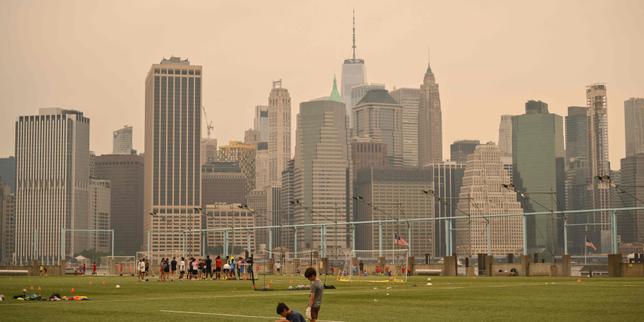
Instead, if you stand at the highest row of the upper deck and look up, the sky is the color of a bruised peach. The air tastes faintly of charred pine and spent campfires. Recently making news in related news: The Cost of a Banner.
Three thousand miles to the north, the boreal forests of Canada are burning. It is an annual tragedy that has turned into a predictable summer feature. But smoke does not recognize international borders. It does not respect tournament brackets. Driven by high-altitude winds, a massive plume of fine particulate matter has drifted down the Atlantic coast, settling over the sprawling concrete and steel of New Jersey like a heavy, invisible wool blanket.
For months, the conversation revolved around tactics. Analysts filled television hours debating how Spain’s midfield would neutralize Argentina’s iconic attack. Now, coaches and team doctors are looking at a completely different set of numbers. They are staring at the Air Quality Index, watching a tiny digital gauge fluctuate between yellow, orange, and red. Further insights regarding the matter are covered by Sky Sports.
The beautiful game is about to meet the raw, unscripted reality of a changing planet.
The Invisible Opponent on the Pitch
To understand what a high particulate count does to an elite athlete, you have to look past the optics of a hazy stadium. Soccer at this level is a game of fine margins. A single percentage point drop in oxygen efficiency can transform a brilliant, ninety-minute press into a desperate, leg-heavy defense.
Consider a player like Argentina’s veteran playmaker, navigating the twilight of an extraordinary career. His genius no longer relies on sprinting twenty miles an hour for the entire match. It relies on explosive bursts of acceleration, followed by moments of intense calculation. When the air is choked with PM2.5—particles thirty times smaller than a human hair—every deep breath introduces microscopic soot directly into the bloodstream.
The lungs react instantly. The bronchial tubes tighten in a protective reflex. For a person sitting on a couch, the effect might be a mild cough or itchy eyes. For a midfielder tracking a runner across sixty yards of open grass, it feels like trying to breathe through a wet towel.
The physiological cost accumulates as the clock ticks down. By the sixtieth minute, the heart must pump faster to deliver the same amount of oxygen to depleted thigh muscles. The brain, starved of clean air, loses a fraction of its processing speed. Pass accuracies drop. Decisions that normally take half a second now take a full second. In a World Cup final, a second is an eternity.
Spain’s medical staff has spent the week behind closed doors, reviewing data from previous sports tournaments held under similar conditions. They know that short-term exposure to wildfire smoke decreases an athlete's peak aerobic capacity. They have introduced specific hydration protocols and specialized warm-up routines designed to minimize lung irritation before the opening whistle blows. But no amount of preparation can completely isolate a human body from the atmosphere it relies on to survive.
The View from Row 84
Away from the pitch, the stakes are measured in human dreams and empty pockets.
Imagine a fan named Mateo. He is not a statistical construct; he is the embodiment of the millions who live and die by this sport. Mateo spent his life savings on a category-one ticket in the upper tiers of the stadium. He flew thirty hours from Buenos Aires, his jersey signed by his grandfather, his voice already hoarse from singing in the concourses of New York City.
For Mateo, the match is a sacred pilgrimage. But as he walks up the concrete ramp into the open air of the stadium, his throat begins to tickle. He rubs his eyes, which are watering from the acrid haze hanging beneath the massive video screens. He looks around and notices something strange. The bright red and blue jerseys in the crowd look muted, their colors stripped of vibrancy by the scattering of light through the overhead smoke layer.
The stadium lights are turned on hours ahead of schedule, cutting through the gloom like headlights in a dense fog.
Mateo does not care about atmospheric chemistry. He cares about glory. Yet, as he looks down at the tiny green rectangle below, the sheer scale of the event feels fragile. A multi-billion-dollar spectacle, the culmination of four years of global competition, is suddenly at the mercy of a wind shift in Ontario or Quebec.
The contrast is jarring. Below him are twenty-two millionaires, backed by corporate empires, playing a game of supreme physical mastery. Above them is a stark reminder that the modern world cannot build a dome big enough to shut out the environment.
The Logistical Nightmare in the Boardrooms
Behind the scenes, FIFA officials are huddled in temporary offices, surrounded by monitors showing real-time meteorological forecasts. They are trapped between two impossible choices.
On one hand, the financial and cultural momentum of a World Cup final is a massive, unstoppable train. Broadcasters across every time zone have scheduled their programming. Sponsors have invested hundreds of millions of dollars. Security apparatuses, transit authorities, and local businesses are locked into a rigid schedule. Postponing the match by even twenty-four hours would trigger a logistical cascade of cancellations, venue conflicts, and legal disputes.
On the other hand, player safety guidelines are clearer than they used to be. Modern sports governing bodies operate under strict thresholds for air quality. If the index crosses into the hazardous zone, the risk of acute respiratory distress, asthma attacks, and long-term lung inflammation skyrocketed.
Officials are checking the wind patterns every fifteen minutes. They are looking for a savior in the form of a cold front or a sea breeze from the Atlantic that might push the worst of the smoke plume out into the ocean.
The atmosphere is tense. Conversations are brief. The decision to play or delay is no longer just a sporting judgment; it is a public health calculation broadcast to a global audience of billions.
The Reality of the Modern Calendar
This is not the first time smoke has threatened a major sporting event, and it will not be the last. The international sports calendar is colliding with a lengthening wildfire season across the Northern Hemisphere.
Tennis players at the Australian Open have previously collapsed on court due to smoke from bushfires. Major League Baseball games have been called off in New York and Washington as skies turned an apocalyptic orange. But the World Cup final is different. It is the apex of global monoculture, the one moment where the entire planet looks at the exact same spot at the exact same time.
The irony is thick enough to choke on. The sport that unites the world is being disrupted by a phenomenon that also unites the world—the shared degradation of our climate.
As the players finally emerge from the tunnel, the roar of the crowd rises up, echoing through the hazy bowl of the stadium. The national anthems play, their notes sounding slightly flat in the heavy, humid, smoke-laden air. The cameras zoom in on the faces of the captains. They are focused, intense, but their eyes are blinking against the sting of the atmosphere.
The referee checks his watch. He places the ball on the center spot. The game will go on, because the world demands it, because the money demands it, and because the human spirit refuses to let a dirty sky ruin a beautiful moment.
But as the first pass is made, a truth hangs over the stadium, far more permanent than the scoreline. The match will eventually end. A trophy will be lifted. A champion will be crowned. But the smoke will still be there, drifting silently across the land, waiting for the next time we try to pretend that the games we play are separate from the world we inhabit.