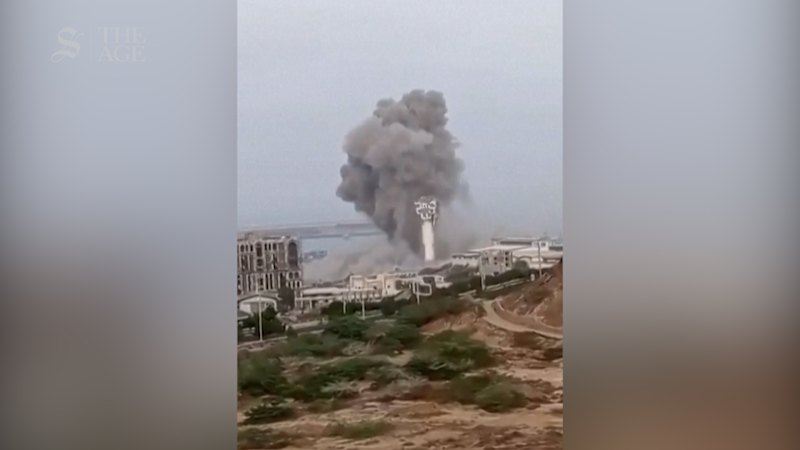
The thick black plume of smoke rising from the watchtower at Chabahar port is not just the aftermath of a missile strike. It is the funeral pyre of the short-lived April ceasefire. By targeting Iran’s only deep-water oceanic gateway, U.S. military strikes have shattered the fragile peace negotiated under the Islamabad Understanding. Shifting the theater of war from the bottleneck of the Strait of Hormuz to the open Gulf of Oman signals a drastic escalation that threatens to drag major regional powers, most notably India, into a dangerous maritime confrontation.
The strikes, executed under a mandate from the White House following a series of Iranian attacks on commercial vessels, mark a significant expansion of the geographical scope of the conflict. Overnight, U.S. Central Command systematically pounded maritime control structures, military installations, and communication arrays along Iran's southeastern coastline. The strategic implications are vast. While previous military engagements were confined to the immediate vicinity of Bandar Abbas, the assault on Chabahar proves that Washington is no longer willing to respect the geographic sanctuaries that Iran spent decades building to secure its eastern trade routes.
Shifting the Theater of War
The target was precise. A maritime control tower and concrete piers at the Shahid Kalantari facility were systematically reduced to rubble while nearby civilian cargo hubs were left physically undamaged. This surgical focus demonstrates a highly calculated message from Washington. For years, Western military planners treated the Strait of Hormuz as the primary flashpoint, a narrow chokepoint where Iranian fast-attack craft and naval mines could easily disrupt global oil flows. But Chabahar is different. It faces the open ocean, offering Iran a strategic alternative to bypass its own western vulnerabilities.
By striking this oceanic outpost, the United States has demonstrated that no Iranian port is safe from direct intervention. The logistical fallout inside Iran was instantaneous. Power grids across Sistan and Baluchestan province collapsed within minutes of the airstrikes, plunging the city of Chabahar into darkness as emergency services struggled to contain fires at the port facilities. By targeting the electrical infrastructure feeding military installations, U.S. forces effectively blinded local air defense radars before the main bombardment began. The Iranian military subsequently reported heavy damage to a barracks in nearby Bampur, resulting in several casualties among its personnel.
The peace is gone. After months of simmering hostility and shadow warfare in the Persian Gulf, the brief respite provided by diplomacy has evaporated under the heat of high-explosive ordnance.
The Fragile Ghost of Islamabad
Ceasefires are fragile things. The diplomatic framework negotiated in Pakistan last spring was designed to freeze direct military action while giving regional diplomats room to negotiate a broader maritime security pact. It failed almost immediately. Tehran’s reliance on irregular warfare in the shipping lanes proved too tempting to abandon, leading to the current retaliatory campaign that has completely neutralized the diplomatic progress made in Pakistan.
The collapse of the truce reveals the fundamental disconnect between Iranian diplomatic posturing and its internal military reality. While government spokespersons in Tehran continue to appeal to the international community for a return to negotiation, the Islamic Revolutionary Guard Corps has consistently worked to undermine the agreement by deploying anti-ship missiles to coastal outposts and harassing oil tankers. The U.S. response was swift and uncompromising, consisting of more than eighty coordinated strikes aimed at eroding Iran's coastal defense architecture. The destruction at Chabahar is the most visible sign that the United States is no longer willing to accept a double standard where Tehran enjoys the economic benefits of a ceasefire while actively funding maritime disruption.
India's Collateral Nightmare in the Gulf of Oman
New Delhi is watching closely. For India, Chabahar is not merely a foreign harbor; it is a multi-million-dollar gateway designed to bypass land routes through Pakistan to trade directly with Central Asia. Under a long-term agreement signed with Tehran, state-backed Indian entities have spent years building out the terminal infrastructure at the nearby Shahid Beheshti port. The explosions on Tuesday night occurred just miles from these Indian-operated facilities.
While Indian assets were not directly targeted, the immediate consequence of the strike is the freezing of commercial confidence. Insurance rates for vessels entering the Gulf of Oman have already surged to prohibitive levels, rendering the entire trade corridor functionally useless for the foreseeable future. Indian policymakers now face an agonizing dilemma. They must either abandon their premier geopolitical project in the Middle East or risk defying Washington by continuing to operate in an active war zone. The diplomatic balancing act that India has maintained between Washington and Tehran for over a decade is no longer sustainable when bombs are falling on the very docks they helped finance.
Economic Strangulation and the Threat of Total War
The missiles were only the beginning. Alongside the aerial bombardment, U.S. Central Command has reimposed a strict naval blockade on all vessels entering or leaving Iranian ports. This represents a return to a policy of maximum economic strangulation. Iran’s Revolutionary Guard has already countered with its own threats to disrupt energy exports across the region, warning that oil and gas flows will be secured for all or none.
It is a dangerous game of chicken. If the blockade holds, Iran’s economy, already suffering from severe inflation and domestic unrest, faces near-total isolation. If Tehran retaliates by mining the Gulf of Oman, the conflict will spill over into a global energy crisis. The smoke rising over Chabahar is a warning that the window for a diplomatic exit is rapidly closing.
Times Now report on the Chabahar airstrike
This video is highly relevant as it captures the immense scale of the destruction at the Shahid Kalantari facility, showing the massive black smoke plumes that rose immediately following the targeted airstrikes.