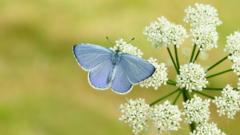
The mainstream media is currently awash with celebratory headlines declaring that Britain is on track for a "bumper year" for butterflies. Warm spring weather and a few timely showers have triggered a visible surge in common garden species, sending nature columnists into a frenzy of optimistic cheerleading. They want you to believe that a sudden flurry of colorful wings in your backyard means nature is healing.
It isn't. It is a optical illusion masking a collapsing baseline.
Celebrating a single boom season for butterflies is like cheering a sudden spike in a failing company’s stock price right before bankruptcy. It ignores the structural decay underneath. The lazy consensus among casual observers is that more butterflies equals a healthier environment. In reality, these sudden, volatile population spikes are often symptoms of an ecosystem losing its balance, driven by climate chaos rather than genuine ecological recovery.
The Myth of the Butterfly Boom
Every few years, the UK experiences what the media loves to call a "butterfly bonanza." The mechanism is entirely predictable: a specific, localized alignment of early warmth and high humidity creates a temporary abundance of larval food plants. Species like the Peacock (Aglais io) or the Small Tortoiseshell (Aglais urticae) experience a massive, synchronized emergence.
But a temporary surge in numbers is not the same as a population recovery.
Data from the UK Butterfly Monitoring Scheme (UKBMS)—run by Butterfly Conservation and the UK Centre for Ecology & Hydrology—paints a starkly different picture. Over the last five decades, 80% of UK butterfly species have declined in abundance, distribution, or both. When you look at the long-term trend line, a single "bumper year" is nothing more than a statistical blip on a downward trajectory.
Worse, these massive population spikes are frequently followed by catastrophic crashes. When a massive generation of caterpillars strips its host plants bare, the subsequent generation faces starvation. A hyper-concentrated population also becomes an all-you-can-eat buffet for parasites and predators, leading to a severe population collapse the following year.
The Climate Disruption Whiplash
The premise of the "good news" story relies on a flawed understanding of insect phenology. Butterflies are ectotherms; their entire life cycle is dictated by temperature. Warmer springs cause them to emerge earlier in the year.
This sounds positive on the surface, but it creates a devastating phenomenon known as ecological mismatch.
Butterflies do not exist in a vacuum. They rely on specific nectar sources, and their caterpillars rely on specific host plants. When unseasonably warm weather forces butterflies to emerge weeks ahead of schedule, they often arrive before their critical food plants have flowered or leafed out.
Imagine a scenario where millions of Peacock butterflies emerge in early April instead of late May, only to find that the local flora hasn't caught up. They starve. Or consider the reverse: the caterpillars hatch and consume the vegetation before it can mature, destroying both the plant and their own future food supply.
Furthermore, the same mild winters that trigger early emergences also disrupt the overwintering diapause of these insects. Instead of staying safely dormant, butterflies wake up during brief winter warm spells, burning through their precious fat reserves with no food available to replenish them. They die of exhaustion before spring even officially arrives.
The Habitat Lie: Why Gardens Won't Save Us
Look at the species driving these "bumper year" headlines. It is almost always generalist, highly mobile species: the Large White, the Small White, the Red Admiral, and the Peacock. These are the weeds of the butterfly world. They are highly adaptable, can feed on a wide variety of common plants (like nettles and cabbages), and can comfortably navigate the fragmented green spaces of suburban Britain.
The media points to a swarm of Peacocks on a garden buddleia bush and declares victory for conservation. This is a dangerous distraction from the real tragedy unfolding in the wider countryside.
While generalist species can ride the waves of climate volatility, specialist butterflies—those that require specific, undisturbed habitats like ancient woodlands, chalk grasslands, or peat bogs—are quietly vanishing. Species like the Duke of Burgundy (Hamearis lucina), the High Brown Fritillary (Argynnis adippe), and the Wood White (Leptidea sinapis) do not care about your garden. They cannot survive on buddleia. They require precise microclimates and complex, undisturbed plant communities that take centuries to form.
By focusing on the highly visible abundance of a few resilient species, we ignore the silent extinction of the specialists. We are trading a rich, complex tapestry of biodiversity for a homogenized monoculture of a few tough survivors.
Dismantling the "People Also Ask" Narrative
When people notice more butterflies, their immediate instinct is to look for confirmation that they are doing the right thing. The questions flooding search engines during these boom periods reflect a deep desire for simple, feel-good solutions.
"Are butterflies recovering in the UK?"
No. They are adapting in the short term while collapsing in the long term. Do not confuse a temporary weather-driven spike with habitat restoration. Until we fix the underlying systemic issues—intensive agriculture, pesticide overuse, and fragmented landscapes—any increase in numbers is temporary.
"How can I help butterflies in my garden?"
Stop buying commercial "butterfly-friendly" wildflower seed mixes that are often packed with non-native species, and stop obsessing over manicured lawns. If you want to actually help, let a patch of your garden go entirely wild with native nettles, brambles, and ivy. More importantly, recognize that your garden is a first-aid kit, not a hospital. The real battle is won or lost in agricultural policy, not suburban backyards.
"Why are there so many butterflies this year?"
Because the weather patterns of the last six months happened to favor the larval stage of a few aggressive, generalist species. It is a weather event, not a conservation success story.
The Harsh Reality of Conservation
I have spent years analyzing ecological data and watching funding pour into superficial environmental initiatives that achieve nothing but good public relations. Companies love to sponsor "wildflower meadows" that look beautiful for a summer photo-op but lack the structural complexity to support long-term insect populations.
The truth is uncomfortable: real conservation is ugly, expensive, and slow. It requires stopping the expansion of housing developments into critical habitats. It requires forcing the agricultural sector to drastically reduce pesticide use, which impacts crop yields and food prices. It requires rewilding massive tracts of land, removing them from economic production entirely.
It is much easier for politicians and corporations to point at a "bumper year" for butterflies, credit their own vague green initiatives, and tell the public to keep planting lavender in their window boxes. It shifts the burden of responsibility from systemic failures to individual consumer choices.
Change Your Lens
Stop looking at nature through the lens of a single season. A sudden influx of butterflies in your yard shouldn't evoke comforting thoughts about the resilience of nature. It should make you ask hard questions about what is happening to the species you don't see.
When the sun shines and the garden is full of wings, enjoy the view, but do not buy into the narrative that the crisis is over. The insects are running out of time, and celebrating a temporary boom is just another way of looking away from the crash.