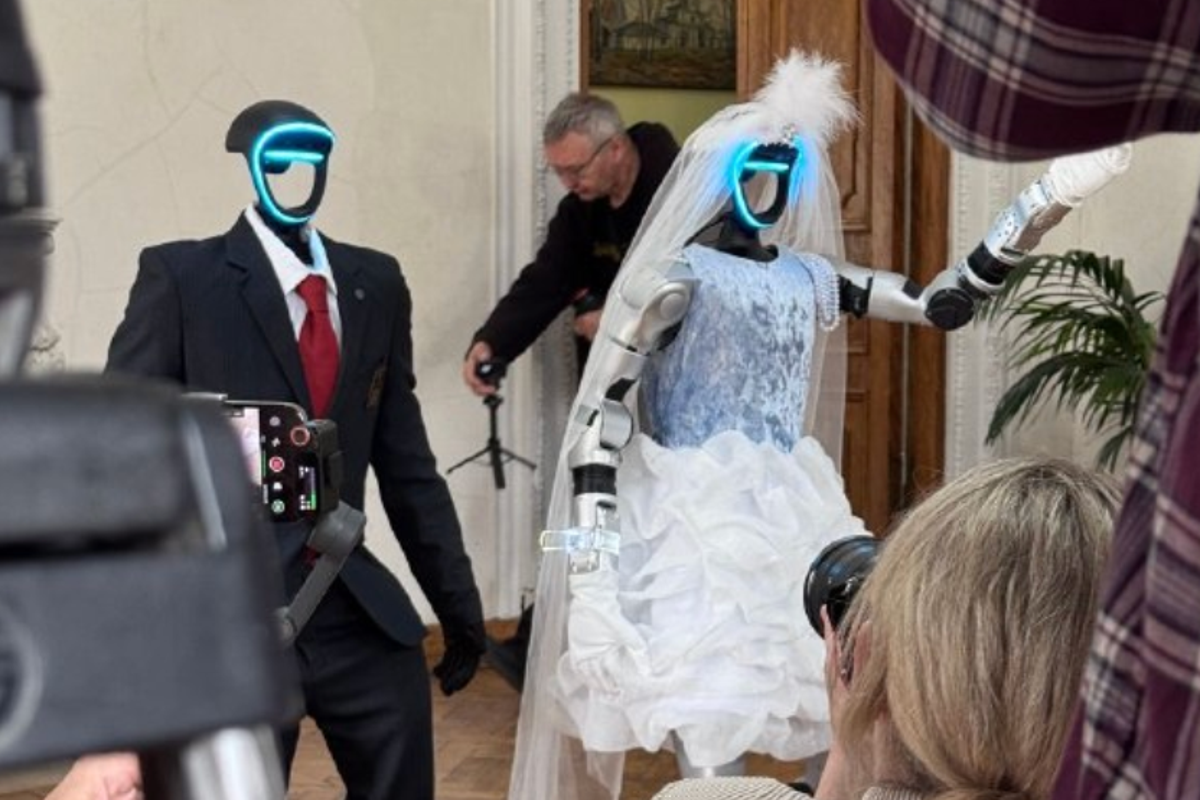
A promotional event featuring two humanoid robots performing a mock marriage ceremony in Russia has captured brief internet attention, but the spectacle masks a harsher reality about the current state of automation and regional tech industries. Beyond the viral headlines of mechanical vows and formal wear lies a calculated public relations exercise designed to distract from deep supply chain isolation and stagnant software development.
The demonstration, while amusing on a superficial level, serves as a stark reminder of the gap between genuine artificial intelligence breakthroughs and superficial robotics theater.
The Mechanics of a Marketing Stunt
The viral event featured two bipedal machines programmed to mimic human wedding rituals. Observers watched as the units exchanged simulated vows, a sequence coordinated entirely through pre-scripted automation rather than autonomous decision-making.
This was not an achievement in machine learning. It was a highly choreographed puppet show.
True humanoid advancement requires real-time environmental processing, dynamic balance adjustment, and adaptive natural language understanding. The machinery on display in Russia relied on deterministic tracks—pre-recorded audio files triggered by a central operator, synchronized with basic servo-motor movements. When a machine raises its hand to place a ring on another metallic finger, it is executing an absolute coordinate command programmed days in advance. If the target hand moves even two centimeters out of alignment, the illusion shatters.
The technical specifications of the models involved reveal a heavy reliance on older, commercially available electronic components rather than proprietary, next-generation hardware. Observers noted that the fluid movement seen in leading international labs was entirely absent. Instead, jerky pneumatic actuation and stiff joint articulation defined the ceremony.
Sanctions and the Component Crisis
To understand why regional robotics companies resort to public relations stunts, one must analyze the severe supply chain constraints currently crippling the domestic tech sector. Decades of reliance on Western microprocessors, precision actuators, and specialized sensors have come to an abrupt halt due to international trade restrictions.
Building a functional humanoid requires specific, high-end hardware that cannot be easily replicated or sourced through secondary markets.
- High-Torque Density Motors: Essential for fluid, human-like movement, particularly in the hips and knees.
- Harmonic Drive Reducers: Precise gear mechanisms that allow robots to move smoothly without backlash.
- Advanced LiDAR and Depth Sensors: The vision systems required for a machine to safely navigate unmapped spaces.
Without access to these specific components, developers are forced to cannibalize existing consumer hardware or turn to lower-grade alternatives that compromise the machine's center of gravity and operational lifespan. The result is a regression in capability. Engineers find themselves building machines that look like the future but possess the internal processing power and physical agility of industrial machinery from twenty years ago. The wedding dress and the tuxedo are simply clever ways to hide the unrefined, bulky chassis underneath.
The Mirage of Autonomous Progress
The broader tech industry frequently utilizes anthropomorphism—the attribution of human traits to non-human entities—to inflate corporate valuations and secure government subsidies. When an organization dresses a machine in human attire, it triggers an instinctual emotional response from the public. People project intent, emotion, and intelligence onto a collection of aluminum and copper.
This projection is dangerous because it distorts public understanding of what automation can actually achieve. A machine does not know what marriage is. It does not feel affection, nor does it understand the cultural weight of the ceremony it is mimicking. It is executing a loop.
WHILE ceremony_active == TRUE:
    Execute joint_movement_sequence_3
    Play audio_track_b
    IF ring_placed == TRUE:
        TERMINATE loop
When contrasted with actual industrial needs, the absurdity of the display becomes clear. Regional manufacturing plants, logistics hubs, and agricultural sectors desperately need basic, reliable automation to combat severe labor shortages. They require autonomous forklifts, automated sorting arms, and ruggedized drone harvesters. They do not need a bipedal machine that can wear a veil but falls over when confronted with an uneven concrete floor.
Funding Illusions in Restricted Economies
In isolated economic ecosystems, venture capital behaves differently than it does in open global markets. Capital cannot easily flow to international startups, forcing domestic investors to allocate funds within a highly restricted local pool. This creates an environment ripe for superficial showmanship.
Robotics startups must constantly validate their existence to state backers and private investors who may lack deep technical literacy. A flashy, media-friendly event generates immediate press clippings, which can be presented as proof of progress during quarterly reviews. It creates the illusion of parity with global tech hubs, suggesting that local engineers are keeping pace with advancements happening in Silicon Valley or Tokyo.
The data tells a completely different story. Global robotics benchmarks focus on metrics like mean time between failures, payload-to-weight ratios, and dynamic balance recovery under external force. The entities behind the mock wedding have released zero peer-reviewed data or open-source code repositories validating their hardware's performance under these standard testing conditions.
The Engineering Realities of Humanoid Motion
Achieving stable bipedal locomotion remains one of the most complex engineering challenges in existence. Human beings utilize a complex network of muscles, tendons, and inner-ear fluid to maintain balance sub-consciously. Replicating this through sensors and actuators requires immense computational power and real-time physics calculations.
When a robot stands still during a scripted ceremony, it is often locked into a rigid framework or subtly supported by hidden tethers. The real test of a humanoid is its ability to adapt to unexpected resistance. If a human pushes a true next-generation robot, the machine's algorithms calculate the force and adjust its foot placement to prevent a fall. The models showcased in the viral Russian video lack the sensory feedback loops required for such dynamic compensation. They operate on a flat, controlled stage because any deviation in the surface would result in a catastrophic mechanical failure.
The reliance on pre-rendered environments and scripted actions proves that these machines are closer to theme park animatronics than true autonomous entities. The distinction is critical for investors and policymakers to understand, as confusing animatronics with advanced robotics leads to misallocated resources and failed industrial strategies.
Behind the Soft Power Play
There is a distinct geopolitical element to these public demonstrations. Technology has long been used as an instrument of soft power, a way for nations to project capability and modernity to the rest of the world. By staging a futuristic event, the organizers attempt to signal resilience against economic pressures.
The narrative they want to project is simple: despite isolation, innovation continues unabated.
However, the global tech community sees through the facade. True innovation cannot be faked with a wedding cake and a ring exchange. It is measured in semiconductor fabrication capabilities, software ecosystem depth, and the retention of top-tier engineering talent. As long as talented programmers and hardware engineers continue to leave the region seeking better opportunities and access to global tools, the local industry will remain limited to producing novelties rather than world-changing infrastructure.
The survival of any regional robotics sector depends on moving past these theatrical displays. Engineers must focus on solving boring, difficult problems—like improving battery efficiency, reducing joint friction, and writing more efficient localized control loops—rather than designing outfits for mechanical brides. The internet will move on to the next viral video tomorrow, leaving the creators of the stunt with the exact same unresolved hardware limitations they faced before the cameras started rolling.