The rapid regulatory clearance of Unitree Robotics for its initial public offering on Shanghai’s STAR Market is being framed as a triumph for embodied artificial intelligence. On June 1, 2026, the Shanghai Stock Exchange approved the Hangzhou-based company's listing application in a blistering 73 days. Unitree aims to raise 4.2 billion yuan ($583 million), targeting a valuation that could reach $7 billion.
But this lightning-fast approval exposes a deeper, more aggressive economic calculation. Beijing is deliberately bypassing standard capital market hesitation to force a massive hardware industry into existence. As public money pours in, a sobering reality remains. While Unitree boasts a 335% revenue surge to 1.71 billion yuan in 2025 and rare sector profitability of 288 million yuan, the global market for humanoid bipedal machines is facing an engineered supply glut before the commercial demand even exists.
The Illusion of Corporate Self Sufficiency
Most early-stage robotics companies operate as cash-incinerating laboratories. Unitree appears to break this mold. It shipped over 5,500 humanoid units last year, capturing a reported 32% of the global market. Its core financials look stellar on paper, showing gross profit margins hovering around 60%.
The financial health of the sector changes under closer scrutiny. A significant portion of this explosive revenue growth does not stem from recurring industrial enterprise deployments. It comes from heavily subsidized academic laboratories, state-backed research institutes, and strategic showcase purchases by automotive giants like BYD and Geely. These companies are politically and financially incentivized to seed the domestic supply chain.
Unitree Financial Trajectory (In Yuan)
Year    Revenue         Net Profit/Loss
2022    123 Million     -22.1 Million
2023    159 Million     -11.1 Million
2024    392 Million     +94.5 Million
2025    1.71 Billion    +288.0 Million
This is a classic top-down industrial build-out. By clearing Unitree’s IPO path in record time, regulators are shifting the financial burden from primary venture capital to public equity markets. This move puts immediate pressure on older competitors like UBTech Robotics, whose shares on the Hong Kong Stock Exchange fell over 30% from their recent peak as investors rotated capital toward the newest government-favored player.
Deflationary Robotics and the Price War
Unitree is pursuing a familiar playbook. Become the DJI of humanoids by weaponizing vertical integration and aggressive price deflation. The company’s G1 humanoid robot launched at a starting price of roughly $16,000. For context, Western competitors design units meant to retail for five to ten times that amount.
This aggressive pricing strategy is achieved through brutal supply-chain proximity. Hangzhou and the surrounding Yangtze River Delta hold a dense concentration of precision gear manufacturers, lithium battery plants, and sensor fabricators. Unitree designs its own actuators, cycloidal reducers, and dexterous hands in-house.
But this extreme cost-cutting brings clear technical compromises.
- Reduced Component Longevity: Cheaply manufactured harmonic drives wear out significantly faster under continuous industrial loads.
- Torque Trade-Offs: Lower production costs mean less sophisticated rare-earth magnets, limiting the sustained lifting capacity of the limbs.
- Thermal Bottlenecks: Inexpensive housing and basic cooling systems cause rapid heat buildup during prolonged operational cycles.
Western robotics firms are optimizing for premium, high-reliability niches. Chinese firms are actively flooding the market with minimum viable hardware. They are betting that software updates will eventually compensate for physical limitations.
The Shift to Edge AI and the Silicon Moat
The capital raised from the STAR Market listing is earmarked for hardware manufacturing plants and intelligent robot model research. This investment targets the true bottleneck of embodied AI: latency and autonomous decision-making.
A robot cannot rely on cloud computing to decide where to place its foot when a factory floor surface shifts unexpectedly. The processing must happen locally. This technical constraint has triggered a parallel race to control the silicon that powers these machines.
As Unitree moves toward its public debut, UBTech responded by forming a joint venture called Xixuan Chuangzhi Technology with graphics processor developer MetaX and component supplier Zhejiang Fenglong Electric. Their goal is to build specialized edge chips engineered purely for the matrix mathematics required by embodied AI.
+-------------------------------------------------------------+
|               The Embodied AI Compute Loop                  |
+-------------------------------------------------------------+
|  [Sensors/LiDAR] -> [Specialized Edge Silicon] -> [Actuator]|
|  (Raw Data)         (Local Matrix Math)           (Movement)|
|                                                             |
|  *Zero reliance on cloud networks ensures sub-millisecond   |
|   reaction times required for physical balance.             |
+-------------------------------------------------------------+
Unitree must now use its 4.2 billion yuan war chest to match this semiconductor integration. If it fails to develop or secure proprietary, low-power edge silicon, its low-cost hardware will become obsolete as software models grow larger and more demanding.
Retail Spaces and the Consumer Mirage
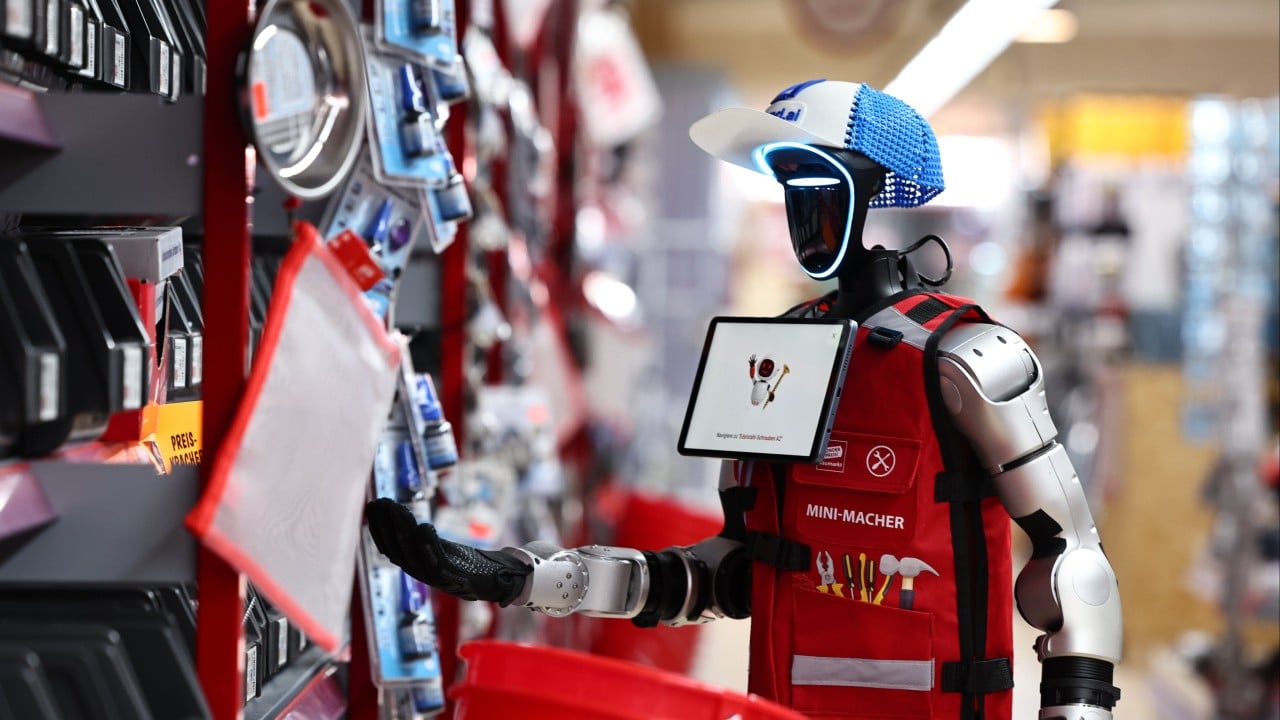
On May 31, 2026, Unitree opened its flagship Embodied Intelligence Experience Hall inside the Jiuguang Department Store on Shanghai’s luxury West Nanjing Road. The showroom displays the G1 and R1 humanoids alongside consumer robot dogs, allowing shoppers to interact with and purchase bipedal machines directly.
This retail push is high-stakes marketing masquerading as consumer distribution. A multi-thousand-dollar bipedal machine remains a novelty for the general public, lacking the clear utility of a smartphone or a vacuum drone.
The immediate economic future of these machines lies in dirty, dangerous, and repetitive industrial labor, not high-end shopping malls. Automakers are currently integrating humanoids into logistics loops to move sub-assemblies and conduct quality inspections. The consumer flagship store serves primarily as an expensive branding tool to inflate retail investor enthusiasm ahead of the IPO ticker launch.
Building a hardware empire on public capital requires clear, sustained industrial adoption. The rapid 73-day regulatory approval solved Unitree's liquidity constraints, but it did not solve the foundational engineering problem. Stripping cost out of a humanoid robot is meaningless if the machine lacks the physical reliability to survive a standard eight-hour factory shift without manual intervention.