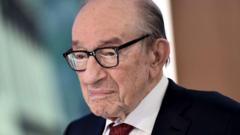
Alan Greenspan is dead at 100. For nearly two decades, he was the closest thing the global financial system had to a living deity. As the Chairman of the Federal Reserve from 1987 to 2006, he did not just manage the American economy. He rewired its fundamental psychology.
He was celebrated as the "Maestro," a technocratic genius who engineered the longest economic expansion in American history during the 1990s. Wall Street worshipped him. Washington deferred to him. Yet, as the dust settles on a century of life, the legacy of Alan Greenspan remains heavily scarred by the catastrophic financial collapse of 2008—a crisis built directly upon the foundation of his deepest ideological convictions.
Understanding the modern American economy requires dissecting the Greenspan era. It requires looking past the glossy magazine covers of the late nineties and examining the specific, highly deregulated financial architecture he left behind.
The Power of the Briefcase
To understand Greenspan's power, you have to understand how markets operated during his prime. There was a time when financial analysts literally measured the thickness of his briefcase as he walked into Federal Open Market Committee meetings. A thick briefcase meant he was carrying heavy data, which the street interpreted as a sign he might raise interest rates. A thin briefcase meant the status quo. It was economic divination.
This level of obsession was entirely rational. Greenspan possessed an unprecedented ability to soothe markets. He assumed control of the Federal Reserve in August 1987. Two months later, "Black Monday" wiped out over 20 percent of the stock market's value in a single trading session. Greenspan immediately flooded the system with liquidity, declaring the Fed stood ready to serve as a source of support.
The market recovered. The panic subsided. And a dangerous precedent was quietly established.
Wall Street learned a lesson that day. They learned that the Federal Reserve, under Greenspan, would act as a universal shock absorber. This became known on trading floors as the Greenspan Put. A "put" is an options contract that limits an investor's downside risk. The Greenspan Put was not a formal policy, but an implicit guarantee. Investors realized that if they took massive risks and succeeded, they kept the profits. If they took massive risks and the market collapsed, Greenspan would slash interest rates and print enough money to bail them out.
Privatized gains. Socialized losses. The structural incentive for reckless speculation was born.
The Objectivist in the Central Bank
Greenspan was not a standard-issue bureaucrat. His approach to monetary policy was deeply rooted in a specific philosophical worldview. In his younger years, he was a member of Ayn Rand’s inner circle. He contributed to her newsletters and absorbed the core tenets of Objectivism, which argued that rational self-interest and totally unregulated markets were the ultimate moral and economic ideals.
Even as he aged and integrated into the Washington establishment, that foundational belief in the self-correcting nature of free markets never truly left him. He genuinely believed that financial institutions were capable of regulating themselves.
The logic seemed flawless on a whiteboard. Why would a Wall Street bank engage in behavior that would destroy its own wealth?
Because of this deeply held belief, Greenspan became the ultimate champion of financial deregulation. Throughout the 1990s, the banking lobby pushed relentlessly to dismantle the Glass-Steagall Act, a Depression-era law that separated commercial banking from investment banking. Greenspan supported the repeal. It was signed into law in 1999. The walls came down. Retail bank deposits were suddenly merged with high-risk investment portfolios, creating massive "too big to fail" conglomerates.
The Clash Over Derivatives
The most tragic chapter of Greenspan’s tenure was his battle against the regulation of over-the-counter derivatives. It is here that his legacy suffers its most severe blows.
In the late 1990s, a lawyer named Brooksley Born took over the Commodity Futures Trading Commission. She looked at the rapidly expanding market for complex financial derivatives—specifically credit default swaps—and grew alarmed. These instruments were entirely opaque. They were traded in the dark, with no central clearinghouse and no requirement for institutions to disclose how much risk they were taking on.
Born proposed a simple concept. She wanted to bring these derivatives out of the shadows and subject them to basic regulatory oversight.
Greenspan mobilized immediately to crush her proposal. He allied with Treasury Secretary Robert Rubin and SEC Chairman Arthur Levitt to block the CFTC from acting. Greenspan argued that regulating derivatives would stifle financial innovation. He insisted that the banks trading these complex instruments were sophisticated enough to manage their own counterparty risks.
Congress listened to the Maestro. Born resigned in warning. The derivatives market exploded from a niche financial tool into a multi-trillion-dollar web of hidden liabilities.
Less than a decade later, it was precisely these unregulated, opaque credit default swaps that brought the global banking system to the edge of total annihilation. When the housing market cracked, nobody knew which banks held the toxic derivatives. The trust evaporated overnight, credit markets froze, and the global economy went into cardiac arrest.
The Flaw in the Architecture
Greenspan retired from the Federal Reserve in 2006, handing the reins to Ben Bernanke. The timing was remarkable. He left the stage exactly as the music was preparing to stop.
The housing bubble of the mid-2000s was the direct result of Greenspan's response to the dot-com crash in 2001. To soften the blow of the tech sector's collapse, Greenspan slashed the federal funds rate to 1 percent and kept it there for a year. It was an unprecedented flood of cheap money.
Capital naturally sought higher returns. It found them in real estate. Adjustable-rate mortgages, subprime lending, and no-documentation loans flourished in an environment where credit was virtually free and regulatory oversight was essentially non-existent. When warned about a housing bubble, Greenspan dismissed the concerns. He argued that central banks could not identify bubbles while they were happening, and that the best course of action was simply to clean up the mess afterward.
In October 2008, a retired Alan Greenspan was called before the House Committee on Oversight and Government Reform. The global economy was collapsing around him. The very institutions he claimed would protect their own shareholders were begging for taxpayer bailouts to survive.
Representative Henry Waxman pushed him on his ideology. Waxman asked if Greenspan had found a flaw in his worldview.
Greenspan's answer was the most defining moment of his public life. He admitted that he had found a flaw. He confessed that his belief that self-interest would protect banking institutions from destroying themselves was wrong. The intellectual foundation he had built his career upon had crumbled.
It was a moment of stunning candor for a public official. But for the millions of Americans losing their homes, their jobs, and their retirement savings, the Maestro's intellectual epiphany was completely useless.
The Enduring Addiction to Cheap Money
The most profound tragedy of Alan Greenspan is not that he made mistakes. Central banking is an imprecise science, and economic environments shift unpredictably. The tragedy is that his specific brand of monetary policy became a permanent addiction for the global economy.
Before Greenspan, central bankers viewed their role as the adult in the room. As former Fed Chair William McChesney Martin famously put it, the Fed's job was to "take away the punch bowl just as the party gets going." The goal was to prevent inflation and ensure stable, boring growth.
Greenspan spiked the punch bowl. He redefined the Federal Reserve as a market-support mechanism.
When the 2008 crisis hit, the Fed had no choice but to double down on the Greenspan playbook. They dropped rates to zero and initiated quantitative easing, buying up trillions of dollars in assets. When the COVID-19 pandemic triggered a shutdown in 2020, the Fed intervened with even more aggressive money printing.
The American economy is now completely dependent on the financial architecture Alan Greenspan designed. We live in an era where asset prices are entirely detached from underlying economic realities, driven instead by the expectation of central bank liquidity.
Every Federal Reserve chair who has followed him—Bernanke, Yellen, Powell—has been trapped by the same market expectations he engineered. They are all still operating inside the Greenspan Put. He built a machine that runs entirely on the promise of a bailout, and we are simply waiting for the day it finally breaks entirely.