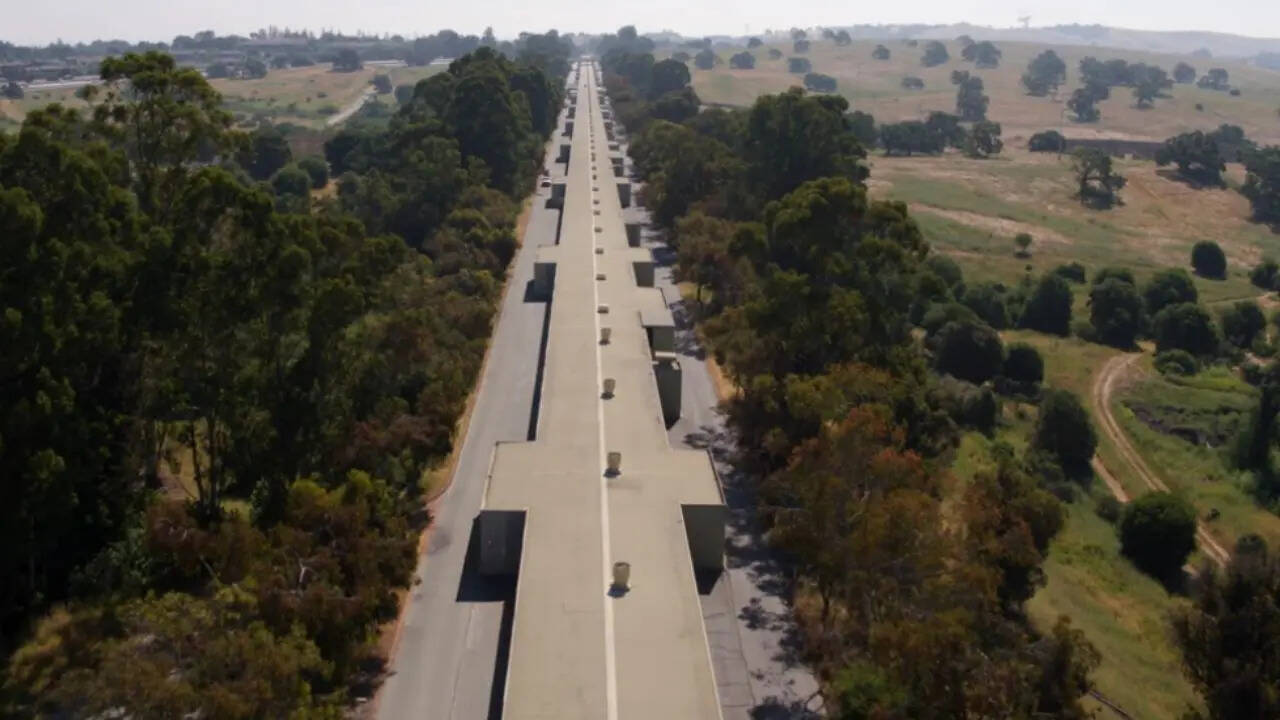
The longest linear accelerator in the world sits beneath the rolling hills of Menlo Park, California, cutting a path so stubbornly flat that the planet itself curves away beneath it.
To the casual observer, the Klystron Gallery at the SLAC National Accelerator Laboratory looks like a triumph of minimalist architecture. It is a concrete corridor stretching exactly 3,073.72 meters—nearly two miles—without a single bend, curve, or deviation. Walking its length takes roughly 40 minutes of monotonous, perspective-bending steps. But treating this structure as a mere architectural curiosity misses the point entirely. The gallery above, and the beamline buried 30 feet below it, represent a violent, ongoing battle against geological reality and the curvature of the Earth. Don't forget to check out our earlier post on this related article.
Building something perfectly straight over a distance of two miles is theoretically simple but practically impossible. The engineers who broke ground on what was originally called "Project M" in the 1960s faced a brutal paradox. If they used a standard surveyor’s level to build the facility, the accelerator would follow the natural curvature of the Earth. Over two miles, that curve accounts for a drop of roughly 24 inches from the center to the ends.
For a high-energy electron beam traveling at 99.9999999% the speed of light, a two-foot deviation is catastrophic. The particles would simply slam into the copper walls of the accelerator pipe within microseconds. To make the machine work, SLAC had to be built completely detached from the Earth's geometry. It had to be straight in a universe that bends. To read more about the history of this, Gizmodo offers an in-depth breakdown.
The Laser in the Light Pipe
The solution to this alignment nightmare was an engineering gamble that had never been attempted on this scale.
Instead of relying on traditional mechanical surveying, the team invented a laser alignment system that remains a masterclass in foundational physics. Underneath the accelerator sits a 24-inch diameter steel support girder that also functions as an evacuated light pipe. At one end, a helium-neon laser projects a point source of light down the entire two-mile stretch.
Along the pipe, 296 distinct retro-reflective Fresnel targets are mounted on hinges. Operators can drop these targets into the line of sight one by one. If the beamline shifts even a fraction of a millimeter, the laser spot hits the target off-center, alerting technicians to the precise location of the distortion.
[Laser Source] -------------------> [Fresnel Target] -----------> [Detector]
                                          |
                                    (Flipped down
                                   to check alignment)
This system bypasses the atmosphere entirely. Because air changes density with temperature and pressure, firing a laser through a two-mile open corridor would cause the beam to refract, dance, and distort. By pulling a vacuum of 10 to 25 torr inside the alignment pipe, SLAC wiped out atmospheric interference completely. The laser travels through a void, providing an unyielding, absolute reference point.
Fighting the Active Crust
But achieving alignment is only half the battle. Maintaining it in California is an exercise in futility.
The SLAC facility runs perpendicular to the San Andreas fault system, cutting through a mosaic of unstable claystone, sandstone, and active tectonic tilt. The ground is constantly breathing, warping, and shifting. Heavy winter rains swell the soil, lifting segments of the tunnel. Summer droughts cause the earth to shrink and drop. Even the daily thermal cycle—the simple expanding and contracting of the above-ground Klystron Gallery as the California sun beats down on its roof—tears at the structural integrity of the machine.
To counter this relentless motion, the entire two-mile system is adjustable. The 101-foot long girder segments do not sit rigidly on concrete pillars. Instead, they rest on heavy-duty mechanical jacks.
Every few months, alignment crews use the laser system to map the microscopic warps that have accumulated along the line. They then manually turn the jacks, physically hoisting or lowering sections of the two-mile tube to bring the path back to an accuracy of within less than a millimeter. It is a Sisyphean task. The moment the crew finishes leveling the far end of the pipe, the front end has already begun to drift.
The Power Behind the Beam
The monotony of the above-ground gallery belies the sheer violence of the energy being funneled into the earth below.
Spaced at regular intervals along the 40-minute walk are more than 130 klystrons. These are not passive pieces of lab equipment; they are specialized, high-power vacuum tubes that serve as the microwave amplifiers for the accelerator. Each klystron generates pulses of radiofrequency energy roughly 60,000 times more powerful than a standard kitchen microwave.
- The Mechanism: Klystrons convert a continuous stream of electrons into high-velocity bunches using a series of resonant cavities.
- The Delivery: This amplified microwave energy is fed directly down through the floor via copper waveguides into the underground accelerator pipe.
- The Capture: Inside the main accelerator, the electrons ride these microwave pulses like a surfer catching an ocean wave, gaining massive energy over every foot of the two-mile journey.
Originally built to smash particles together and probe the fundamental building blocks of matter—a process that yielded three Nobel Prizes, including the discovery of the charm quark and the tau lepton—the linac has transitioned to a different kind of extreme physics.
Today, a portion of the original accelerator drives the Linac Coherent Light Source (LCLS). Instead of smashing electrons into targets, the machine forces them through a series of alternating magnets called undulators. This violent, slalom-like maneuvering forces the electrons to emit incredibly bright, ultra-fast X-ray laser pulses.
These X-rays allow scientists to take snapshots of chemical reactions occurring at the attosecond scale, effectively creating stop-motion movies of molecular bonds breaking and forming in real time.
The Myth of Permanent Infrastructure
The Klystron Gallery is a stark reminder that high-end experimental physics cannot exist in a vacuum of ideal conditions.
Every piece of data gathered by modern researchers at SLAC relies on the fact that an army of engineers figured out how to ignore the horizon, pump a vacuum through a two-mile steel tube, and manually wrestle the California crust into submission. The straight line never curves because humans refuse to let it.