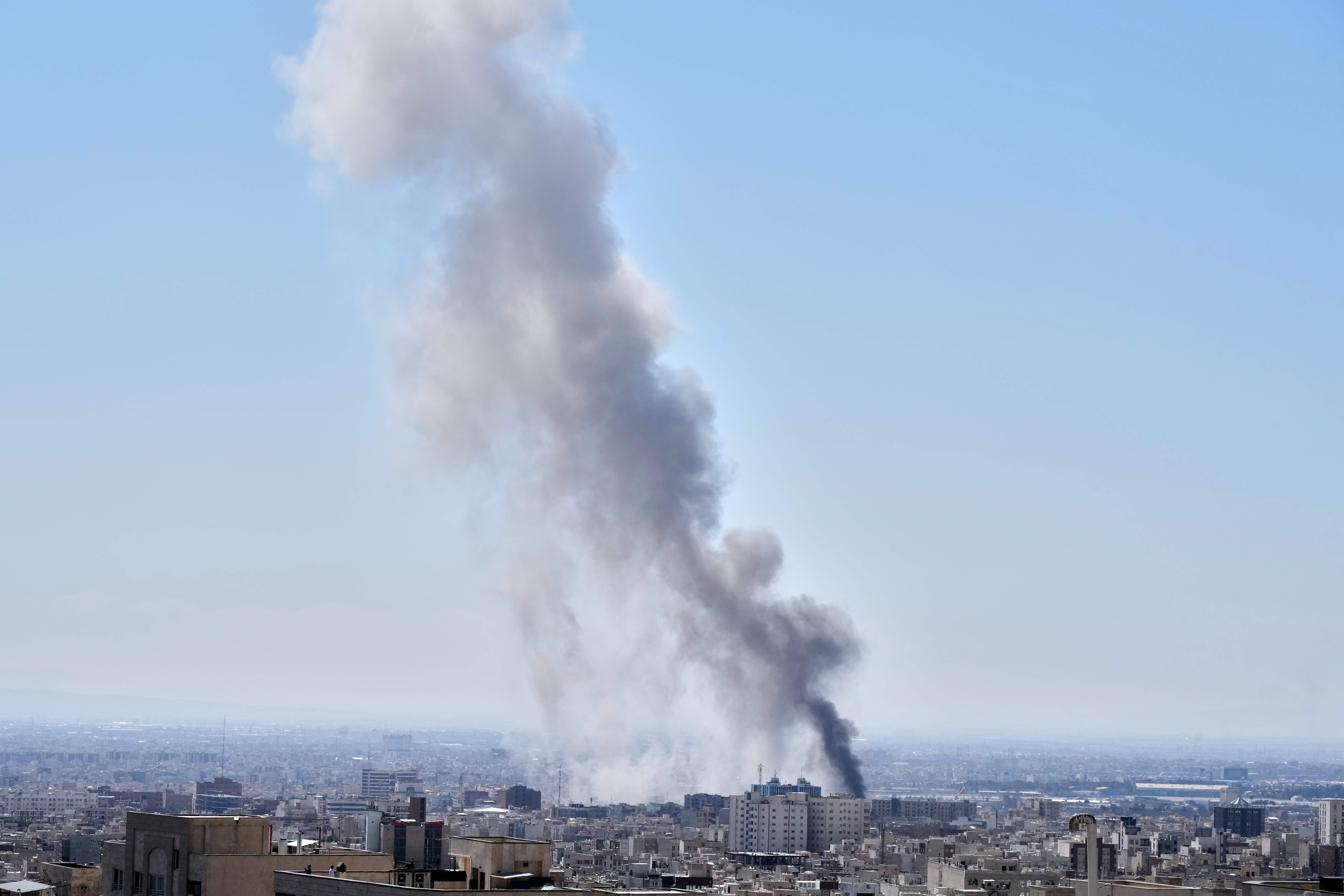
The current cycle of violence between the United States, Israel, and Iran has moved past the era of shadow wars into a direct, high-stakes confrontation that threatens to collapse the existing regional order. For decades, the conflict relied on a predictable, if bloody, script of proxy skirmishes and deniable assassinations. That script has been burned. We are now witnessing a fundamental shift where deterrence is no longer measured by the absence of conflict, but by the scale of the inevitable retaliation. The immediate future holds a relentless "tit-for-tat" escalation where each side feels compelled to have the last word to maintain domestic credibility and regional standing.
The Illusion of De-escalation
Diplomats in Washington and Brussels often speak of "de-escalation" as if it were a dial that could be turned down at will. This is a fundamental misunderstanding of the current friction. For Tehran, the "Axis of Resistance"—comprising Hezbollah, Hamas, the Houthis, and various Iraqi militias—is not just a foreign policy tool. It is a survival mechanism. By pushing the front lines away from its own borders, Iran ensures that any cost of conflict is paid in Lebanese, Syrian, or Yemeni lives rather than Iranian ones.
However, the recent direct exchanges of long-range missiles and drones between Israel and Iran have punctured this shield. When Israel strikes Iranian soil, or vice versa, the buffer zone vanishes. This creates a new, more volatile reality. Every strike requires a counter-strike of equal or greater magnitude to prove that the red lines still exist. If you don't hit back, the red line moves.
The Missile Gap and the Cost of Defense
There is a cold, mathematical reality to this war that few are willing to discuss openly. The cost of defense is vastly higher than the cost of offense. During a major drone and missile swarm, Israel and its allies—including the U.S. Navy—spend billions of dollars in sophisticated interceptors like the Arrow 3 and SM-3 to shoot down hardware that costs a fraction of that price.
Iran has spent the last twenty years perfecting the art of "asymmetric saturation." They don't need to have a better air force than Israel or the United States. They only need enough cheap, one-way attack drones to overwhelm the magazines of the world's most advanced air defense systems. We are reaching a point where the interceptor inventory of the West could be depleted faster than the Iranian assembly lines can be shut down. This isn't just a tactical problem. It is a fiscal and industrial nightmare that limits how long the U.S. can sustain a high-intensity defense of its partners in the region.
Hezbollah and the Northern Front
While the world watches the direct exchanges between Jerusalem and Tehran, the real "sword of Damocles" remains Hezbollah in Southern Lebanon. Hezbollah is not a ragtag militia. It is a state-level military force with an arsenal of over 150,000 rockets, including precision-guided munitions that can strike specific buildings in Tel Aviv.
If a full-scale war breaks out on Israel's northern border, the intensity will dwarf anything seen in Gaza. Israel’s military strategy, often referred to as the "Dahiya Doctrine," involves the use of overwhelming, disproportionate force against civilian infrastructure used by militants. Hezbollah’s strategy is to turn the Israeli home front into an unlivable war zone. Neither side can win this exchange in a traditional sense; they can only ensure the other side loses more.
The Intelligence Failure of Stability
For years, the intelligence community operated under the assumption that Iran was a rational actor that valued its own economic survival over regional hegemony. This was a projection of Western values onto a revolutionary regime. The Iranian leadership views the expulsion of U.S. forces from the Middle East as a theological and historical necessity, not just a political goal.
When we analyze the "why" behind the recent escalations, we have to look at the internal pressures within the Islamic Republic. The regime is facing a disenfranchised youth population and a crumbling economy. In the eyes of the hardliners in the Islamic Revolutionary Guard Corps (IRGC), a state of perpetual external conflict is the best way to justify internal repression. War is a distraction, but it is also a forge.
The Red Sea Stranglehold
One of the most overlooked factors in this tripartite struggle is the Houthi movement in Yemen. By effectively closing the Bab al-Mandeb Strait to much of the world's commercial shipping, a group once dismissed as a regional nuisance has gained global leverage. This is the "Iran model" in its most successful form. With minimal investment, Iran has enabled a proxy to disrupt 12% of global trade.
The U.S.-led "Operation Prosperity Guardian" has struggled to reopen the shipping lanes because the cost-benefit analysis favors the insurgents. It costs millions to fire a Tomahawk missile at a Houthi launch site that consists of a pickup truck and a rail. This is the reality of modern warfare. The high-tech, high-cost military machine of the West is being bled dry by low-tech, high-willpower adversaries.
Nuclear Threshold Politics
The ultimate endgame for Tehran remains the nuclear threshold. They don't necessarily need a bomb to achieve their goals; they only need the world to know they could build one in a matter of weeks. This "latent capacity" provides a permanent insurance policy against regime change.
Israel, however, views a nuclear-capable Iran as an existential threat that cannot be managed through containment. This divergence in risk tolerance between Washington and Jerusalem is the primary source of tension in the alliance. Washington wants to manage the fire; Jerusalem wants to put it out.
The Erosion of American Hegemony
We are currently seeing the limits of American power in real-time. Despite the presence of aircraft carrier strike groups and thousands of troops, the U.S. has been unable to deter Iran or its proxies from continuing their attacks. Deterrence requires two things: the capability to inflict pain and the perceived will to do it.
The withdrawal from Afghanistan and the domestic political divisions in the U.S. have signaled to the IRGC that the American public has no appetite for another "forever war." Iran is betting that they can outlast the American political cycle. They believe that if they keep the pressure high enough for long enough, the U.S. will eventually decide that the cost of staying in the Middle East outweighs the benefits.
The Intelligence War Beneath the Surface
Beyond the missiles and the rhetoric, a vicious intelligence war is being fought in the digital and physical shadows. Stuxnet was the beginning, not the end. Today, the battlefield includes cyberattacks on water grids, the assassination of nuclear scientists, and the sabotage of oil tankers.
This "gray zone" conflict is dangerous because it lacks clear rules of engagement. When a cyberattack shuts down a gas station network in Iran, is that an act of war? When an Iranian-backed group kills three U.S. soldiers in Jordan via a drone strike, how much of a response is "proportional"? The lack of a hot-line or any formal communication channel between the primary combatants means that a simple miscalculation—a missile hitting a crowded hospital instead of a military base—could trigger the regional conflagration everyone claims they want to avoid.
The New Alliances
The geography of the conflict is also changing. Iran is no longer isolated. Their deepening military cooperation with Russia—supplying drones for the war in Ukraine in exchange for advanced fighter jets and air defense—has integrated the Middle East's tensions into the broader global struggle between the West and a new "axis of convenience" involving Moscow and Beijing.
China, meanwhile, is happy to play the role of the neutral mediator, as seen in the Saudi-Iran normalization deal. However, Beijing’s primary interest is the uninterrupted flow of cheap energy. They will not lift a finger to help the U.S. stabilize the region if the instability hurts Washington more than it hurts them.
Realities of the Modern Battlefield
If you want to understand where this is going, look at the munitions. The age of the billion-dollar aircraft carrier being the ultimate decider of regional power is fading. In its place is the age of the swarm.
- Precision and Range: Iran’s Fattah hypersonic missiles and long-range drones mean that no point in the Middle East is safe.
- Intelligence Saturation: With commercial satellite imagery and open-source intelligence, the element of surprise is nearly impossible to maintain.
- Proxy Autonomy: Groups like Hezbollah and the Houthis are increasingly capable of manufacturing their own weapons, making "cutting off the head of the snake" a much more difficult proposition.
The United States and Israel are fighting a 21st-century war with a 20th-century mindset of territorial control and clear military victories. Iran is playing a much older game of attrition and endurance. They are willing to suffer more than we are.
The Collapse of the Old Guard
The regional leaders who once provided a modicum of stability—the traditional monarchs and long-standing dictators—are finding their influence wanned. The street in Cairo, Amman, and Riyadh is increasingly radicalized by the images coming out of Gaza. This limits the ability of "moderate" Arab states to cooperate openly with Israel or the U.S. against Iran.
The Abraham Accords were supposed to create a new security architecture that would isolate Tehran. Instead, the regional dynamics have shifted so violently that the signatories are now forced to hedge their bets, engaging in their own diplomacy with Iran to avoid being caught in the crossfire.
No Exit Strategy
The tragedy of the current situation is that there is no obvious off-ramp. Israel cannot stop until its borders feel secure, which they haven't since the October 7th attacks. Iran cannot stop its regional expansion without admitting that its revolutionary ideology has failed. And the United States cannot leave without ceding the most energy-critical region on earth to its primary global rivals.
We are not headed toward a peace treaty. We are headed toward a permanent state of high-intensity conflict that will redefine the borders and the power structures of the Middle East for the next fifty years. The only question left is how much of the existing world will be left standing when the dust eventually settles.
Direct your attention away from the diplomatic statements and toward the movement of logistics and the production of munitions. That is where the truth of the next decade lies. Prepare for a region where the exception is peace and the rule is a calculated, devastating exchange of fire.


