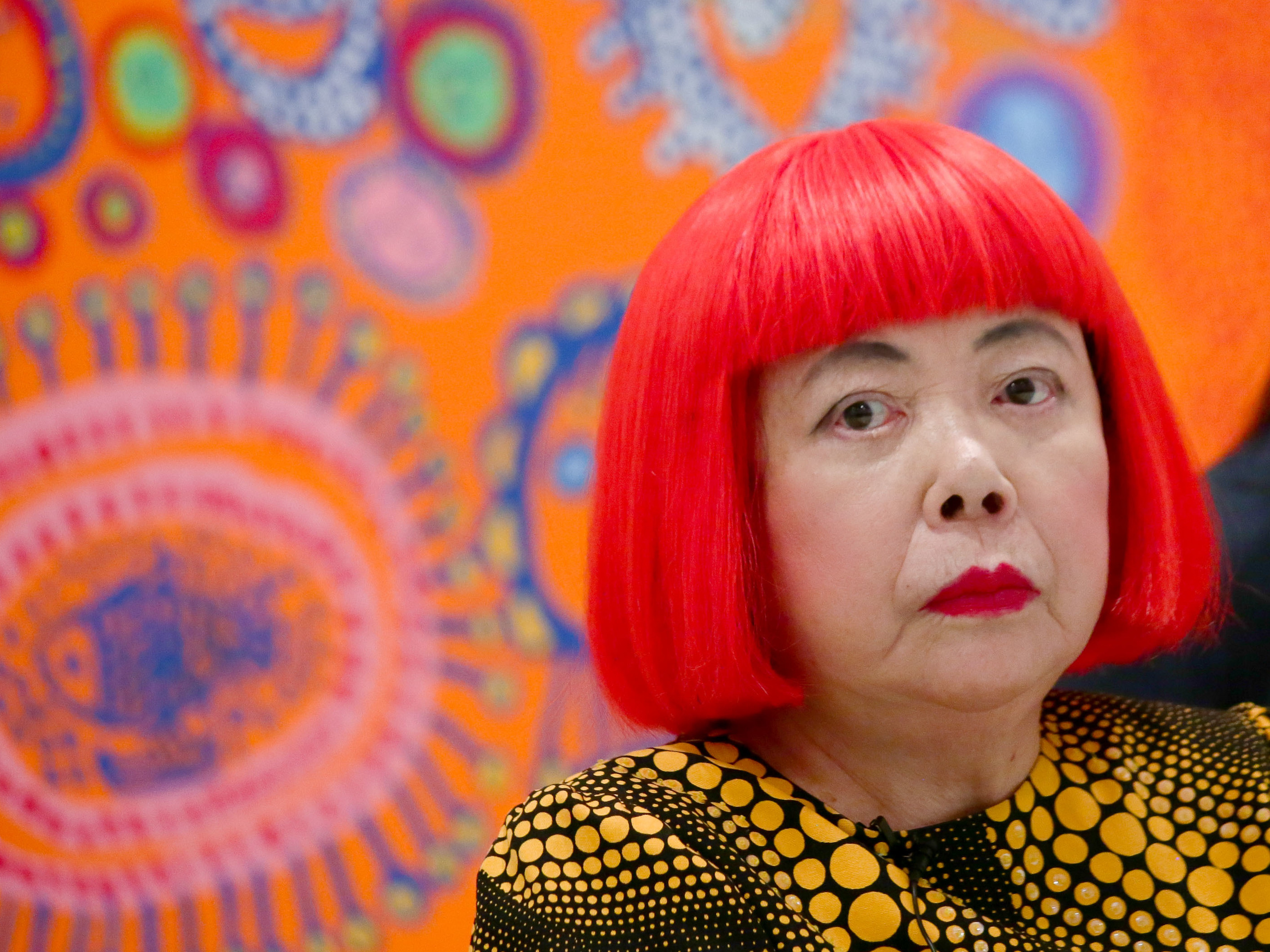
Yayoi Kusama did not merely paint polka dots; she weaponized them against a void that threatened to consume her mind. When the legendary avant-garde artist passed away at a Tokyo hospital at the age of ninety-seven, the global cultural apparatus moved with terrifying speed to sanitize her legacy. Headlines reduced her to a whimsical grandmother of aesthetic repetition, a quirky vendor of Instagram backdrops who happened to like bright wigs. This narrative is convenient. It is also a lie.
The true trajectory of Kusama's life was a grinding war between severe psychological torment and an art market that spent decades ignoring her before cannibalizing her imagery for eight-figure auctions and luxury retail tie-ins. To understand Kusama is to confront how the modern creative economy digests outsider trauma, stripping away the raw edge of survival until only marketable consumer goods remain.
The Genesis of the Infinity Net
Long before her immersive environments drew multi-hour queues in New York, London, and Tokyo, Kusama was a terrified child in Matsumoto, Japan. Born in 1929 into a wealthy family that ran a seed nursery, she suffered under an abusive mother who forced young Yayoi to spy on her father’s affairs, pairing this psychological cruelty with a total disdain for any creative ambitions.
It was during this fractured childhood that the hallucinations began. Red flower patterns from a tabletop would suddenly detach, multiplying across the walls, the ceiling, and her own body until the physical world dissolved into an endless expanse. To prevent herself from disintegrating into total panic, she drew what she saw.
[Hallucination Trigger] ---> [Obsessive Replication] ---> [Self-Obliteration]
This mechanism became her art. When she fled postwar Japan for New York City in 1957, carrying hundreds of silk paintings hidden inside her kimono, she encountered a downtown scene dominated by male abstract expressionists. Figures like Donald Judd and Frank Stella recognized her brilliance, buying her early infinity net canvases for nominal sums. Yet, mainstream recognition eluded her while contemporaries like Andy Warhol and Claes Oldenburg famously absorbed concepts from her soft sculptures and environmental installations into their own rising empires.
Kusama was too erratic, too foreign, and too female to fit comfortably into the clean-cut boxes of American minimalism. By the early 1970s, physically exhausted and mentally depleted, she returned to Japan. She checked herself into a psychiatric hospital in Tokyo voluntarily, a residence she maintained for the remainder of her life while walking daily to her nearby studio to paint.
The Machinery of Mass Appropriation
For two decades, Kusama lived as a ghost in her own industry. The institutional art world forgot her. Then came the cultural pivot of the late twentieth century, which transformed avant-garde marginalia into blue-chip inventory.
By the time galleries rediscovered her in the late 1980s and 1990s—culminating in her triumphant representation of Japan at the Venice Biennale in 1993—the mechanisms of commercial commodification had shifted. Her obsessive fear of the void was repackaged as a playground for the masses.
Consider the modern iteration of her Infinity Mirror Rooms. Originally conceived as claustrophobic, dizzying spaces designed to evoke the terror of infinite self-annihilation, they evolved into the ultimate status symbols for digital social media. Visitors line up for hours not to experience psychological ego-death, but to capture a mandatory forty-five-second selfie. The art market completed the translation from existential survival strategy to luxury asset class, pushing her canvases past the ten-million-dollar mark at auction.
Luxury conglomerates followed. Collaborations with high-end fashion houses turned her signature motifs into seasonal prints splashed across handbags and department store windows. A humanoid robot of the artist blinking inside flagship storefronts completed the strange cycle, turning a woman who once staged naked anti-war protests on Wall Street into an automated corporate mascot.
The Unbroken Discipline
Despite the multi-million-dollar valuations and the global merchandising machine, Kusama's daily reality remained anchored to a monastic discipline. Up until her final weeks, she walked from her psychiatric residence to her studio, picking up her brush with the exact same urgent compulsion that drove her as a child.
She did not paint to build a brand, nor did she construct mirrored chambers to optimize engagement metrics. Every dot was a suture holding her psyche together against the dark. When we look back at her century-spanning footprint, the temptation is to celebrate her late-life ubiquity as a heartwarming triumph over obscurity. That view misses the grit. Her success was a byproduct of an unyielding, terrifying stamina that outlasted the gatekeepers who tried to write her out of art history.
The polka dots remain, blanketing the canvas, the pumpkins, and the modern consciousness. Beneath the shiny veneer of global pop culture superstardom lies the stark reality of a solitary creator who stared into the infinite void and painted until the darkness blinked first.