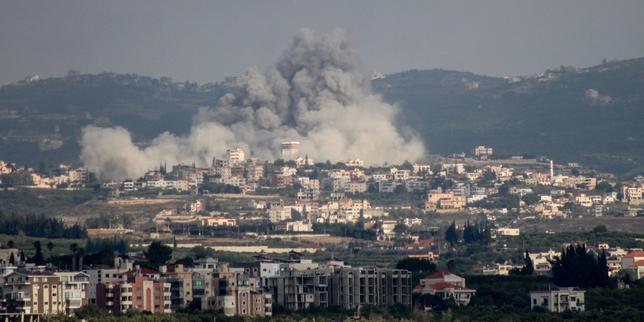
The latest surge of violence in Southern Lebanon has claimed at least 31 lives in a single day of Israeli strikes, marking a grim escalation in a conflict that has outpaced diplomatic efforts. These casualties, reported by Lebanese health authorities on Tuesday, represent more than just numbers on a ledger of regional instability. They signify the collapse of the "buffer zone" logic that has governed the border for nearly two decades. While the world watches the humanitarian disaster in Gaza, the northern front has quietly transformed from a series of skirmishes into a full-scale war of attrition that neither side seems capable of stopping.
The Geography of Attrition
The strikes targeted a cluster of towns across Southern Lebanon, hitting residential areas that have become the primary battleground between the Israeli Defense Forces (IDF) and Hezbollah. This isn't a conventional war with defined front lines. It is a mathematical horror. For every rocket launched toward the Galilee, a retaliatory strike levels a structure in Nabatieh or Tyre. The 31 deaths recorded on Tuesday reflect a shift in target selection and intensity, suggesting that the "rules of engagement" that once limited the scope of civilian harm have been discarded.
Military analysts have long warned that the proximity of Hezbollah infrastructure to civilian centers would make any escalation lethal. However, the sheer volume of ordinance now being dropped suggests a policy of scorched earth intended to make the border region uninhabitable. This strategy aims to create a de facto security belt by displacement, forcing tens of thousands of Lebanese civilians to flee north, mirroring the displacement of Israeli citizens from their own northern communities.
The Failure of International Deterrence
For months, Western diplomats have shuttled between Beirut, Tel Aviv, and Paris, carrying various iterations of a peace plan that hinges on the implementation of UN Resolution 1701. The goal remains the same: push Hezbollah forces north of the Litani River. Yet, these diplomatic overtures feel increasingly disconnected from the reality on the ground.
Hezbollah views any retreat as a strategic surrender that would leave Southern Lebanon defenseless. Conversely, the Israeli government faces immense domestic pressure to return its displaced citizens to the north, a feat that requires more than just a temporary ceasefire. They demand a fundamental change in the security architecture of the border. This deadlock ensures that the violence continues, with Tuesday’s death toll serving as a violent reminder that diplomacy without leverage is merely a delay tactic.
The Weaponization of Intelligence
One overlooked factor in the rising death toll is the precision and depth of modern surveillance. The IDF is utilizing a vast network of signals intelligence and aerial reconnaissance to identify targets in real-time. This sounds clinical, but the results are visceral. When a "precision" strike hits a multi-story building in a densely populated southern village, the collateral damage is inevitable.
The intelligence apparatus is designed to find militants, but it cannot account for the families living on the floor above or the neighbors walking by at the moment of impact. The speed at which targets are processed and approved has increased, leading to a higher frequency of strikes and, by extension, a higher probability of civilian casualties.
The Economic Collapse of the South
Beyond the immediate loss of life, these strikes are systematically dismantling the economic backbone of Southern Lebanon. This region relies heavily on agriculture, particularly tobacco and olive groves. Thousands of acres have been scorched by white phosphorus and high-explosive munitions. Farmers cannot harvest their crops, and the soil in many areas is now contaminated with unexploded ordinance.
Lebanon was already reeling from a multi-year financial crisis that decimated the value of its currency and the savings of its citizens. The war in the south is the final blow for a population that has no safety net. When a home is destroyed in a village like Bint Jbeil, there is no government insurance or reconstruction fund waiting to rebuild it. The displacement isn't just a temporary move to a shelter; it is a permanent descent into poverty.
A Cycle of Calculated Escalation
Both Hezbollah and Israel are engaged in what can be described as a "climb to the top" of the escalation ladder. Each side believes that by increasing the pain threshold for the other, they can force a favorable settlement.
- Hezbollah's Strategy: Maintain a steady flow of attacks to drain Israeli resources and keep the northern border a bleeding wound, linking the fate of the south to the ceasefire in Gaza.
- Israel's Strategy: Use superior air power to degrade Hezbollah’s mid-level command and logistics, while signaling that Lebanon as a state will pay the price for the militia's actions.
This logic is fundamentally flawed. It assumes that the opponent is a rational actor with a breaking point that leads to compromise. In reality, the violence often hardens resolve and narrows the space for political maneuvering. The 31 lives lost on Tuesday won't bring either side closer to the table; they will be used as recruitment tools and justifications for the next round of barrages.
The Shadows of 2006
Veteran observers of the 2006 Lebanon War see terrifying parallels in the current trajectory. Back then, a 34-day conflict resulted in massive civilian casualties and a stalemate that satisfied no one. Today, the weapons are more sophisticated, the range of the missiles is longer, and the regional context is far more volatile.
Hezbollah has spent eighteen years digging deeper tunnels and acquiring more advanced drone technology. Israel has spent that same time refining its "Dahiya Doctrine," which posits that the use of disproportionate force against civilian infrastructure used by militants is a necessary deterrent. When these two philosophies collide, the civilian population is caught in the gears of a machine designed for total destruction.
The Role of the Lebanese State
The Lebanese government in Beirut remains a spectator to its own tragedy. The military is underfunded and lacks the mandate to confront either the IDF or Hezbollah. Political paralysis has prevented the election of a president for over a year, leaving the country without a unified voice. This vacuum allows external actors and non-state militias to dictate the fate of the nation.
Ministers give press conferences decrying the violation of sovereignty, but sovereignty is a myth when you cannot control your own borders or protect your own citizens from foreign air strikes. The state’s inability to provide even basic medical supplies to the overwhelmed hospitals in the south is a stark admission of its irrelevance in this conflict.
No End in Sight
The international community's focus remains fragmented. There is no appetite for a major ground intervention, and the UNIFIL forces stationed along the Blue Line are restricted to a monitoring role that grows more perilous by the hour. Without a massive, coordinated shift in regional policy—one that addresses the underlying grievances of both parties—the daily death tolls will continue to climb.
The 31 people killed on Tuesday are victims of a strategic gamble that hasn't paid off. They are the collateral of a war that refuses to stay within its borders, a conflict that consumes the future of a region while the world's diplomats trade papers in climate-controlled rooms far from the smoke of the south. The reality is that the fire in Southern Lebanon isn't just a side effect of the regional crisis; it is a central pillar of it, and it is burning out of control.
Expect the numbers to rise tomorrow.