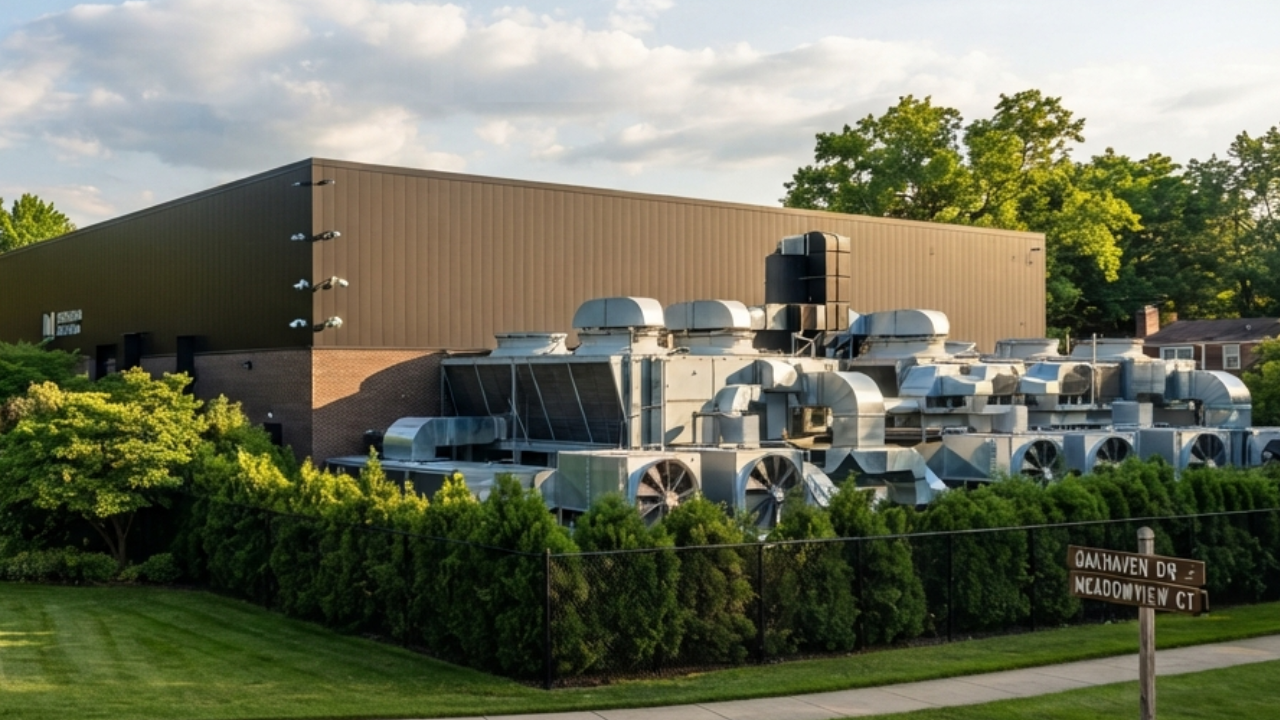
The global rush to build infrastructure for artificial intelligence is running headfirst into a physical reality that tech giants failed to anticipate. While Silicon Valley counts computational gains, communities surrounding new data centers are dealing with a relentless, low-frequency drone that destroys property values and ruins health. This is not a minor localized zoning dispute. It is a fundamental engineering and regulatory failure. Data centers require massive cooling systems to keep thousands of high-density server racks from melting down, and the resulting acoustic footprint is transforming quiet residential zones into industrialized acoustic nightmares.
The issue centers on the physics of cooling. Traditional data centers hosting basic cloud storage could rely on standard air conditioning units that cycled on and off. The hardware powering modern AI workloads demands continuous, high-intensity cooling. Industrial chillers and massive arrays of cooling towers run at maximum capacity twenty-four hours a day, seven days a week. The sound they produce is not the white noise of a household fan. It is a deep, mechanical hum that penetrates standard residential walls, windows, and insulation.
For residents living near newly expanded facilities in tech hubs across Michigan, Virginia, and Georgia, the arrival of these facilities has brought a harsh awakening. The constant noise creates a phenomenon known as acoustic entrapment. Because low-frequency sound waves travel further and penetrate solid structures more effectively than high-frequency sounds, moving indoors offers little relief.
The Mechanics of the Industrial Hum
To understand why this problem is so difficult to fix, you have to look at the architecture of a modern hyperscale facility. Inside, rows of servers generate immense thermal energy. To dissipate this heat, operators install massive rooftop chillers and exhaust fans. These fans move millions of cubic feet of air per minute.
When thousands of these fans spin simultaneously, they create a complex acoustic profile.
[Server Heat Generation] -> [Continuous Max-Capacity Exhaust Fans] -> [Low-Frequency Vibrations] -> [Resonance inside Nearby Homes]
Standard municipal noise ordinances are fundamentally unequipped to handle this type of pollution. Most local laws measure sound using the A-weighted decibel scale (dBA). This scale mimics the human ear's sensitivity to mid-to-high frequency sounds but largely ignores low-frequency noise. A data center might technically comply with a 55 dBA nighttime limit, yet still emit a constant 30 Hz to 100 Hz rumble that causes walls to vibrate and prevents sleep.
This regulatory loophole allows tech companies to claim full compliance with local laws while utterly destroying the livability of surrounding neighborhoods. It is a disconnect between outdated legal frameworks and the unprecedented physical footprint of the infrastructure required to power modern computing.
Why Retrofitting Fails to Solve the Problem
When local outcries grow loud enough, tech operators usually offer standard mitigation strategies. They build acoustic walls, install silencers on exhaust ports, or plant rows of trees.
These superficial fixes rarely work for low-frequency sound.
A 20-foot concrete sound barrier might block the high-pitched whine of a standard motor, but low-frequency waves simply bend over the top of the wall through a process called diffraction. Vegetation does nothing to stop these wavelengths. To truly contain the noise, companies must alter the core engineering of their cooling systems, a solution that costs millions of dollars per facility and threatens the thin profit margins of data infrastructure providers.
Consider a hypothetical example of a facility trying to fix an existing site. To damp a 60 Hz tone, an acoustic barrier would need to be dozens of feet thick and incredibly tall, effectively turning the data center into a fortified bunker. The alternative is switching from air cooling to liquid cooling. While liquid cooling is far quieter because it relies on closed-loop fluid circulation rather than massive air displacement, retrofitting an active, air-cooled data center is an operational nightmare that requires taking critical servers offline.
The Human Cost of Computational Power
The biological impact of chronic low-frequency noise exposure is well-documented but rarely factored into tech company projections. Public health studies consistently show that long-term exposure to low-frequency industrial noise disrupts sleep architecture, increases cortisol production, and elevates the risk of cardiovascular issues. It triggers a chronic stress response because the human body perceives the low-frequency vibration as a structural threat.
Real estate values in affected zones plummet. Homes located near these facilities become virtually unmarketable, trapping residents financially. They cannot afford to leave, and they cannot bear to stay.
Local governments frequently find themselves caught between protecting their constituents and securing the massive tax revenues that data centers promise. In many rural or deindustrialized parts of the country, a new data center represents a major influx of property tax dollars and infrastructure investment. County commissioners often approve these projects with little understanding of the long-term environmental consequences, relying entirely on the biased environmental impact assessments provided by the developers themselves.
The Illusion of Clean Tech
The tech industry has spent a decade branding itself as a clean, virtual alternative to heavy manufacturing. This narrative is dissolving. Data centers are heavy industrial facilities. They consume millions of gallons of water, draw massive amounts of power from strained electrical grids, and generate significant noise pollution.
The current crisis highlights a broader trend of externalizing the costs of technological progress. The individuals living downwind of these facilities are subsidizing the global tech boom with their health and their property values.
Fixing this requires an immediate overhaul of how we measure and regulate industrial noise. Municipalities must abandon simple dBA metrics and adopt C-weighted (dBC) or unweighted Z-weighted scales that accurately capture low-frequency acoustic energy. Building permits should be contingent on real-world acoustic modeling that accounts for local topography and atmospheric conditions, which can bounce sound waves directly down onto residential valleys.
Until local zoning boards demand hard, legally binding guarantees on low-frequency emissions, the tech sector will continue to build outward, turning quiet neighborhoods into collateral damage for the digital economy. The noise will not stop until the regulatory landscape forces companies to pay the true cost of quiet engineering.