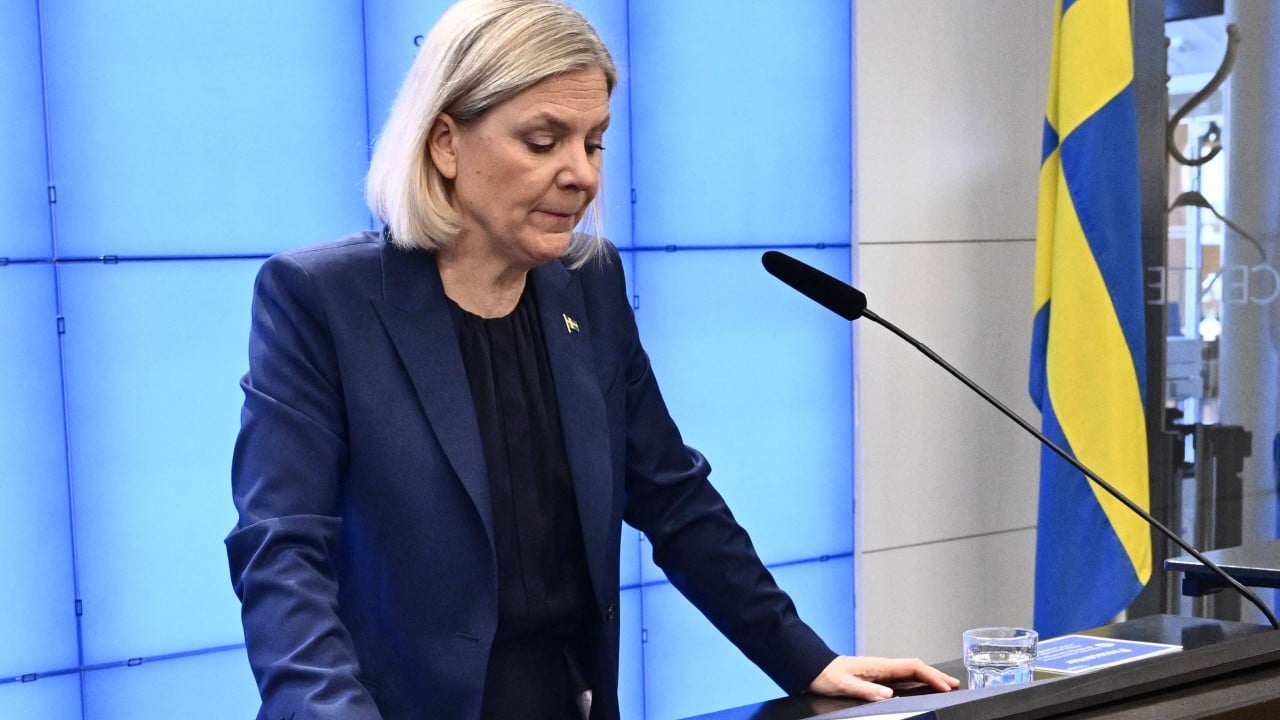
The coffee in the press room goes cold before anyone has the decency to finish it. Outside, the Stockholm evening drops like a heavy woolen blanket, gray and indifferent, dimming the grand stone facades that have stood witness to centuries of calculated compromise. Inside, behind closed doors that should have opened hours ago, the silence is louder than any shouting match.
Magdalena Andersson walks out. For a different view, check out: this related article.
There are no grand gestures. No dramatic throwing of papers or weeping into microphones. Just the quiet, heavy footsteps of a leader who has stared into the machinery of democracy and found the gears temporarily locked solid. The government-formation talks are over. Not with a breakthrough, but with a flat, echoing thud.
To read the ticker tape is to see a statistic: a political impasse, a failed negotiation, another day of parliamentary gridlock in a nation famed for its clockwork efficiency. But statistics do not capture the weight of a Tuesday night when an entire country discovers that its steering wheel has detached from the axle. Related insight on this matter has been provided by NBC News.
Consider what happens next in an ordinary apartment in Södermalm. A young nurse, working double shifts, wonders if her rent will climb again next month while politicians posture over budget lines that no one can agree to sign. Across town, a factory owner in Gothenburg looks at expansion plans frozen in ink because no one can guarantee which way the tax winds will blow tomorrow.
Democracy, we are told, is a noisy business. We picture shouting matches in grand chambers, fierce debates echoing off marble pillars, the theatrical clash of ideologies. Yet the reality of modern political breakdown is shockingly mundane. It looks like people staring at phones in quiet rooms. It looks like spreadsheets with unallocated funds. It looks like a calendar that keeps turning while the people charged with steering the ship simply stare at the compass, realizing it is spinning.
Andersson knows this machinery better than most. She is a economist by trade, a person who believes in the brutal, beautiful logic of numbers. Numbers do not lie. If you spend more than you earn, the ledger bleeds. If you promise more than parliament can deliver, the coalition collapses. Yet politics is stubbornly resistant to pure arithmetic. You can balance a spreadsheet, but you cannot balance human pride, ideological purity, and the desperate scramble for electoral survival.
The deadlock did not happen overnight. It was built brick by slow brick through months of delicate maneuvering, red lines drawn in vanishing ink, and demands that could neither be met nor abandoned without political suicide. In a system built on consensus, where absolute majorities are rare unicorns, power is rented, never owned. And when the landlord suddenly raises the rent, the whole house shakes.
Walk the cobblestones of Gamla Stan on a night like this, and you feel the ghosts of old parliaments whispering about stability. Sweden has long fancied itself the quiet adult in the European room. While neighbors to the south and east wrestled with populist earthquakes and chaotic leadership carousels, Swedish politics was supposed to be different. It was supposed to run like a well-oiled Saab: sturdy, predictable, engineered for safety.
Instead, the country finds itself drifting in uncharted waters.
The core of the fracture lies in a shifting political landscape where the old tribes are dissolving. The traditional blocks
When the Map Falls Apart in Stockholm
news
The coffee in the press room goes cold hours before anyone decides to tell the truth. Outside, the Stockholm dusk settles early, a heavy, bruised violet that swallows the corners of Riddarholmen and turns the freezing waters of Lake Mälaren into ink. Inside the Riksdag, the air smells of old wool, stale espresso, and the distinct, sour metallic tang of prolonged panic.
Magdalena Andersson stood at a podium, her coat still damp from the sleet, and said the words that no one wanted to hear. The talks were over. The math had failed. There would be no tidy announcement, no smiling handshake in front of the blue-and-gold backdrop, no collective sigh of relief from a nation that prides itself on keeping its administrative machinery oiled down to the millimeter.
Just a quiet, heavy stop.
For months, foreign observers had looked at Sweden the way people look at a clock that has suddenly begun running backward. This was supposed to be the sanctuary of consensus, a place where politics was treated like a municipal water project—boring, predictable, and fundamentally functional. Yet here was Andersson, the Social Democratic leader who had clawed her way to the head of a historically fractured political landscape, walking away from the table with empty hands.
To understand why this matters, you have to throw away the spreadsheet and look at the kitchen table.
Imagine a cooperative apartment building where everyone has lived for forty years. Everyone knows whose turn it is to shovel the snow, who leaves the basement light on, and how much the roof repairs will cost. It is a system built on unwritten trust. Now imagine that the basement is flooding, the roof is leaking, and half the tenants refuse to speak to the other half because they disagree on the color of the new front door. That was Sweden on the night the government-formation talks collapsed.
The core of the deadlock was not merely ideological. It was structural, a collision between rigid party platforms and a volatile electorate that had grown tired of the old certainties. On paper, the numbers were clear. Every member of parliament knew the arithmetic. But arithmetic does not account for pride, nor does it measure the deep, calcified distrust that had grown between the traditional left and the surging populist right, with the center-right parties caught somewhere in the middle, sweating through their collars.
Andersson herself is not a politician of grand rhetorical flourishes. She is an economist by training, a woman who treats budgets the way an experienced surgeon treats a delicate suture. When she talks about welfare spending or tax adjustments, she sounds less like a campaigner and more like an auditor trying to keep a household from bankruptcy. That precision is precisely why her failure cut so deep. If Magdalena Andersson couldn't find the invisible seams to stitch a coalition together, the problem wasn't a lack of negotiation skill. The loom itself was broken.
Consider the human cost of this administrative paralysis. It sounds bloodless—a government failing to form, a coalition slipping through the cracks. But freeze the frame. Look at the municipal workers waiting to see if their local budgets will survive the winter freeze. Look at the small business owners in Norrland trying to plan three years out while electricity prices dance like a fever chart. Look at the immigrant families in Malmö wondering if the rules of the road are about to change underneath their feet again.
When political machinery seizes up, real life doesn't pause. It stutters.
The press conference ended with the usual shuffling of papers and the aggressive clicking of camera shutters trying to manufacture drama out of exhaustion. Andersson didn't blink. She answered the questions with the flat, defensive precision of a seasoned combatant who knew the ground had shifted beneath her boots. Then she turned, walked down the corridor, and vanished into the gray Swedish night.
The lights in the parliamentary offices stayed on long after she left. Janitors wheeled grey bins through empty hallways. The coffee machines hissed in the breakrooms, serving no one.
In a democracy, a failed negotiation is not the end of the world, but it is a warning tremor. It tells you that the old agreements are rotting away and the new ones have not yet been born. The map no longer matches the terrain. And as the dark water laps against the stone quays of Stockholm, the politicians are left with the oldest, hardest task in human history: figuring out how to live together when nobody trusts the person across the table.


