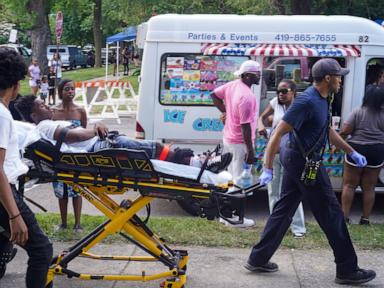
The arrest of a 23-year-old suspect following a mass shooting at an annual community festival in Ohio provides cold comfort to a community dealing with 12 wounded victims. While local police departments routinely point to swift apprehensions as a sign of operational success, this arrest masks a deeper, systemic breakdown in municipal event security, regional gang intelligence sharing, and the predictable flashpoints of summer crowd management. The gunfire did not erupt in a vacuum, and the suspect is only the final link in a chain of failures that began months before the first tent was pitched.
Every summer, mid-sized cities across the Midwest host heritage festivals, street fairs, and carnivals. These events are economic lifelines and cultural staples. They are also, from a security standpoint, absolute nightmares. When thousands of people pack into a confined downtown footprint with porous borders, open access points, and minimal perimeter screening, the risk profile skyrockets.
To understand how a celebratory weekend turned into a chaotic scene of blood and panic, we have to look past the booking photo of the shooter. We must examine the structural vulnerabilities that city administrators and understaffed police forces ignore year after year.
The Illusion of the Secure Perimeter
Municipalities love to tout their event safety plans. They point to barricades, orange cones, and the visible presence of private security guards wearing neon vests.
It is a theatrical performance. Private security guards hired for seasonal events are frequently underpaid, undertrained, and explicitly instructed not to engage with violent individuals. Their primary function is directional, not protective. They check wristbands, look for outside alcohol, and watch for gate-crashers. They are entirely unequipped to detect a concealed semi-automatic handgun carried by someone determined to settle a score in a crowd.
Law enforcement deployment at these festivals faces similar constraints. Budgets are tight. Overtime funding is scarce. When a police department commits dozens of officers to a festival weekend, it drains resources from neighborhood patrols, leaving the rest of the city vulnerable. To compensate, departments often rely on a stationary presence—officers standing by marked cruisers or congregating near the main stage.
This creates blind spots. The edges of the festival, where the bright lights fade into residential side streets or unlit parking lots, become dead zones. This is precisely where the Ohio shooting began. It started as a verbal dispute on the periphery of the festival grounds, spilling into the main crowd as the suspect drew a weapon and fired indiscriminately while retreating. A perimeter that only exists on paper cannot stop a bullet.
The Failure of Predictive Intelligence
Mass violence at community gatherings is rarely random, even when the victims hit are entirely innocent. Initial investigative details reveal the confrontation stemmed from an ongoing dispute between rival local factions.
This brings a critical question to light. Why was regional law enforcement caught off guard?
The modern criminal landscape has shifted from defined geographic territories to fluid, hyper-localized disputes fueled by social media provocations. A slight on a Friday afternoon Instagram live stream can lead to a retaliatory shooting by Saturday night. If police departments are not actively monitoring these digital undercurrents, they are policing in the past.
Traditional Policing vs. Modern Reality
--------------------------------------------------
Old Model: Fixed territories, predictable rivals
New Model: Digital feuds, fluid flashpoints
Result:    Surprise violence in soft-target venues
Predictive intelligence should dictate resource allocation. If intelligence units had logged the rising tensions between these specific groups, the tactical approach to the festival would have changed. Officers would not have been stationed passively at the main entrance. They would have been deployed in proactive, plainclothes details on the perimeter, watching for known instigators and intercepting threats before they reached the dense crowd. Instead, the department was forced into a reactive posture, responding only after the first shots shattered the air.
The Medical Chaos of the Golden Hour
When twelve people are struck by gunfire simultaneously, the immediate challenge shifts from law enforcement to emergency medicine. The first 60 minutes after a traumatic injury are known as the golden hour. Survival rates drop precipitously if a critically wounded patient does not reach a trauma surgeon within this window.
Festivals are designed for foot traffic, not emergency vehicles. When the shooting started, panic ensued. Thousands of attendees rushed for the exits, blocking the very paths that ambulances needed to use to enter the area.
"The gridlock was total. We had victims bleeding out on the pavement while the paramedics were stuck three blocks away, unable to push through the fleeing crowd and the abandoned vehicles."
This reality requires a total overhaul of event logistics. Standard practice relies on staging ambulances outside the event footprint and waiting for police to clear the scene. That process takes too long when multiple victims have arterial bleeding.
High-risk public events must integrate tactical emergency medical support directly into the moving security detail. If medical personnel equipped with tourniquets, chest seals, and blood-clotting agents are not moving through the crowd alongside police, people die from preventable injuries while waiting for an ambulance to navigate a traffic jam.
Balancing Open Access and Public Safety
The response from some civic leaders following tragedies of this scale is predictable. They call for metal detectors, chain-link fencing, and airport-style screening at every community gathering.
This approach is both logistically impossible and culturally destructive. Turning a free, open-air neighborhood festival into a fortified green zone kills the spirit of the event. It is also prohibitively expensive for small-market organizers and municipal budgets already stretched to their breaking points.
A more realistic framework requires a shift in how cities view security technology and personnel placement.
- Mobile Surveillance Towers: Deploying temporary, elevated cameras with real-time video analytics to spot crowd anomalies and rapid gathering points.
- Acoustic Gunshot Detection: Integrating temporary sensors that instantly pinpoint the location of gunfire, routing officers to the exact coordinates within seconds rather than relying on chaotic 911 calls.
- Staggered Layouts: Designing festival footprints with natural choke points and wide evacuation lanes to prevent crowd crushes and allow emergency vehicle access.
The Cost of Reactive Governance
Mayors and city councils across the country watch these incidents unfold, express sympathy, and reassure their constituents that "it can't happen here." Then they approve the permits for their own local festivals without demanding a rigorous, updated threat assessment from their police chiefs.
The arrest of the suspect in Ohio is a necessary piece of judicial business, but it does not fix the underlying vulnerability. The individual will face trial, the legal system will grind forward, and the news cycle will move on to the next tragedy. Meanwhile, the structural flaws that allowed a dispute to turn into a mass casualty event remain unaddressed in dozens of similar cities.
True security is not measured by how fast handcuffs are slapped on a suspect after twelve people are shot. It is measured by the measures taken to ensure the gun is never drawn in the first place. Until municipal leaders stop treating security as an afterthought or a line item to be trimmed, the summer festival circuit will remain a high-stakes gamble for the public.


