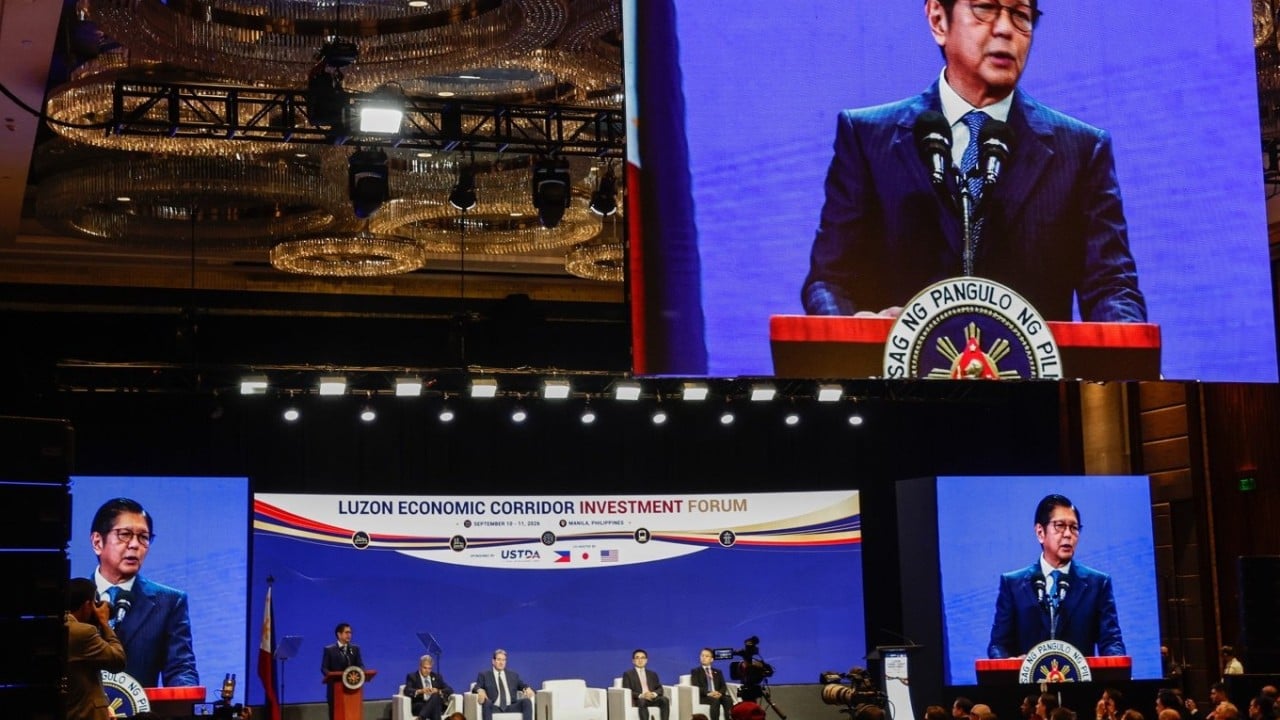
The Washington-backed infrastructure push across the Philippines, anchored by the high-profile Luzon Economic Corridor, is colliding with a harsh domestic reality. What was pitched as a transformative trilateral investment blueprint involving the United States, Japan, and the Manila administration is now facing severe local pushback over who actually reaps the rewards. Outside executive boardrooms and luxury hotels in Bonifacio Global City, the friction is palpable. Demonstrators clash with police not out of abstract anti-foreign sentiment, but from a concrete fear of resource drain, land conversion, and environmental degradation.
To understand why this multibillion-dollar initiative is stalling on the ground, one must look past the optimistic press releases issued by trade delegations. The corridor spans a densely populated region generating roughly half of the country's gross domestic product, connecting Subic Bay, Clark, Manila, and Batangas. Originally framed as a logistics upgrade focused on ports, rail, and cold storage facilities, the project's scope has rapidly expanded. It now encompasses critical minerals, energy grids, and advanced technology manufacturing tied to artificial intelligence supply chains—often referenced alongside frameworks like Pax Silica.
This scope expansion changed the political physics of the project. A highway or a logistics hub is relatively uncontroversial; an industrial ecosystem requiring intensive water allocations, high-capacity power supplies, and massive land clearances is entirely different. For a farmer or a provincial resident near New Clark City, the promise of abstract macroeconomic growth competes directly with the immediate threat of displacement and rising utility tariffs. Compensation terms remain largely opaque, leaving local communities to shoulder the adjustment costs while corporate entities extract high-value materials.
The core friction stems from a fundamental disconnect between geopolitical strategy and municipal welfare. Under the banner of a free and open Indo-Pacific framework, external powers view the corridor through a lens of supply chain resilience and national security. For Washington and Tokyo, securing alternative nodes for semiconductor production and energy distribution outside traditional geopolitical rivals is an urgent necessity. But translation into local economic reality requires more than foreign direct investment targets. When fifty American firms express interest in corridor investments, local stakeholders immediately ask a blunt question: where does the wealth stay?
Philippine regulatory architecture has struggled to manage this pressure. Unlike jurisdictions with unified project statutes for strategic industrial corridors, local execution relies on a patchwork of Senate resolutions and existing mining and investment frameworks. This regulatory ambiguity creates fertile ground for friction. Environmental groups and civil society organizations are demanding rigorous social-license filters that mandate verifiable onshore value creation rather than mere export-oriented extraction.
Consider a hypothetical manufacturing facility established under these corridor provisions. If the plant imports specialized raw inputs, consumes subsidized local water resources, utilizes heavy grid power during peak demand periods, and ships finished high-tech components entirely offshore with minimal domestic supply-chain integration, the host community absorbs the environmental toll while capturing virtually none of the fiscal upside. This exact scenario fuels the current skepticism.
Financial institutions and Western multinational operators face a distinct window of vulnerability over the next six to twenty-four months. Project delays driven by community resistance, contested land titles, and protracted permitting battles can quickly erode projected margins. Infrastructure funding tied strictly to top-down policy reforms, such as energy threshold programs backed by international agencies, often fails to address the micro-level grievances of displaced landowners or fishermen whose livelihoods depend on coastal access.
For the Manila government, the challenge is balancing strategic alliances with domestic accountability. Officials must enforce rigorous local-benefit mechanisms that tie foreign capital deployment to tangible infrastructure upgrades for ordinary citizens—such as reliable municipal power, transparent relocation compensation, and workforce development programs that build domestic technical depth rather than serving as cheap labor conduits.
The success of these transnational corridors will not be judged by the volume of memorandums signed at international economic forums, but by whether they can pass the local-benefit test on the ground. Until transparent safeguards replace vague promises of trickle-down prosperity, the asphalt and fiber-optic cables of the Luzon corridor will remain lines drawn across a deeply contested landscape.