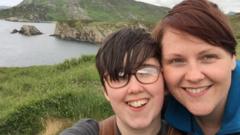
A single bullet fired from a cheap handgun into a crowded street can destroy a life in less than a second. For Northern Ireland, that second came on April 18, 2019, when 29-year-old investigative journalist Lyra McKee was shot in the head while observing a riot in the Creggan area of Derry. The New IRA claimed responsibility, but the specific individual who pulled the trigger slipped away into the shadows of the estate.
Seven years later, the legal apparatus built to deliver answers has crashed down in spectacular failure. Three men accused of being part of the joint enterprise that assisted the gunman—Jordan Devine, Paul McIntyre, and Peter Cavanagh—were completely cleared of her murder at Belfast Crown Court.
It's a familiar, gut-wrenching script for anyone who understands the modern landscape of dissident republicanism and the tight-lipped communities where these groups operate. Sara Canning, Lyra’s partner, has lived through every excruciating moment of this delay. She didn't expect a sudden wave of civic conscience from the killer, but she openly hopes that the reality of what they did clings to them forever, a mental weight that never lightens.
But hope doesn't fix a broken justice system.
The Mirage of the Joint Enterprise Conviction
When a masked gunman stands on a street corner and fires indiscriminately at police vehicles, they aren't working in a vacuum. They have spotters. They have people fetching the weapon. They have individuals blocking roads or picking up spent bullet casings.
The prosecution tried to nail the three co-defendants using the concept of joint enterprise. The idea is simple. If you are part of a mob, actively encouraging or assisting a gunman, you share the legal guilt for the death that follows.
Joint Enterprise Framework:
[Assisting the Gunman] + [Encouraging the Riot] = Shared Liability for Murder
The theory makes sense on paper, but proving it in a court of law is a nightmare. Mrs. Justice Smyth ruled that the evidence simply didn't cross the threshold required for a criminal conviction. She noted that while there was a case to answer initially, the prosecution's arguments eventually fell short under intense scrutiny. Much of the case relied on circumstantial footage and assumptions about who was doing what beneath hoodies and masks.
Lyra’s sister, Nichola Corner, didn't hold back outside the court. She stated plainly that the system completely failed Lyra, failed the family, and failed Northern Ireland. When the state cannot secure a conviction for a globally condemned murder of a journalist, it sends a chilling message to the public. It tells people that if you wear a mask and keep your mouth shut, the law can't touch you.
Radicalized Ceasefire Babies
Lyra McKee was a brilliant writer because she looked at the parts of Northern Ireland that politicians tried to ignore. She wrote extensively about the "ceasefire babies"—the generation born around or after the 1998 Good Friday Agreement who were supposed to inherit a peaceful paradise.
Instead, she uncovered a dark reality of skyrocketing suicide rates and deep-seated trauma. The tragedy is that she was ultimately killed by the exact ecosystem she was trying to understand.
The gunman who shot Lyra is believed to have been a teenager, someone who never lived through the worst of the historic Troubles. The New IRA and other small dissident groups didn't disappear after the peace process; they morphed. They recruit young, impressionable boys from disadvantaged estates, feeding them outdated romantic notions of armed struggle.
These young recruits are used as frontline fodder. They throw petrol bombs, they hijack cars, and occasionally, they are handed a gun by older, cynical handlers who stay safely in the background. When the violence ends, the community closes ranks.
The Wall of Silence and the Price of Intimidation
The real reason Lyra’s killer hasn't been brought to court isn't a lack of police effort. It's fear.
Derry's Creggan estate, like several hardline areas across Northern Ireland, suffers under an invisible pressure cooker of paramilitary intimidation. People know who the gunman is. They know who held the gun before the shooting and where it went afterward. A man was eventually jailed for possessing the weapon used in the murder, but the hands that fired it remain free.
If you speak to the Police Service of Northern Ireland (PSNI), you risk being branded a "tout"—an informer. In these neighborhoods, that label carries a heavy cost, ranging from social exclusion to a bullet in the knees or worse. The dissident groups leverage this historical anti-police sentiment to protect themselves, using the community as a human shield against the legal system.
Paramilitary Control Loop:
[Orchestrate Riot] -> [Commit Violence] -> [Enforce Community Silence via Fear] -> [Evade Prosecution]
This creates a self-perpetuating cycle. Because the public sees that the courts can't secure convictions, their trust in the state's power to protect them erodes further. Why risk your life giving information to the police when the defendants are just going to walk free a few years later?
What Happens When Trust Dissolves Completely
The acquittal of these three men isn't just a loss for the McKee family. It's a massive setback for the broader peace process. In 2019, Lyra's death caused such a wave of public anger that it actually forced deadlocked politicians back to the table to restore the power-sharing government at Stormont. Leaders from all political factions stood side by side to condemn the violence.
Now, that moment of unity feels incredibly distant. The failure to secure a murder conviction erodes accountability.
To break this cycle, the focus has to shift from relying solely on shaky post-incident video footage to dismantling the social hold these groups have over young people.
- Investment in youth infrastructure in neglected estates must be prioritized to counter the romanticized allure of paramilitary groups.
- Legal protections and relocation options for witnesses need to be drastically enhanced to make speaking out viable.
- Intelligence gathering must intercept the supply of legacy weapons before they reach the hands of teenagers.
If the state cannot offer safety to those who tell the truth, the wall of silence will stay up, and more families will find themselves standing on court steps, wondering why the law failed them. Lyra McKee spent her career giving a voice to the forgotten victims of violence. The greatest tragedy is that her own name has been added to that very list.
Police release new CCTV footage of suspects in journalist Lyra McKee's murder
This video shows the real-time CCTV footage released by investigators tracking the movements of the suspects and the gunman in the Creggan area on the night Lyra McKee was killed.