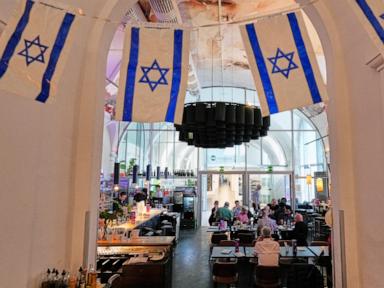
The steam from the espresso machine hissed, a sharp, metallic sound that cut through the low hum of morning chatter in Vienna’s second district. For decades, this has been the sound of peace. In the Leopoldstadt, once known as Mazzes-insel or Matzo Island, the clinking of porcelain spoons against saucers is the rhythm of a neighborhood that has spent a century trying to heal.
But lately, the air has grown thick. Meanwhile, you can find similar events here: The Myth of Wes Streeting’s Loyalty and the Real Reason the Labour Coup is on Ice.
It began as a vibration felt from across the continent. In Malmö, Sweden, the Eurovision Song Contest was preparing to launch into its annual explosion of glitter and pop. Usually, this is the world’s most glittery distraction. Not this year. This year, the contest became a lightning rod. Outside the Malmö Arena, the chants were loud, the anger was visceral, and the target was a twenty-year-old singer named Eden Golan. Her crime? Carrying the flag of Israel onto a stage built for song.
Back in Vienna, a city that knows the cost of silence all too well, the tension wasn't just headline news. It was a physical presence on the streets. To see the bigger picture, check out the recent article by The Guardian.
Alexander Juritsch, the proprietor of Cafe Gold, watched this unfolding discord from behind his counter. He saw the social media boycotts. He saw the way people were crossing the street to avoid eye contact with neighbors. He felt the creeping chill of a world where certain identities were becoming "too complicated" to welcome.
He decided to do something small. Something quiet.
He placed a blue ribbon on his door. He didn't issue a press release. He didn't hire a security team. He simply opened his doors and signaled that, in this corner of the world, supporters of Israel and those who simply wanted to celebrate a young girl’s right to sing would find a seat, a warm drink, and a moment of sanity.
It was a gamble of the heart.
Vienna is a city of layers. Beneath the imperial gold and the pristine cobblestones lies a history that is often whispered rather than shouted. Leopoldstadt was the heart of Jewish life before the darkness of the 1930s. To stand in this district today is to walk among ghosts. When Juritsch made his cafe a sanctuary for those feeling ostracized by the Eurovision backlash, he wasn't just selling coffee. He was reclaiming a piece of the city’s soul.
Imagine a woman named Sarah. She is hypothetical, but she represents dozens who walked through those doors last week. She has lived in Vienna for ten years. She loves the opera, the parks, and the way the city feels like a museum you can live in. But for the last few months, Sarah has felt a tightening in her chest every time she checks her phone. She sees friends—people she’s shared wine with—posting slogans that feel like erasures of her heritage.
She hears the news from Malmö: the booing during rehearsals, the protests, the climate of fear. She feels a sudden, sharp loneliness.
She walks toward Cafe Gold. She sees the ribbon.
When she enters, the bell above the door rings with the same tone it always has. But the atmosphere is different. There is a sense of shared breath. She isn't there to debate geopolitics or argue over borders. She is there because she needs to know that she hasn't been edited out of the social fabric.
The facts of the Eurovision controversy are well-documented. The European Broadcasting Union (EBU) fought to keep the event "non-political," a task that proved impossible. They forced song lyric changes. They banned flags other than those of participating nations. They tried to build a wall of sound around the stage to drown out the protesters.
But you cannot legislate a feeling.
The "welcome" at Cafe Gold became a story not because of the coffee, but because of the scarcity of the gesture. We live in an era where neutrality is often mistaken for cowardice, and taking a stand is mistaken for an act of war. Juritsch’s stance was different. It was an act of hospitality. In the middle of a continent-wide storm of polarized shouting, he chose the oldest human tradition: the shared table.
The stakes were invisible until they weren't. In the days following his announcement, the cafe didn't just fill with patrons; it filled with meaning. People arrived from across the city. Some brought flowers. Others just sat in silence, reading the paper, grateful for a space where they didn't have to hide their sympathies or apologize for their existence.
The pushback against Israel’s participation in the contest wasn't just about a song. It was a litmus test for how much pressure a cultural institution could take before it fractured. In Malmö, the fracture was visible. Armed police lined the streets. Snipers sat on rooftops. The "United by Music" slogan felt like a grim joke.
Yet, in a small cafe in Vienna, the unity was real because it was local.
Consider the physics of a crowd. It is easy to be angry in a mass of ten thousand people. It is easy to chant a slogan when you cannot see the eyes of the person you are chanting against. But in a cafe, you are forced into the singular. You see the steam. You hear the clink of the spoon. You see the person across from you as a human being, likely just as tired and worried as you are.
The Eurovision Song Contest ended with a winner, a trophy, and a lot of broken glass. The headlines moved on to the next crisis. But the blue ribbon in the window of Cafe Gold stayed.
It remains a quiet testament to the fact that when the world becomes a theater of noise, the most radical thing you can do is offer someone a place to sit down.
History isn't just made by the people on the stages or the people in the streets with the microphones. It is made by the person who decides that their door will remain open, even when the wind outside is howling. It is made in the Leopoldstadt, one cup of coffee at a time, reminding us that we are only as lost as we choose to be.
The bell rings again. Another customer walks in. The steam hisses. The city goes on, but for a moment, the world feels a little less cold.