A Quiet Afternoon in Berlin Turned Sharp
Rain slicked the stone, softening the glare of the midday light.
Every year, people gather at the Bendlerblock in Berlin to mark the anniversary of July 20, 1944. It is solemn ground. This is where Colonel Claus von Stauffenberg and his co-conspirators paid with their lives after their plan to assassinate Adolf Hitler failed. The courtyard carries the heavy weight of silence. It is a place dedicated to honoring those who risked everything to tear down a murderous regime from the inside.
Then came the wreath.
It bore the ribbon of the Alternative for Germany party. Known as the AfD, the far-right political force has long sparked fierce debate across the nation. For many families connected to the original anti-Nazi resistance, seeing those colors laid beside the memorial was an unbearable contradiction.
One descendant could not simply stand by and watch.
The Friction of Memory
Valerie Riedesel Freifrau zu Eisenbach carries resistance in her veins. Her grandfather, trial lawyer Adam von Trott zu Solz, was a central figure in the Kreisau Circle—a group of intellectuals and officials who secretly plotted against Hitler's tyranny. He was executed in August 1944, leaving behind a legacy of absolute moral clarity.
When the AfD delegation placed their official floral arrangement at the site, the atmosphere shifted instantly.
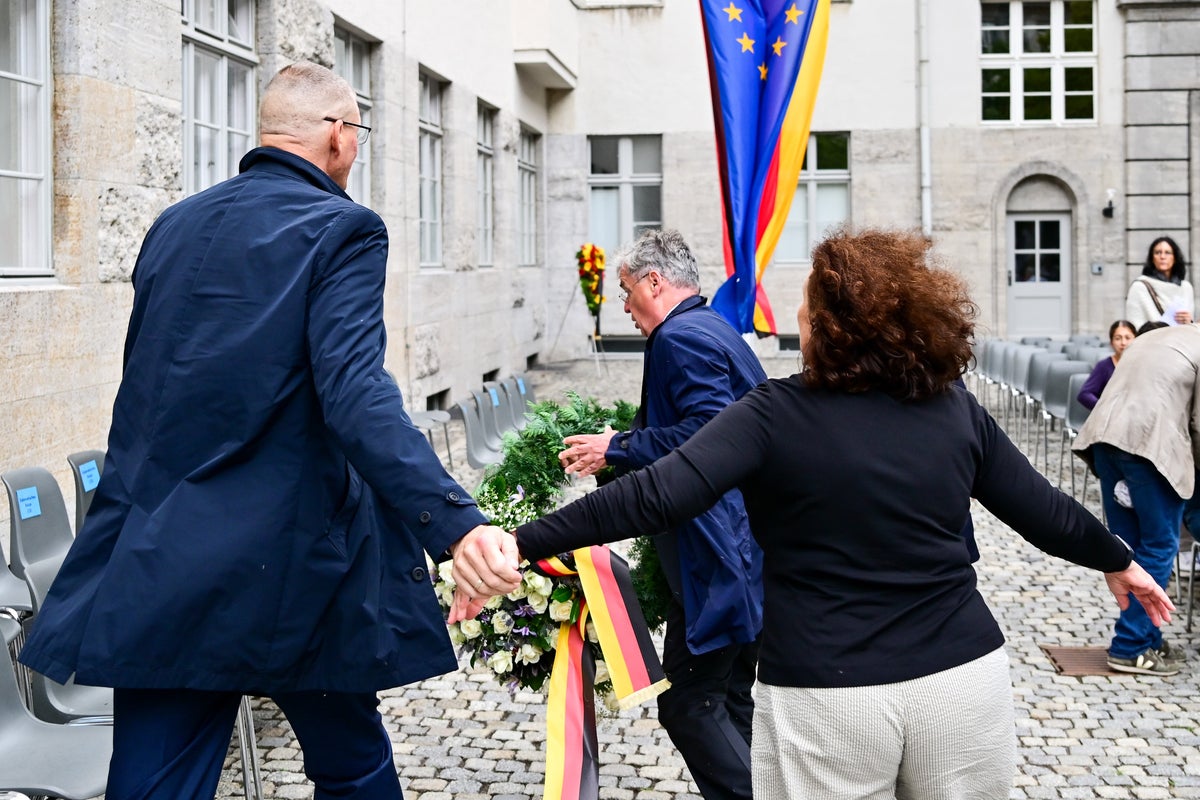
Riedesel stepped forward. Her intention was clear. She walked directly toward the wreath, reached down, and attempted to lift it away from the memorial wall. She did not raise her voice. She did not launch into a speeches or shout slogans. Her movement was direct, fueled by a deep personal conviction that the memory of her grandfather's sacrifice was being co-opted.
Security guards immediately intercepted her. A brief, tense struggle unfolded in full view of the crowd and photographers. Hands clamped onto the wreath from opposing sides. The physical tug-of-war lasted only moments, but the symbolic collision resonated far beyond the courtyard walls.
Officers pulled her back, citing protocol and public order rules. The wreath remained in place. Yet, the quiet solemnity of the ceremony was shattered.
Why the Wreath Touched a Raw Nerve
Memory in Germany is not passive history. It is an active, ongoing responsibility.
For decades, the story of July 20 was carefully preserved by families who lost parents, uncles, and grandparents to the Nazi executioners. To these descendants, the resistance was born out of an undeniable moral imperative to protect human dignity, freedom, and democratic values.
The controversy surrounding the AfD stems from statements made by prominent figures within the party over recent years. Critics argue that elements of the party seek to downplay the atrocities of the Nazi era or reshape how the country remembers its dark past. When a party accused of harboring ethno-nationalist views lays a wreath for men who died fighting a total totalitarian state, the families view it as a profound betrayal.
For Riedesel and other descendants present that day, allowing the wreath to rest undisturbed felt like consenting to a rewrite of history. Her attempt to move the flowers was not merely a protest against a modern political party. It was a defense of her family’s living legacy.
The Long Shadow of Stauffenberg's Plot
To understand the intensity of those few seconds at the Bendlerblock, one must look at the ghosts present in the courtyard.
In the summer of 1944, Germany was collapsing under the weight of war and horror. A small group of military officers, diplomats, and civilians recognized that moral inaction was complicity. They knew the odds were stacked against them. They knew failure meant torture and death.
They acted anyway.
When Stauffenberg planted the briefcase bomb in Hitler's conference room at the Wolf's Lair, the conspirators were attempting to salvage what was left of their nation's soul. The plot failed. The retribution was swift and brutal. Over 4,000 people were arrested, and hundreds were executed, including Adam von Trott zu Solz.
That history lives in the present. When relatives step into the Bendlerblock each July, they carry the memory of those final, desperate hours. The courtyard is not just an open-air museum. It is a sacred burial ground of ideas and sacrifice.
A Struggle That Continues in Public Squares
After police separated Riedesel from the wreath, the event continued under an uneasy calm. Reporters swarmed. Photographers captured the stark image of a descendant being held back from a tribute she believed polluted the memory of her ancestors.
The AfD officials maintained their right to participate in official state remembrances as a democratically elected party represented in parliament. They argued that honoring anti-Nazi resistance is a duty that belongs to all Germans, regardless of political affiliation.
This clash highlights a growing divide over who owns historical memory in modern Europe. Can a state-funded memorial exclude elected officials? Or does the moral weight of history grant descendants the right to police who gets to pay respects?
There are no easy answers written into procedural manuals.
As the crowd dispersed and the rain quieted down, the wreath remained leaning against the cold stone wall, its ribbon visible against the grey backdrop. Valerie Riedesel Freifrau zu Eisenbach stood a short distance away, surrounded by witnesses to a moment where past and present collided head-on.
The flowers will eventually fade and be cleared away. The fundamental question raised in that Berlin courtyard—who gets to claim the mantle of history's heroes—will remain unsettled for a long time to come.