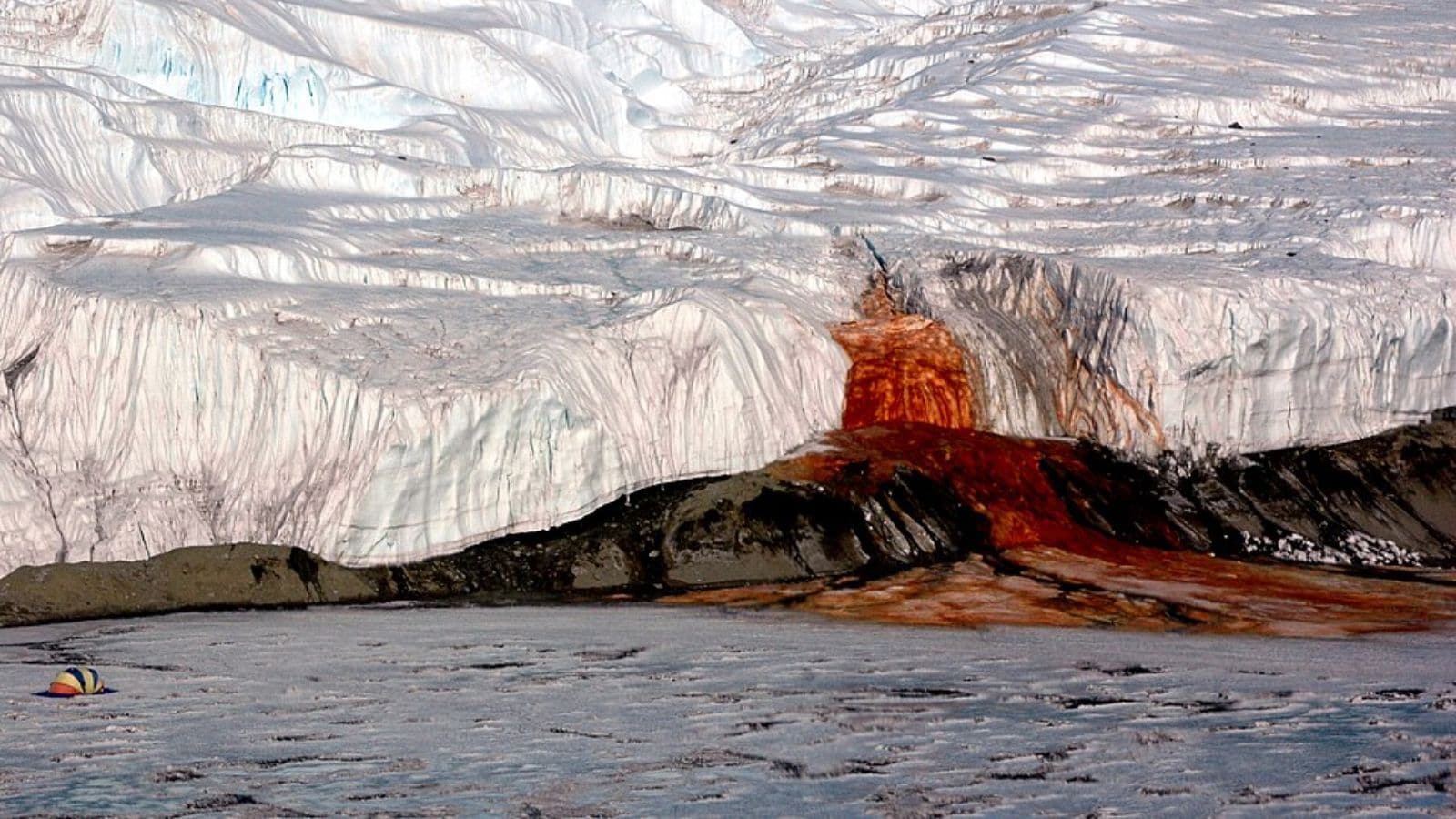
The wind in the McMurdo Dry Valleys does not blow; it scrapes. It carves its way through the most desolate desert on Earth, a place so stripped of moisture that snow cannot even fall. Everything is a monochrome expanse of blinding white and bruised blue. If you stood there, your skin would tighten instantly from the ambient dryness, and the silence would press against your eardrums until you could hear the rhythm of your own pulse.
Then, you see it.
Tearing through the pristine face of the Taylor Glacier is a five-story torrent of deep, visceral crimson. It looks exactly like an open wound. For over a century, explorers and scientists have stood before this feature—appropriately named Blood Falls—feeling a primal spike of adrenaline. The human brain is hardwired to recognize that specific shade of red. It signals trauma. It signals life leaving a body.
When Griffith Taylor, the British explorer, stumbled upon this scene in 1911, the sight jarred him. Imagine the psychological toll of months in the freezing dark, only to find a glacier that appeared to be bleeding into a frozen lake. Taylor did what any rational nineteenth-century mind would do: he guessed. He assumed microscopic red algae were blooming in the ice, clinging to life by coloring the water.
He was wrong. But it took us more than a hundred years to understand exactly how wrong he was, and the truth is far stranger than a simple patch of algae. The red water of Blood Falls isn't a sign of death. It is the breath of an alien world trapped right beneath our feet.
The Secret Ocean Under the Ice
To understand the blood, you have to look through the eyes of someone like Kenisha, a hypothetical glaciologist who spent three seasons freezing her fingers off in the Dry Valleys to collect samples. Think of her standing at the base of that crimson wall, holding a sterile plastic vial as the frigid, salty water splashes against her parka.
For decades, the standard scientific consensus was straightforward. The water was red because it contained iron, and when that iron hit the air, it rusted. Simple chemistry.
But Kenisha’s real-world counterparts noticed a nagging flaw in the data. If it was just simple rust, the minerals should have structured themselves into predictable crystalline forms. When scientists analyzed the water under standard instruments, the results were messy, chaotic, and incomplete.
The breakthrough came when a team of researchers decided to deploy a specialized piece of technology: a transmission electron microscope. This isn't your high school science classroom apparatus. It is a machine that fires a high-energy beam of electrons through a sample to image things at an atomic scale.
What they found shattered the old consensus.
The iron wasn't sitting in the water as a standard mineral. Instead, it was trapped inside nanospheres—infinitesimal bubbles of amorphous iron that are one-hundredth the size of a human red blood cell. Because these nanospheres have no crystalline structure, they don't react to analytical tools the way regular iron does. They had been hiding in plain sight, mimicking rust but possessing a completely different molecular identity.
But where did they come from?
To find the source, we have to travel two miles backward, up the glacier, and deep into the bedrock. Roughly two million years ago, a massive reservoir of hyper-saline water was trapped beneath the advancing ice sheet. Cut off from the rest of the planet, this subterranean lake has seen no sunlight, no fresh air, and no contact with the atmosphere since the dawn of the human species.
It is a time capsule filled with a brine so salty it cannot freeze, even at temperatures that would turn a human being to stone.
Life in the Dark
Consider what happens to an ecosystem when you lock it in a dark room for two million years.
Without sunlight, photosynthesis is impossible. Without a connection to the open ocean, the oxygen supply quickly plummets to zero. By all the rules of biology we learn in textbooks, this subglacial lake should be a dead zone. A stagnant, sterile tomb.
Yet, when samples from Blood Falls are analyzed, they are teeming with life.
Microbes have transformed this terrifyingly hostile environment into a thriving metropolis. Deprived of oxygen, they have learned to adapt. They survive through a complex, multi-stage metabolic process that sounds like science fiction: they harvest sulfates from the surrounding water, use them to break down organic matter, and then utilize the abundant iron in the bedrock to reset the system.
They are quite literally eating the mountain, using iron as a surrogate breathing mechanism.
The nanospheres that turn the waterfall red are the direct byproduct of this microscopic engineering. The microbes chew through the rock, shedding these tiny, iron-rich glass bubbles into the brine. When the pressure of the shifting glacier squeezes the reservoir, the water forces its way through cracks in the ice, eventually spilling out into the valley.
The moment that subglacial brine touches the oxygen in our atmosphere, the nanospheres oxidize. The chemical reaction is instantaneous.
White ice turns to bleeding rust.
The Cosmic Echo
The reason teams of highly funded scientists endure the punishing logistics of Antarctica to study a remote waterfall isn't just curiosity about a strange geological quirk. The stakes are infinitely higher.
Look at the images of Europa, the icy moon of Jupiter, or the frozen poles of Mars. For years, planetary scientists have stared at those distant, frozen landscapes and wondered if life could ever survive the crushing cold and deadly radiation of deep space.
Blood Falls is our Rosetta Stone for the cosmos.
If life can thrive two miles beneath an Antarctic glacier, completely severed from the sun and breathing through iron, then the frozen oceans of the outer solar system are no longer empty voids. They are viable habitats. The exact same electron microscopes used to find the nanospheres in Antarctica are currently being calibrated to analyze data from probes that will soon taste the icy plumes of alien moons.
When we look at the bleeding glacier, we are looking at a blueprint for how life persists when the universe tries its hardest to wipe it out.
The red torrent of the Taylor Glacier is a reminder that our understanding of nature is fragile. We looked at a waterfall for a century and saw a simple chemical reaction, a bit of rust, a trick of the light. We missed the truth because our tools were too blunt and our imaginations were too small.
Now we know better. The falls are not a macabre display of death in the wasteland. They are the overflow of an ancient, indestructible engine of life, pumping secrets from the dark heart of the ice into the blinding Antarctic sun.


