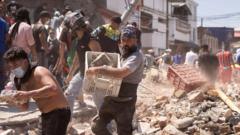
The headlines rolled in like clockwork. Nature strikes again. Tragedy in the Andes. A seismic monster tears through Colombia, leaving over a hundred dead, thousands displaced, and the media scrambling for the same tired narrative of helpless humanity at the mercy of tectonic fury.
Stop right there.
Earthquakes do not kill people. Bad concrete kills people. Corrupt zoning laws kill people. Decades of institutional apathy toward infrastructure reinforcement in secondary cities kill people. The tectonic plates merely expose the receipts.
When a major earthquake hits Japan, skyscrapers sway like willow trees, shinkansen trains halt automatically, and people text their families from beneath sturdy desks. When a major earthquake hits parts of the Andes, buildings pancaked like cheap cardboard crumble into dust because construction codes are treated as polite suggestions rather than non-negotiable safety boundaries.
We need to stop treating natural disasters as acts of God when they are largely acts of human negligence.
The Myth of Unpredictable Destruction
The lazy consensus in mainstream disaster reporting is simple: random acts of violence from the earth cannot be anticipated, so we must rely on post-disaster charity and emergency relief funds. This worldview keeps politicians off the hook and insurance executives smiling. It frames geography as destiny.
It is a lie.
Seismology is not astrology. We know where the Nazca plate subducts beneath the South American plate. We know the fault lines running through the Colombian interior like the back of our hands. The energy release is physics, not a surprise attack. Yet, emergency preparedness budgets across much of Latin America are perpetually underfunded, redirected into pork-barrel projects that vanish long before the earth starts shaking.
I have walked through seismic retrofit sites in high-risk zones where contractors pocketed half the budget and used substandard rebar that snaps under a light bending test, let alone a moment magnitude 6-plus jolt. When the inevitable happens, everyone points fingers at the Richter scale. Nobody points fingers at the municipal inspector who signed off on unreinforced masonry.
Follow the Money Trail of Vulnerability
Let us look at the economic reality of seismic resilience. Retrofitting an older building is expensive. Knocking it down and rebuilding to modern standards is disruptive. So, property owners—backed by lax municipal enforcement—roll the dice. They gamble that the big one will not hit on their watch.
When the dice come up snake eyes, the public picks up the tab. Taxpayers fund the rescue helicopters, the temporary tent cities, and the international aid packages. The private developer who cut corners walks away with their insurance payout or shielded assets.
This is moral hazard on a national scale. As long as society privatizes the profits of cheap construction and socializes the costs of seismic failure, buildings will continue to collapse.
"Disasters are not natural. They are the intersection of natural hazards and human vulnerability."
Until we internalize that definition, every earthquake will be treated as an anomaly rather than an indictment of our urban planning.
Dismantling the Emergency Response Theatre
Watch the news cycle after any major seismic event. Politicians fly in on private jets, wearing hard hats, shaking hands with survivors, and promising a rebuild. It is political theatre designed to project empathy while avoiding systemic reform.
Real emergency response is boring. It looks like mandatory bi-annual evacuation drills in schools. It looks like aggressive seizure and demolition of seismically vulnerable structures in historical centers. It looks like strict criminal penalties for engineers and contractors who bypass safety margins.
Instead, we get reactive panic. We marvel at the bravery of rescue workers digging through rubble with their bare hands—heroic acts that should never have been necessary in the first place if the structure had been engineered to withstand the load. Praising the rescue while ignoring the structural failure is like praising a surgeon for trying to save a patient who was poisoned by their own water supply.
The Engineering Reality Check
Let us demystify what actually happens to a building during a seismic wave. Ground motion generates lateral forces. Gravity pulls down; lateral shear pushes sideways. Unreinforced brick and concrete have great compressive strength, meaning they can hold heavy weights pressing straight down. But they have terrible tensile strength. They cannot handle being whipped sideways repeatedly without shattering.
Modern anti-seismic design does not fight the earth. It works with it. Base isolation systems float buildings on rubber and steel bearings, absorbing the shock before it reaches the superstructure. Moment-resisting frames bend without breaking.
These technologies are not science fiction. They are standard civil engineering. They add a percentage point to initial construction costs. But skipping them saves money upfront and buries people later.
The Hard Truth About Regional Development
Why are so many vulnerable buildings concentrated in specific regions? Economic centralization. When economic opportunity is hyper-concentrated in a few major hubs, secondary and tertiary cities experience rapid, uncontrolled urbanization. People migrate faster than infrastructure can scale. Informal settlements sprout up on steep hillsides prone to liquefaction and landslides.
When an earthquake hits these areas, the compounding disasters—liquefaction followed by structural collapse followed by blocked access roads—create an impossible bottleneck for emergency services.
You cannot solve earthquake mortality with better ambulances. You solve it by decentralizing economic development so smaller cities can afford world-class municipal engineering, and by enforcing zoning laws that prevent housing from being built on geological fault lines or unstable slopes.
What Actually Works
If we want to stop writing obituaries after every major tremor, we have to adopt a zero-tolerance policy for substandard construction.
- Mandatory Audits: Every public building, school, and hospital in high-risk seismic zones must undergo an independent structural audit by engineers who do not report to local political appointees.
- Criminal Liability: Make structural negligence resulting in death a felony with mandatory prison sentences for developers, contractors, and inspectors.
- Subsidized Retrofitting: Instead of waiting to rebuild destroyed cities with billions in post-disaster aid, redirect a fraction of that capital into pre-disaster reinforcement loans for existing vulnerable housing stock.
The earth is going to keep moving. The tectonic plates do not care about our budgets, our political cycles, or our excuses. The only variable we control is how we build our world before the ground starts to shake. Stop blaming the fault lines. Fix the concrete.