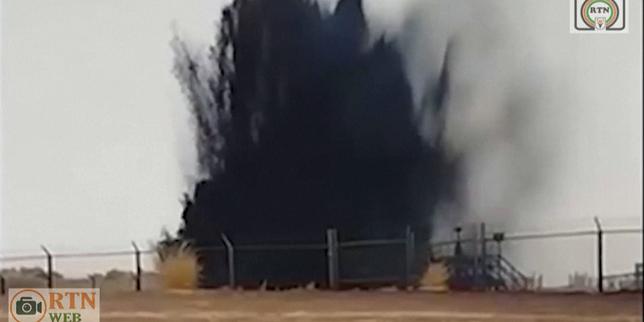
Black. Thick. Iridescent.
It does not belong in the open air of the Sahel, where the dust usually rises dry and pale under a brassy sky, carrying the scent of millet stalks and sun-baked clay. Yet across screens and messaging groups, images of a sudden crude oil eruption in Niger have sparked an immediate wave of alarm—not merely because black liquid spurting from the earth looks dramatic on a phone screen, but because in a semi-arid region where every drop of clean water and every square meter of arable soil is a hard-won margin of survival, an uncontrolled blowout feels like an open wound in the ground.
I have stood beside spills and industrial leaks where the first thing that hits you isn't the sight of the dark pool spreading outward. It is the smell. A sharp, heavy, metallic stench of hydrocarbons and sulfur that coats the back of your throat and makes your eyes water before your brain even finishes registering what you are looking at. You watch people step backward with quiet dread because once crude oil soaks into porous earth or slips toward a seasonal channel, you cannot simply sweep it away with a broom.
Let's be honest about what we actually see when viral footage of an oil eruption surfaces. A phone camera captures the shock—the spray, the crowd gathered at a safe or not-quite-safe distance, the dark sheen pooling over dry scrub. What a fifteen-second clip rarely shows is the slow chemistry happening beneath the surface over the next weeks, months, and years. Crude oil is not a single substance. It is a complex cocktail of volatile compounds, heavy hydrocarbons, and trace metals. When pressure forces it upward faster than containment systems can hold, two emergencies unfold at once: the immediate hazard of fire, toxic fumes, and soil saturation, and the quieter, longer-lasting threat to shallow aquifers, grazing land, and livelihoods.
A Morning in the Dust
To feel why an image from Niger carries weight far beyond newsroom tickers, let's construct a hypothetical scenario—explicitly a composite illustration rather than a report of a single verified household—grounded in the real conditions of Niger's oil-producing corridors, such as the Agadem basin in the east where extraction has expanded over the past decade and a half.
Imagine a hypothetical herder named Moussa waking before dawn as dry harmattan wind rattles the thorn branches outside his compound. For months, rain has been scarce, and his small herd of cattle and goats depends on sparse tufts of grass and shallow water points that already require longer walks than they did ten years ago. News travels fast even in remote corners: a wellhead or pipeline section has ruptured, sending dark oil surging into the open air and pooling across the ground.
Even if Moussa's own grazing spot sits miles away, his mind immediately runs through a chain reaction that every pastoralist and farmer in an arid zone understands intuitively.
First comes the air and the spark. Light hydrocarbons evaporate rapidly into warm air, creating fumes that irritate lungs and eyes and raising the risk of ignition near any open flame, cigarette, or idling engine. Then comes the soil. When crude oil coats topsoil, it suffocates microorganisms, blocks water infiltration, and turns fertile or semi-arid ground into a hydrophobic crust where rain beads up and runs off instead of feeding roots. Finally comes the water question—the sharpest fear of all. In a country where climate stress, desertification, and insecurity already strain rural resilience, any threat that crude hydrocarbons could migrate downward toward groundwater or wash across low-lying depressions during a sudden rainstorm triggers dread that lingers long after the gusher is capped.
An oil blowout is a loud event with a quiet aftermath: the spray stops in hours or days, while the chemical footprint can stay locked in soil and water for years.
What Makes Niger's Stakes Different
Oil production in Niger is relatively young compared with giant exporters elsewhere in the world. Commercial extraction took off after the Agadem Rift Basin came online in the early 2010s, transforming a landlocked Sahelian nation with modest fiscal revenues into an oil producer—and later tying its export ambitions to long-distance pipeline infrastructure reaching the coast.
That history shapes how people react when images of an eruption circulate. When an oil industry is new or rapidly scaling, trust is fragile. Communities and observers ask practical questions that go straight to governance and accountability: Was this a mechanical failure, a pressure surge, equipment wear, or third-party interference? How quickly can specialized response crews reach the site with booms, absorbent materials, vacuum trucks, and well-control gear? Who tests the surrounding soil and water afterward, and are those findings shared openly with the people living closest to the leak?
I don't pretend to have every technical detail of a fast-moving incident from a single photograph or short clip alone. Visual media can exaggerate scale through camera angles, or conversely hide how far a thin, nearly invisible hydrocarbon sheen has traveled across water or dry channels. Being candid about that uncertainty matters. Panic spreads fast when facts are thin, yet dismissing public worry as overreaction is just as reckless when livelihoods sit on fragile ground.
Consider what happens next: an eruption forces a collision between industrial ambition and ecological vulnerability. A metaphor helps clarify the tension, provided we treat it strictly as a comparison rather than a literal geological mechanism. Think of an arid ecosystem as a tightly woven woven basket holding precious grain and water. A clean, controlled extraction system is like threading a needle carefully through the weave to pull out value without tearing the structure. A sudden eruption is like driving a heavy iron spike straight through the bottom: the damage is immediate, visible, and far harder to mend than the hole looks from above.
The Invisible Ledger Behind Every Spill
When people look at an oil spill or eruption, they usually tally what can be photographed—charred grass, black puddles, smoking flares, or damaged machinery. The harder accounting is invisible.
It shows up in the extra hours a family spends walking to a cleaner water source. It shows up in livestock that graze tainted vegetation or drink from contaminated puddles and lose condition. It shows up in local distrust when official explanations arrive slowly or sound overly sanitized. And it shows up in the wider economic math of a country trying to balance energy revenue against environmental stewardship and rural stability.
In places like the Sahel, environmental shocks rarely stay isolated inside an ecological box. Land degradation pushes herders and farmers into narrower corridors, heightening competition over pasture and water that can feed local friction. Even a localized hydrocarbon release becomes a stress test for infrastructure, emergency readiness, and public confidence.
Yet recognizing the danger does not mean surrendering to fatalism. Technical containment, rapid shut-in of pressurized lines, skimming and bioremediation of contaminated soil, independent environmental monitoring, and transparent communication with nearby communities all exist for a reason. When operators and authorities act swiftly—securing the site, containing the spread, protecting water sources, and publishing clear remediation steps—the worst long-term damage can often be reduced. When response lags or secrecy fills the vacuum, a technical incident turns into a lasting social wound.
That is why those images from Niger stir unease rather than mere curiosity. They catch a moment when something heavy, dark, and volatile breaks out of the earth in a place where life already demands endurance every single day.
Watch the edges of the black pool—where dark crude meets pale sand, dry grass, and waiting water—because that thin, shifting line is where the real story begins.