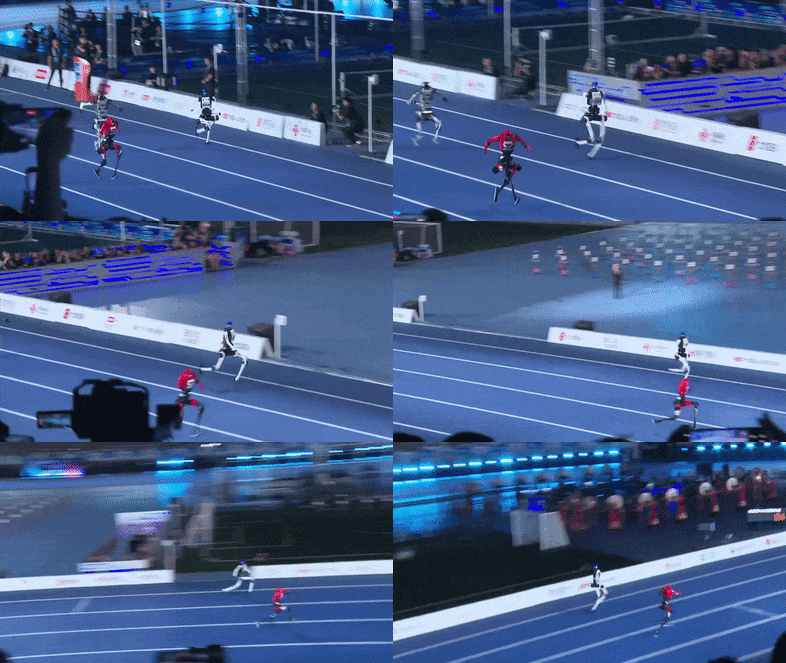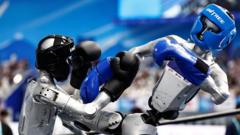
The World Humanoid Games billed itself as a milestone for engineering. Robots did not just walk; they threw punches, chased soccer balls, and sprinted down rubberized tracks. Spectators cheered for metallic limbs and synchronized servos. Behind the grandstands, however, engineers wiped cooling fluid from overworked motherboards and nursed fractured actuators. The spectacle masked a stubborn truth. Bipedal robotics remains a masterclass in fragile mechanics, where every step on a soccer pitch threatens a catastrophic drop to the turf.
Watch any promotional clip from the event. You will see agile machines darting forward, mimicking human motion with eerie precision. You will not see the three backup units waiting in the pit, nor the thermal throttling that forces processors to slow down after ninety seconds of exertion. We are throwing bipedal machines into human sports arenas before solving the foundational mathematics of dynamic balance under unpredictable loads.
The Physics Problem Nobody Wants to Solve
Human athletes absorb shock through cartilage, tendons, and muscle elasticity. Humanoids absorb shock through expensive carbon-fiber frames and gearboxes that strip their teeth under high-impact collisions.
When a humanoid soccer bot strikes a rolling ball, the reactive force travels straight up through the tibia actuator into the main chassis. Without biological adaptation, engineers must over-engineer every joint. That means adding weight. Weight demands stronger motors. Stronger motors require larger batteries. Larger batteries add more weight, creating an insatiable engineering loop that destroys efficiency.
Consider the sprinting events. While wheeled machines cover ground with boring, unbroken reliability, bipedal runners experience a chaotic airborne phase. Every time a humanoid foot leaves the ground, the control algorithm faces a complex calculation of trajectory, wind resistance, and angular momentum. One microsecond delay in sensor feedback results in a face-plant.
[Foot Lift] -> [Sensor Feedback Delay] -> [Algorithmic Adjustment Failure] -> [Catastrophic Drop]
We treat these falls as humorous bloopers in highlight reels. They are actually severe design failures. Every high-speed tumble risks micro-fracturing delicate LiDAR sensors and shearing internal wiring harnesses. Sports punish equipment. Until mechanical engineers discover materials that mimic muscle hysteresis, running machines at high speeds will remain an expensive parlor trick.
Why Boxing is a Mechanical Dead End
Nothing highlights the absurdity of humanoid sports quite like the boxing ring. Two metal figures swing servo-driven arms at each other, generating about as much kinetic energy as a stiff kitchen blender.
The media loves to frame this as the dawn of automated combat. It is actually a distraction from real-world utility. In a factory or a disaster zone, impacts are accidental and chaotic. In a boxing ring, impacts are deliberate, focused, and violent. When a metal fist connects with a titanium jaw bracket, the resulting shockwave rattles delicate onboard cameras and shakes inertial measurement units loose from their mounts.
Engineering teams spend months hardening these circuits against vibration. That is time stolen from solving actual mobility challenges, such as navigating rubble or climbing stairs without falling over. We are prioritizing visual entertainment over functional progress because venture capital demands viral moments. A robot landing a clumsy right hook looks great on social media feeds. A robot quietly sorting laundry in a dark warehouse does not generate ad revenue.
The Software Mirage
Hardware gets the glory, but software carries the burden. Modern humanoid machines rely heavily on machine learning models trained in simulated environments. Engineers spin up virtual physics engines, run millions of walking cycles overnight, and deploy the resulting policies onto physical hardware.
Simulation lies.
A virtual floor offers perfect friction. A virtual motor never overheats. When these algorithms meet the real world—with its slightly uneven turf, random temperature fluctuations, and loose rubber granules—the models stumble.
During the football matches at the games, several units froze mid-field not because of hardware failure, but because their neural networks encountered a visual state they had never seen in simulation. A shadow cast by an overhead light bar was enough to confuse a vision-based positioning system. Instead of adapting, the machine locked its joints to protect its internal gyroscopes, turning into a stationary titanium statue while the ball rolled past.
The Utility Divergence
We must draw a sharp line between exhibition robotics and industrial robotics.
The World Humanoid Games celebrates form over function. A bipedal layout is deeply inefficient for ninety percent of warehouse and logistics tasks. Wheels roll further on less power. Quadruped designs handle rough terrain with far greater stability than any two-legged machine.
Why do we insist on making robots look like us?
Anthropomorphic design satisfies a deep psychological need for companionship and mirrored identity. We want our creations to resemble our reflections. Yet, forcing a machine to walk on two legs is like forcing a car to walk on mechanical stilts instead of using tires. It is a triumph of stubborn engineering over common sense.
The companies pouring millions into humanoid sprinting and boxing are chasing theatrical validation. Meanwhile, companies building unglamorous wheeled platforms for hospital corridors and agricultural fields are quietly capturing the actual market.
The spectacle in the stadium will fade. The broken servos will end up in recycling bins. What remains is a sobering realization: building a machine that can run a hundred meters or throw a punch is easy compared to building a machine that can survive the reality of physical friction without a pit crew standing by with wrenches.