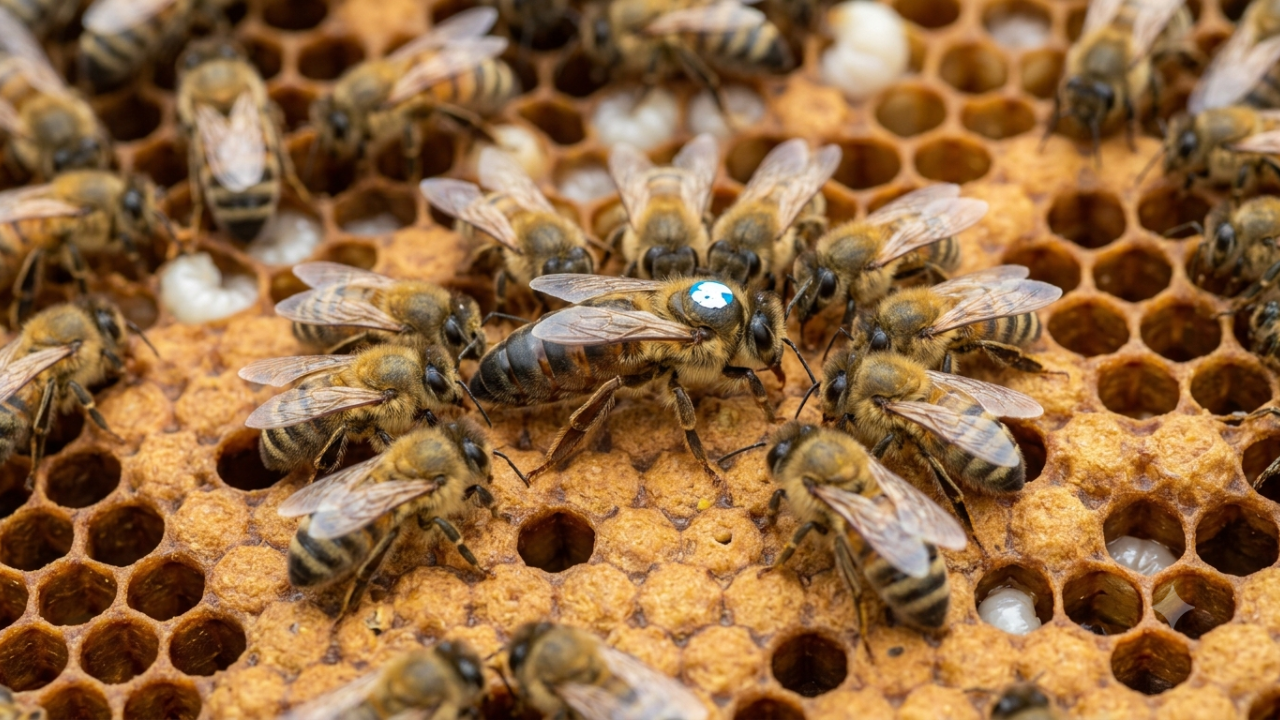
The internet loves a scientific fairy tale. For years, viral science blogs and amateur beekeeping sites have repeated a spectacular claim: the queen honeybee, fueled by a magical substance called royal jelly, lives up to eight years, while her sisters, the worker bees, burn out in a mere six weeks.
It is a beautiful story of longevity. It is also flatly wrong. Also making waves recently: The Anatomy of Regulatory Friction Why Australia Age Assurance Policy Fails the Implementation Test.
In the harsh reality of the modern apiary, a queen honeybee rarely survives beyond two to three years. In commercial operations, she is often replaced after just one. Yet, even when we strip away the exaggeration, the true gap in lifespan between a queen and a worker remains one of nature’s most jarring biological inequalities. These two insects are genetic clones, sharing the exact same DNA. One lives for years and produces millions of offspring; the other works herself to death in under two months without ever reproducing.
This is not a story of a magical eight-year reign. It is a story of a brutal, epigenetically enforced caste system that exploits the cellular machinery of the worker bee to keep a single, genetically identical sister alive. Additional insights into this topic are covered by Mashable.
The Epigenetic Switch and the Royal Jelly Myth
Every female larva in a hive starts on equal footing. For the first three days of life, every single one of them eats royal jelly, a nutrient-rich secretion from the glands of young nurse bees.
On day four, the hive makes a decision.
For the vast majority of larvae, the menu changes. They are switched to "worker jelly"—a coarser mixture of honey, pollen, and water. Only a select few, housed in vertically oriented queen cups, continue to swim in royal jelly until they pupate.
This dietary divergence triggers a massive epigenetic cascade. The continuous consumption of royal jelly suppresses a key gene called Dnmt3. When Dnmt3 is silenced, it stops methylating the bee's DNA.
This lack of methylation acts like a green light for a suite of queen-specific genes. It is a molecular restructuring. The queen develops fully functional ovaries, a larger abdomen, and a brain wired for reproduction rather than labor.
Conversely, the worker bees are chemically castrated by their restricted diet. Plants contain p-coumaric acid, a compound found in the pollen fed to worker larvae. This compound, along with the nutritional deprivation of their transition diet, downregulates their reproductive development. The worker bee is not merely "not chosen" to be queen; she is actively steered away from it by chemical intervention.
The Cost of Labor and the Oxygen Trap
To understand why a worker bee dies so quickly, you must look at how she breathes. Bees do not have lungs. Instead, they rely on a network of tracheal tubes that deliver oxygen directly to their tissues.
This system is highly efficient, but it comes with a devastating cost during active flight.
When a worker bee transitions from hive duties to foraging—usually around her third week of life—her metabolic rate skyrockets. She must beat her wings up to 230 times per second to carry nectar and pollen back to the hive. This extreme physical exertion generates massive amounts of reactive oxygen species (ROS), commonly known as free radicals.
These free radicals ravage the worker's cellular structures.
Because her body is optimized for short-term labor rather than long-term maintenance, her repair mechanisms cannot keep up. Her flight muscles degrade, her nervous system accumulates damage, and her immune system begins to fail. The worker bee literally burns herself out from the inside.
The queen, by contrast, lives a life of profound physical leisure.
Once her initial mating flights are completed early in life, she never flies again unless the hive swarms. She remains in the dark, temperature-regulated core of the hive, surrounded by an entourage of workers that groom her, feed her pre-digested food, and remove her waste. Her metabolic output is entirely focused on egg-laying, an activity that, while demanding, does not generate the catastrophic oxidative stress of long-distance aviation.
The Vitellogenin Tradeoff
At the center of this longevity divide sits a single, dual-purpose protein called vitellogenin.
In most animals, vitellogenin is simply a yolk precursor protein used to make eggs. In honeybees, evolution hijacked this molecule and turned it into a powerful antioxidant and immune regulator.
The queen's body is flooded with vitellogenin. Because she is constantly producing eggs, her vitellogenin levels remain perpetually high. This abundance of the protein acts as a systemic shield, neutralizing free radicals before they can damage her organs and protecting her cells from oxidative stress.
For the worker bee, vitellogenin is a finite resource managed through a biological zero-sum game.
The Worker's Resource Split
- The Nurse Phase: Young workers have high levels of vitellogenin, which they use to produce royal jelly for the larvae. During this phase, their immune systems are strong, and they are relatively resilient to aging.
- The Forager Transition: When a worker transitions to foraging, a hormonal shift occurs. Juvenile hormone levels rise, causing vitellogenin levels to plunge.
- The Downward Spiral: Once vitellogenin is depleted, the worker loses her antioxidant protection. Her immune system collapses, leaving her vulnerable to pathogens, parasites, and environmental toxins.
This biological tradeoff is so rigid that if you experimentally remove a foraging bee's flight opportunities, her vitellogenin levels do not recover. The transition is a one-way ticket to senescence.
The Modern Apiary and the Declining Reign
While the evolutionary mechanics of the hive should allow a queen to live three to five years in the wild, the reality of modern agriculture has shattered this timeline.
Queens are dying younger than ever before.
A primary driver of this decline is the ubiquitous use of agricultural pesticides, particularly neonicotinoids. Research has demonstrated that even sublethal exposure to these chemicals impairs the queen’s reproductive tract, reduces her pheromone production, and cuts her lifespan in half.
Furthermore, the varroa mite (Varroa destructor) and the viruses it vectors—such as Deformed Wing Virus—have compromised hive health globally. To combat these pests, beekeepers frequently apply chemical miticides to their hives. While these treatments kill the mites, they also accumulate in the wax comb, creating a toxic environment that degrades the quality of the queen's eggs and shortens her operational life.
When a queen’s pheromone output drops or her egg-laying slows down, the workers do not mourn her. They execute her.
Through a process called supersedure, the workers will identify a failing queen, raise a handful of new queen larvae from her eggs, and then ball the old queen—clustering around her until she overheats and suffocates.
In the industrial apiary, the romanticized "eight-year" monarch is a myth of a bygone era. The modern queen is a highly specialized biological machine operating in an increasingly hostile environment, her extended lifespan bought entirely paid for by the systemic exploitation and rapid death of her sterile sisters.

:max_bytes(150000):strip_icc():focal(842x0:844x2)/twin-peaks-billy-zane-040425-70a37fe9a7cb4ffb9e7821106c80f296.jpg)

