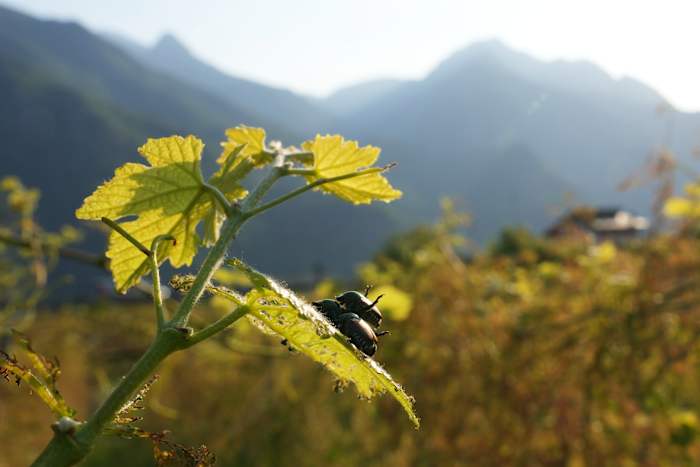
The invasion of Popillia japonica (Japanese beetle) across the Po Valley represents a structural failure in regional biosecurity, transforming a localized phytosanitary threat into a chronic operational tax on European agriculture. Originating near Milan's Malpensa Airport in 2014, the scarab beetle has exploited the continuous monocultures of the Pianura Padana to establish self-sustaining breeding populations. The resulting agricultural damage across Piedmont and Lombardy follows a dual-vector mechanism: adult foliar skeletonization above ground and larval root destruction below ground.
Mitigating this species requires moving past reactive pest control toward an integrated bioeconomic framework. Evaluating the biological mechanisms, financial exposure, and current management failures demonstrates the exact structural interventions required to protect high-value viticulture and fruit production.
The Vector Dynamics of the Po Valley Expansion
The rapid establishment of Popillia japonica in Northern Italy relies on three distinct environmental and operational vectors.
Continuous Host Availability
The Po Valley provides an uninterrupted corridor of preferred host plants. The beetle is a polyphagous pest capable of feeding on over 300 plant species. In Northern Italy, this dietary breadth aligns with high-density production of Vitis vinifera (wine grapes), Prunus persica (peaches), Malus domestica (apples), and Zea mays (corn). The spatial continuity of these crops eliminates the natural geographic barriers that typically slow pest dispersal.
Soil Hydrology and Oviposition Optimization
Females require moist, fine-textured soils to lay eggs. The extensive flood-irrigation networks serving the region's rice fields and forage crops create microclimates for egg survival and larval development. Dry summer soil suppresses egg hatching; irrigated agricultural land artificially removes this environmental constraint.
Transportation Interception Deficits
Adult beetles are strong flyers over short distances, but their long-range expansion occurs via hitchhiking on cargo transport, passenger vehicles, and freight trains. The logistical density of Lombardy and Piedmont serves as an accelerator, moving small founder populations into previously uninfested agricultural zones faster than natural flight capability allows.
Quantitative Impact on Agronomic Yields
The economic burden of Popillia japonica is divided into direct yield losses and indirect management overhead.
Total Agronomic Loss = Direct Foliar Defoliation Loss + Below-Ground Root Biomass Loss + Secondary Pathogen Vulnerability Cost + Phytosanitary Market Access Penalty
Foliar Surface Area Reduction
Adult beetles feed on the parenchyma tissue between leaf veins, leaving behind a characteristic skeletonized network. When defoliation exceeds 20% during critical phenological stages—such as veraison in grapevines or fruit swelling in stone fruits—photosynthetic capacity drops sharply. The plant reallocates stored carbohydrate reserves from fruit development to emergency leaf production, resulting in:
- Lower Brix levels in wine grapes, altering sugar-to-acid ratios and degrading wine quality classification.
- Smaller fruit size and premature fruit drop in stone fruit orchards.
- Reduced cold hardiness in perennial vines, increasing mortality risk during winter freezes.
Larval Root Demolition
Overwintering grubs feed on the root systems of grasses and young perennial crops. In newly established vineyards and orchards, root pruning by grubs starves the plant of nitrogen and phosphorus. This results in stunted canopy growth, systemic drought stress even under irrigation, and high sapling mortality rates during the first two years of planting.
Secondary Microbial Vectoring
The physical wounds left by adult feeding act as infection pathways for opportunistic fungal and bacterial pathogens. Botrytis cinerea (grey mold) and sour rot outbreaks increase in infested vineyards, requiring supplemental fungicide applications that further escalate the input cost per hectare.
Structural Failures of Current Suppression Models
The current frustration among Italian agricultural producers stems from an over-reliance on single-variable suppression strategies that fail to address the pest's lifecycle dynamics.
Chemical Resistance and Regulatory Limits
Broad-spectrum synthetic insecticides (such as pyrethroids and neonicotinoids) offer short-term knockdowns of adult populations. However, European Union regulations restrict the frequency, timing, and chemical active ingredients permitted in food production. Continuous chemical application triggers three distinct failure points:
- Rapid re-infestation from adjacent untreated non-crop vegetation within 48 to 72 hours.
- Suppression of natural predator populations, including predatory mites and beneficial ground beetles.
- Increasing compliance costs and risk of exceeding Maximum Residue Limits (MRLs) on exported produce.
Mass Trapping Artifacts
Pheromone and floral attractant traps are widely deployed across affected municipalities. While effective for monitoring population density, mass trapping frequently backfires as a population control mechanism. Attractants draw significantly more adult beetles into a localized area than the physical trap can capture. The surplus beetles spill over onto adjacent crops, creating localized defoliation hotspots worse than untrapped control zones.
Mismatched Biological Controls
The introduction of entomopathogenic nematodes (Heterorhabditis bacteriophora) and fungi (Metarhizium anisopliae) targets the soil-dwelling larval stage. While ecologically sound, performance fluctuates widely based on soil moisture, temperature, and application timing. Poor soil penetration and UV degradation reduce field efficacy, leaving farmers with high biological input costs and inconsistent grub mortality.
Strategic Interventions for Long-Term Control
Addressing the threat requires an integrated management system built on three coordinated operational moves.
First, transition from localized trap deployment to perimeter-buffer trapping networks. Pheromone attractants must be positioned at least 150 meters away from high-value crop borders, inside non-crop aggregation zones, to intercept incoming flights without drawing beetles into active production fields.
Second, adjust soil management routines during peak oviposition windows in mid-to-late summer. Intentionally withholding irrigation on non-essential field margins hardens the topsoil layer, preventing female beetles from penetrating the surface to deposit eggs and sharply lowering grub survival rates for the following season.
Third, standardize regional applications of entomopathogenic nematodes by pairing them with soil moisture sensors. Applying biological agents strictly when soil temperatures remain between 15°C and 25°C with saturated soil profiles maximizes larval infection rates, providing a predictable reduction in the overwintering population.