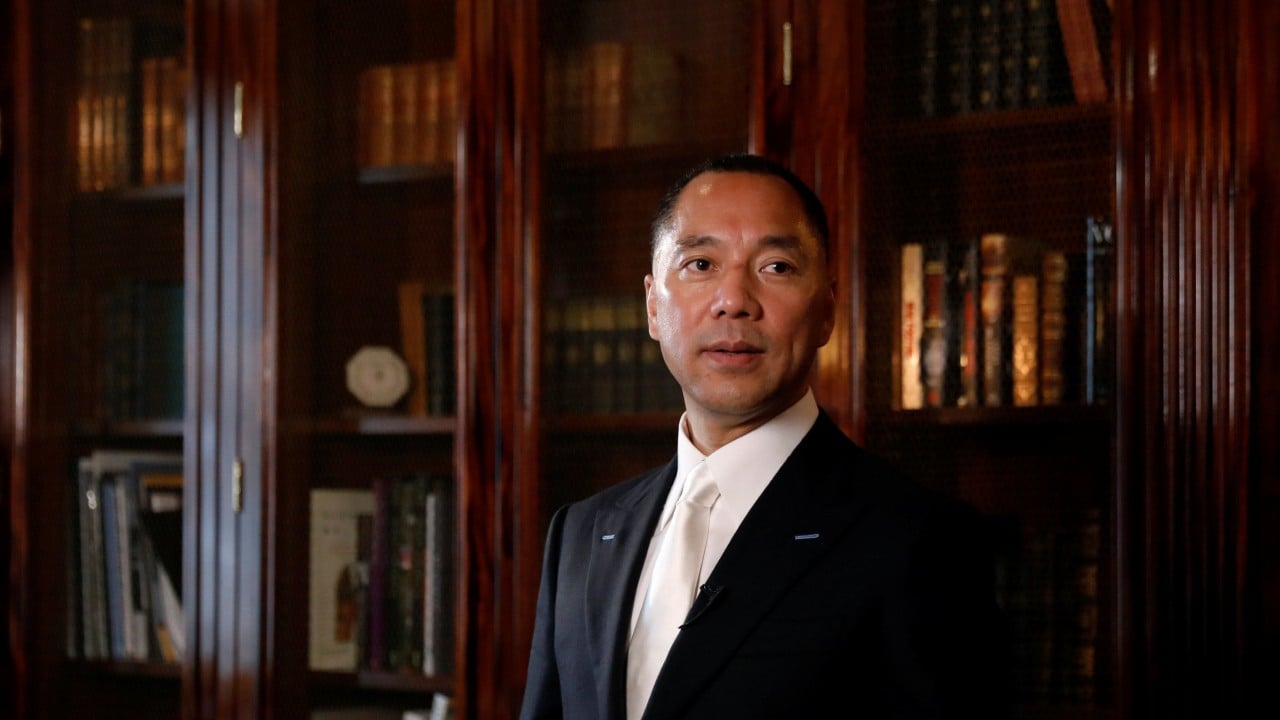
The rain outside the Manhattan federal courthouse did nothing to wash away the heavy, suffocating silence in the courtroom. When the judge finally spoke the number, it hit the room like a physical blow. Thirty years. For a man who once commanded an empire of digital whispers, luxury yachts, and a fiercely loyal online army, the sentence felt less like a legal conclusion and more like the sudden, violent closing of a theater curtain.
Miles Guo Wengui had spent years positioning himself as the ultimate defector, the billionaire whistleblower who knew too much, the one man the Chinese Communist Party feared above all else. But when the gavel fell in New York, the grand illusion shattered. He wasn’t a geopolitical chess master. He was, according to a federal jury, a thief who systematically stripped his own followers of more than a billion dollars.
Across the ocean, in Beijing, the reaction from official state channels arrived with a chilling, clinical promptness. To the Chinese government, Guo was never a political dissident. He was a fugitive. An Interpol red notice with a name attached. His three-decade American prison sentence wasn't viewed in Beijing as a triumph of Western democracy, but as a long-delayed accounting for a man who ran from the law, only to get trapped in a cage of his own making.
The story of Guo Wengui is not just a tale of high-stakes international intrigue. It is a deeply human tragedy about the weaponization of trust, the desperation of exile, and the crushing weight of a system that eventually catches up with everyone.
The Currency of Rage
To understand how a man could convince thousands of people to hand over their life savings, you have to understand the specific type of loneliness that comes with being part of a diaspora.
Imagine an ordinary family living in a quiet suburb of Vancouver or Sydney. Let us call them the Chens—a hypothetical compilation of the hundreds of real victims who filled out victim impact statements for the prosecution. They left China years ago, seeking a different life, yet their hearts remained tethered to the homeland. They watched from afar, deeply uneasy about the tightening grip of authoritarian rule back home, feeling completely powerless to change it.
Then, out of the digital ether, came Guo.
He did not look or sound like a typical political activist. He broadcasted from a $68 million penthouse overlooking Central Park. He wore immaculate bespoke suits. He smoked expensive cigars while lounging on the deck of a 150-foot mega-yacht named the Lady May. He possessed an explosive, charismatic energy, delivering daily livestreams that promised to topple the Chinese ruling regime.
To people like the Chens, his wealth was his credentials. In the cynical arena of transnational politics, a poor dissident is easily dismissed. But a billionaire? A billionaire must know where the bodies are buried. His opulence was treated as proof of his power. When Guo claimed he had secret inside information about corruption at the highest levels of the Chinese state, people believed him because his lifestyle screamed that he was untouchable.
He tapped into a profound, aching desire for change among overseas Chinese communities. He didn't just sell political commentary; he sold a sense of belonging to a historic movement. He created an insular, digital ecosystem complete with its own media platforms and a custom cryptocurrency scheme called the "H-Coin."
Guo told his followers that this cryptocurrency would become the financial backbone of a new society, a safe haven completely insulated from both the Chinese government and traditional banking collapses. He told them their money would be used to fight the good fight.
The reality was far uglier. The money didn't go toward funding a revolution. It went toward maintaining a mirage.
The Anatomy of an Illusion
The federal prosecutors in New York laid bare the architecture of the fraud with a devastating mountain of financial records. Bank transfers, wire receipts, and luxury purchase orders stripped away the political mystique to reveal a textbook affinity fraud.
While his followers believed they were investing in freedom, their hard-earned money was being funneled into an astonishing array of personal luxuries. The funds bought a $4.4 million Bugatti sports car. They paid for a $3.5 million Ferrari for Guo’s son. Millions more vanished into ultra-premium Italian mattresses, luxury home renovations, and the daily maintenance of a lifestyle that was entirely parasitic.
Consider the psychological cruelty of this setup. The people sending him money were not institutional venture capitalists who could afford to take a loss. Many were working-class immigrants, retirees, and families who poured their entire life savings into Guo’s various entities. They did so because they trusted him as a fellow compatriot who claimed to share their deepest values.
When a follower raised questions about where the money was actually going, the digital army Guo created would pivot instantly. The doubter would be branded a spy for Beijing. They would be harassed online, their personal information doxed, and in some cases, protesters loyal to Guo would show up outside their homes. He built a fortress of paranoia where loyalty was measured by financial compliance, and dissent was treated as treason.
This weaponization of political anxiety is what makes the case so profoundly tragic. Guo didn't just steal money; he hijacked a legitimate, deeply felt political grievance and turned it into a marketing funnel for a scam.
The View from the Other Side
When the news of the 30-year sentence hit the wires, the Chinese Foreign Ministry’s response was predictably unyielding. For years, Beijing had viewed Guo as a public relations thorn in their side, an embarrassing rogue element who utilized the protection of the American legal system to launch relentless rhetorical attacks against the state.
The official narrative from China has always been simple: Guo Wengui was a corrupt real estate mogul who fled the country in 2014 ahead of a sweeping anti-graft crackdown. He was wanted for bribery, fraud, and a host of other financial crimes long before he ever set foot on American soil or styled himself as a freedom fighter.
From Beijing's perspective, the US court ruling is an objective vindication of their long-standing characterization of Guo. It allows them to signal to other domestic elites that fleeing abroad does not grant permanent immunity. The message is clear: the shield of Western political asylum is fragile, and eventually, the true nature of a fugitive's conduct will expose them.
Yet, this geopolitical framing completely misses the human collateral left in Guo’s wake. The back-and-forth rhetoric between international superpowers matters very little to an elderly investor who watched her retirement fund evaporate into a billionaire's custom mattress collection. The geopolitical theater is vast and cold, but the pain of betrayal is intensely local.
The Collapse of the Citadel
The end did not come with a cinematic climax, but with the quiet, methodical turning of pages in a federal archive.
During the trial, the defense tried desperately to maintain the narrative that Guo was the target of a massive, sophisticated cross-border assassination of character orchestrated by foreign intelligence agencies. They argued that his financial arrangements were complex because he had to keep his money safe from state actors who wanted to freeze his assets.
But a jury of ordinary New Yorkers looked past the smoke and mirrors. They didn't see an international man of mystery. They saw a promoter who promised a 100% return on investment, took the cash, and bought a fleet of exotic cars. The contrast between the grand political rhetoric and the mundane greed of the shopping sprees was too stark to ignore.
Watching the downfall of a figure like Guo leaves behind a complex mixture of anger and profound sorrow. It forces us to confront how easily our deepest convictions can be turned against us when we let our desire for a savior override our critical faculties.
The 150-foot yacht has been ordered sold by a bankruptcy court. The Central Park penthouse is quiet. The digital followers who once chanted his name are left to navigate the wreckage of their finances and the bitter realization that their faith was used as collateral.
Guo Wengui will spend the twilight of his life inside the sterile walls of an American federal penitentiary, a stark departure from the marbled halls and open oceans he once claimed as his domain. He remains a man caught between two worlds, rejected by the homeland he fled, and locked away by the country he claimed would protect him.
The empire built on rage and digital illusions has finally run out of runway, leaving behind a stark reminder that the cost of misplaced trust is always paid by those who can least afford it.