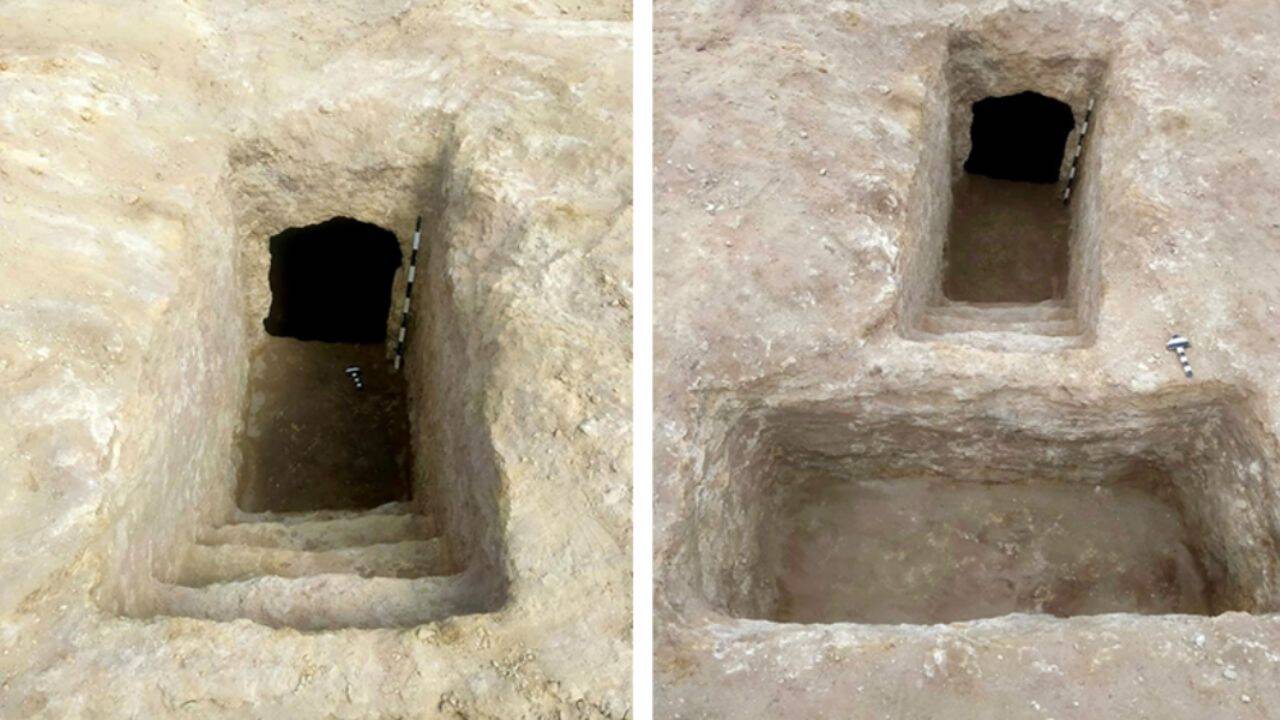
Archaeology in Egypt often suffers from a severe case of southern bias. For generations, the glamorous narrative of pharaonic power has been dictated by the limestone cliffs of Luxor, the scorched grandeur of the Valley of the Kings, and the towering monuments of Aswan. Yet, when excavation teams working at Tell el-Yahudiya in the eastern Nile Delta uncovered rare rock-cut tombs dating from the late New Kingdom into the Late Period, they exposed a starkly different physical reality. Beneath a later Roman military camp lay a mortuary architecture that should not exist according to standard textbook rules of the Delta.
The Nile Delta is an immense, water-logged blanket of clay-rich alluvial silt. For millennia, the annual inundation deposited fine-grained mud across the flat expanse, creating an environment utterly devoid of natural rock outcrops. Building a tomb in the Delta traditionally meant working with mudbrick—molded earth dried in the sun, durable enough for houses and storage silos, but notoriously susceptible to moisture, groundwater erosion, and the relentless creep of agricultural expansion.
To carve a tomb directly into subterranean rock in this environment is an architectural anomaly. Geologically, the earth here does not lend itself to shafts hewn out of solid bedrock unless builders targeted specific localized geological formations or hauled massive structural elements from elsewhere. The discovery of these tombs proves that ancient populations went to extraordinary lengths to subvert local environmental limitations, opting for permanent rock-cut chambers over fragile mudbrick architecture.
Reading the Stratigraphy of Tell el-Yahudiya
To understand the weight of this discovery, one must look at the physical layering of the site. Tell el-Yahudiya, located in the Qalyubia Governorate north of Cairo, has long been recognized for its association with the Hyksos period, when foreign rulers established dominance over portions of Lower Egypt. But archaeology is never a single story frozen in time; it is a stack of discarded epochs sitting directly on top of one another.
In the upper strata of this excavation, researchers found the structural remains of a Roman camp. Empires do not build on virgin ground; they appropriate, pave over, and repurpose whatever foundations precede them. The Roman military occupation utilized this elevated land for strategic purposes, completely oblivious—or indifferent—to the elaborate subterranean funerary architecture resting silently beneath their barracks and mess halls.
When the excavation team cut through these upper Roman layers, they encountered tombs divided into distinct architectural types. These were not casual trench burials or crude pit graves hastily dug into soft silt. They featured carefully planned chambers, carved with an engineering precision usually reserved for the high-status cliffs of Middle and Upper Egypt.
Portable artifacts recovered from the interior chambers provided the chronological anchors necessary to date the usage sequence. Pottery shards, amulets, and funerary goods tied the initial creation of the tombs to the late New Kingdom, while subsequent layers of use confirmed that the site remained active through the Late Period. This longevity shatters the assumption that the Delta's mortuary landscape was transient or haphazard. Communities returned to these subterranean vaults across centuries of political upheaval, foreign conquest, and shifting dynastic control.
Why Delta Archaeology is a Nightmare
To appreciate why finding a rock-cut tomb in the Delta makes headlines among specialists, one must understand the logistical nightmare of excavating this region. Southern Egypt offers dry air, stable stone, and desert sands that naturally preserve organic materials, textiles, and painted plaster. The Delta does the exact opposite.
High water tables act as a slow-motion chemical weapon against ancient organic remains. Groundwater laden with salts creeps upward through capillary action, saturating stone and brick, evaporating on the surface, and leaving behind destructive mineral crystals that crumble ancient masonry from the inside out. Furthermore, thousands of years of intensive farming have churned the upper layers of soil, obliterating fragile surface structures.
For decades, this meant that our understanding of ancient Egyptian social structure and daily life was heavily skewed toward the elite monuments of the south. What we knew about the Delta came largely from textual references in southern tombs or from heavily battered mounds that yielded broken pottery rather than intact architectural complexes.
When researchers find structural anomalies like these rock-cut tombs, it forces a complete recalibration of regional administrative capabilities. Who commissioned these subterranean spaces? Were they local elites who commanded enough labor and engineering expertise to bypass the limitations of alluvial soil, or were they provincial officials tied to state-sponsored projects designed to secure Egypt’s vulnerable northern frontier?
The Roman Overprint
The presence of the Roman camp directly above the tombs highlights a recurring theme in Egyptian history: the ruthless efficiency of imperial land management. Rome’s military apparatus was pragmatic. If a strategic elevation existed in the Delta, it was fortified, garrisoned, and integrated into the logistical network controlling grain supply and provincial communications.
The juxtaposition of a Roman military installation over an ancient Egyptian necropolis is a physical manifestation of cultural supersession. The soldiers marching across the surface levels were standing on top of ancestral burial grounds that had likely fallen out of active memory or were deliberately disregarded. Documenting how the Roman builders interacted with the underlying archaeology—whether they accidentally breached the tombs, intentionally sealed them, or simply ignored them—provides critical data on the micro-geography of imperial occupation.
This dual-layer narrative rescues Tell el-Yahudiya from being categorized as a single-period footnote. It transforms the site into a multi-generational archive where the ambitions of New Kingdom nobility, the shifting demographics of the Late Period, and the tactical grid of the Roman military machine collide within a few vertical meters of earth.
The Work That Remains
Excavation reports issued by the Ministry of Tourism and Antiquities mark only the beginning of a long analytical cycle. Finding the tombs and clearing the debris is the easy part. The real labor happens in conservation laboratories and academic offices, where specialists must piece together the micro-stratigraphy, analyze the chemical composition of the surrounding stone, and catalog every fragment of pottery recovered from the damp earth.
Every artifact tells a story of trade networks, manufacturing techniques, and economic shifts. The pottery styles will reveal whether the occupants relied on local Delta workshops or imported goods from Mediterranean trade hubs. The skeletal remains, if preserved well enough to withstand the hostile soil chemistry, will offer biochemical insights into the diet, disease load, and ancestry of the people who lived and died at the edge of the empire.
As modern remote sensing techniques and targeted excavations peel back the layers of the Nile Delta, the old picture of a culturally barren northern frontier continues to dissolve. Beneath the mud, beneath the Roman camps, and beneath the modern agricultural fields lies a dense, complex network of human ambition that refused to let a lack of stone stop them from carving their names into the earth.


