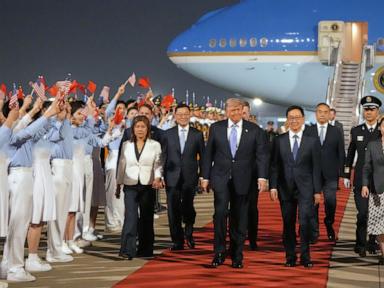
Donald Trump just touched down in a Beijing that looks very different from the city he visited nearly a decade ago. While the red carpets are thick and the military bands are playing with precision, the substance of this summit is a desperate exercise in geopolitical horse-trading. Trump isn't here to settle old scores over trade deficits. He is here because the war in Iran is bleeding the American treasury dry and he needs Xi Jinping to hand him a face-saving exit.
The primary objective is the reopening of the Strait of Hormuz. With oil prices sitting at levels that threaten to collapse the global economy and inflation gutting the American middle class, Trump’s political survival depends on a deal. But in the cold math of global power, a favor from Beijing comes with a price tag that involves the future of Taiwan and a total reconfiguration of the high-tech trade war.
The Iran Trap and the Beijing Lifeboat
The war with Iran, which began with strikes in February 2026, has reached a stalemate that Washington can no longer afford. While the United States has the military hardware to project force, it has found that bombs cannot keep a shipping lane open when the opponent is willing to fight a war of attrition. China, as the largest buyer of Iranian crude, is the only player with the leverage to force Tehran to the negotiating table.
Trump is betting that Xi is just as worried about the blockade as he is. China’s economy relies on that oil, and despite their "no-limits" partnership with Russia and their own strategic reserves, a prolonged global recession is the one thing the CCP fears more than American presence in the Pacific.
However, Beijing has played its hand perfectly. By staying officially neutral while quietly providing Tehran with satellite data and industrial components, Xi has made himself the indispensable man. Trump is no longer coming to China as the enforcer of "America First" trade policies; he is coming as a buyer in a seller’s market.
Selling the Taiwan Shield
The most explosive part of this summit isn't the trade talk. It is the fate of the $11 billion arms package authorized for Taiwan. For forty years, the "Six Assurances" have dictated that the U.S. would never consult Beijing on arms sales to the island. Trump just signaled he is willing to tear that playbook up.
Before boarding Air Force One, Trump told reporters that Xi "would like us not to" sell those weapons and that he would "have that discussion." To the veterans of the State Department, this is heresy. To Trump, it is a bargaining chip.
If Beijing can guarantee a permanent ceasefire in the Gulf and the total reopening of the Strait of Hormuz, Trump appears ready to "delay" or "re-evaluate" the shipment of advanced missiles and jets to Taipei. The logic is brutal. He needs a win in the Middle East to secure his domestic standing, even if it means eroding the defense of the first island chain.
The Weaponization of Rare Earths
While the guns are silent in the Pacific for now, the trade war has moved into the molecular level. Last year, Trump hit China with tariffs exceeding 140%. Beijing didn't respond with equivalent tariffs; they responded with an embargo on rare earth minerals.
This move effectively paralyzed the American defense industry. You cannot build a Tomahawk missile or an F-35 without the minerals that China currently controls. The "Board of Trade" being discussed in Beijing this week is essentially a surrender document disguised as a diplomatic breakthrough. Trump needs those minerals to replenish the stockpiles depleted by the Iran conflict.
The proposed deal on the table looks something like this:
- The U.S. eases restrictions on high-end Nvidia chips, specifically the H200 and Blackwell architectures.
- China resumes the export of critical minerals and agrees to massive purchases of Boeing aircraft and American soybeans.
- Both sides establish a "Board of Investment" to allow Chinese capital back into U.S. manufacturing under specific "non-sensitive" labels.
The AI Cold War Safety Valve
The tension in the air isn't just about ships and minerals; it is about the ghosts in the machines. In April, the White House accused China of the largest intellectual property theft in history, targeting American AI labs. Beijing didn't even bother to offer a sophisticated denial.
Both leaders realize that an unconstrained AI arms race is a recipe for a conflict that neither can control. There is a quiet push among the tech advisors in both delegations to establish "hotlines" for AI incidents. They are looking for a non-binding framework to prevent an autonomous system from misinterpreting a flare in the Persian Gulf as a declaration of war.
This is the "Red Telephone" for the 21st century. It acknowledges a terrifying reality: neither superpower fully understands the tools they are currently deploying on the battlefield.
The Soybeans and Steel Mirage
Expect the state media on both sides to focus on the easy wins. There will be photos of Trump and Xi at the Temple of Heaven. There will be announcements of multi-billion dollar orders for American beef and agriculture. These are the optics designed to soothe the markets and the voters back home.
But look at what isn't being discussed. There is no mention of the massive state subsidies China uses to dominate the electric vehicle and solar market. There is no talk of human rights. There is only the transactional necessity of two aging leaders trying to prevent their respective ships of state from sinking under the weight of a global energy crisis.
The real victory for Xi won't be the trade numbers. It will be the sight of a U.S. President coming to Beijing to ask for help with a war that Washington couldn't finish on its own. For decades, the U.S. has been the guarantor of global shipping. By asking China to fix the Strait of Hormuz, Trump is effectively handing over the keys to the global economy.
When Air Force One departs on Friday, the world will likely have cheaper gas and a "truce" in the Middle East. But the price for that temporary relief will be a Taiwan that feels significantly more alone and a China that has finally proven it can bring the American economy to its knees without firing a single shot.
The transaction is almost complete. Trump gets his "peace" for the 2026 election cycle. Xi gets the blueprint for a century where Beijing, not Washington, calls the shots.