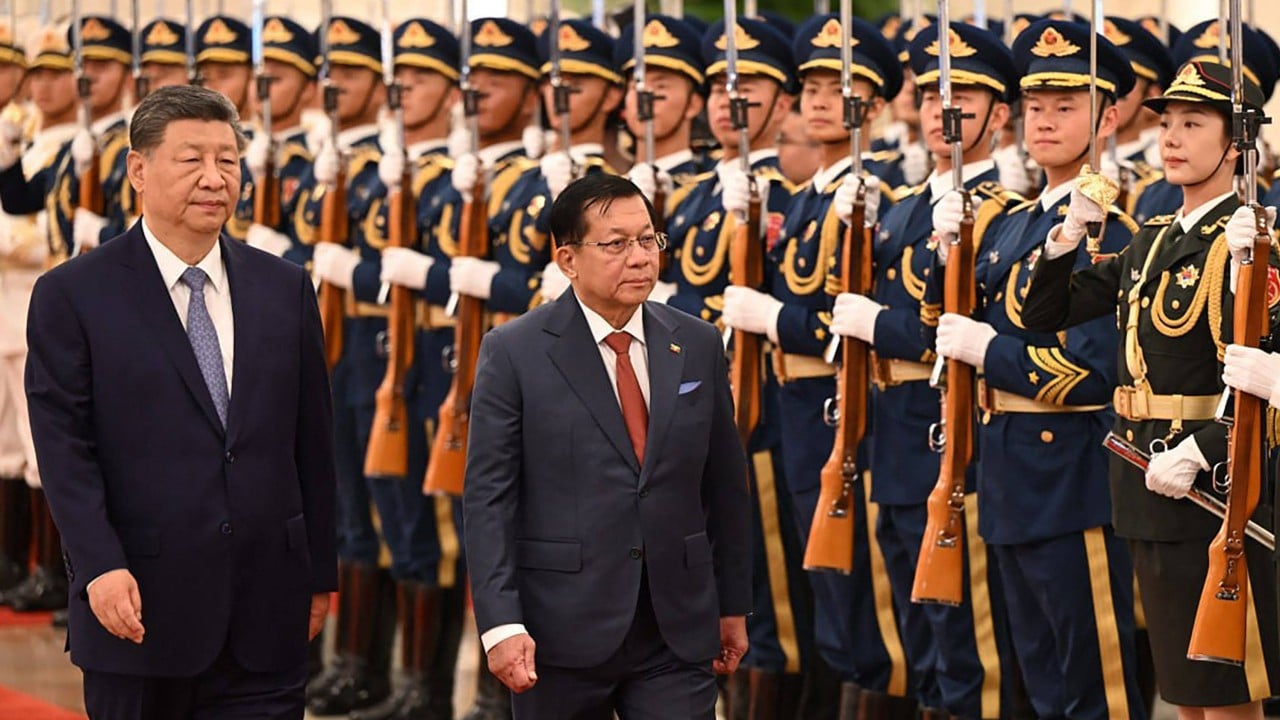
You can buy a lot of things with a 21-gun salute, but real legitimacy isn't usually one of them. Yet, inside the Great Hall of the People in Beijing, Myanmar's military ruler-turned-president Min Aung Hlaing got exactly that. A lavish welcome banquet, an honor guard review, and a personal endorsement from Chinese President Xi Jinping.
For a man who has spent the last five years being treated as an international pariah, the scene was a massive diplomatic win.
Min Aung Hlaing's arrival in Beijing for a five-day state visit marks a massive shift in how the region deals with the ongoing crisis in Myanmar. After a series of highly controlled, staged elections held between December 2025 and January 2026, the former junta leader formally shed his military uniform to become the "civilian" president of a new government in April. The West immediately called the elections a complete sham. Most of the political opposition remains locked up or active in the armed resistance. But Beijing decided it didn't care. By rolling out the red carpet, Xi Jinping gave the new administration in Naypyidaw something it desperately needed: a lifeline of political recognition.
If you want to understand why China is stepping in to prop up its neighbor right now, you have to look past the official talk of "brotherly friendship." It's not about affection. It's about cold, hard strategic math.
The Real Cost of Beijing’s Endorsement
Beijing's sudden embrace isn't a blank check. Xi Jinping made it clear during their talks that Chinese backing comes with heavy strings attached. China and Myanmar share a massive 2,100-kilometer border, and that border has been a chaotic mess since the 2021 coup. The civil war has disrupted trade, sent waves of refugees toward Chinese territory, and allowed criminal syndicates to flourish.
During the meetings, the two leaders signed 18 cooperation agreements covering everything from free trade to transportation. But the real core of the discussion centered on two massive headaches for Beijing: broken infrastructure and runaway border crime.
1. Resuscitating the Indian Ocean Shortcut
The absolute centerpiece of China's economic interest in Myanmar is the China-Myanmar Economic Corridor (CMEC). This isn't just a collection of random roads. It's a massive network of infrastructure meant to give Beijing direct access to the Indian Ocean, completely bypassing the congested Malacca Strait.
The corridor cuts straight from China's southwestern Yunnan province down to the western coast of Myanmar. The ultimate destination is the Kyaukphyu deep-water port and special economic zone in Rakhine State. Xi Jinping explicitly pressured Min Aung Hlaing to get these stalled projects moving again. The catch? Many of these construction sites sit directly inside active combat zones. China wants its energy pipelines and ports protected by actual security forces, but the Myanmar military is currently stretched thin trying to fight off a dozen different rebel groups.
2. Squeezing the Scam Compounds
The other major issue driving China's policy is the explosion of multibillion-dollar online scam networks and telecom fraud hubs along the border. These compounds, often run by organized crime groups under the loose protection of local militias, have targeted tens of thousands of Chinese citizens.
Beijing has lost patience with the lawlessness. While Min Aung Hlaing promised to work closely with China to stamp out online gambling and drug trafficking, executing that promise is a nightmare. The central government simply doesn't control the territory where many of these networks operate.
The Illusion of Control in a Broken Economy
The timing of this diplomatic push highlights just how desperate Myanmar's new government is for cash and recognition. Right before heading to Beijing, Min Aung Hlaing took a five-day trip to India. He's actively trying to play his two giant neighbors against each other to break his international isolation.
But a fancy foreign trip can't hide a collapsing domestic economy. The World Bank just released a grim assessment of Myanmar's financial reality. The numbers are ugly:
- Inflation skyrocketed to 25 percent in April 2026.
- Growth forecasts were slashed from a meager 3 percent down to just 2 percent for the fiscal year.
- The country's remaining private sector is completely focused on pure survival rather than expansion.
The military thought holding staged elections would calm the waters and invite foreign investment back into the country. Instead, international sanctions remain tightly locked in place, and the domestic conflict shows no signs of stopping.
What This Means for the Civil War
By backing the post-election government, China is betting that military-backed rule—even under a thin civilian veneer—is the only realistic path to stability. It's a dangerous gamble.
Beijing's public support is going to give the military government the confidence to launch fresh offensives against the ethnic armed organizations and anti-regime resistance fighters. It also signals to other regional groups, like the Association of Southeast Asian Nations (ASEAN), that it's time to start normalizing relations with the regime.
However, this dynamic also means Myanmar is sliding into a state of total economic and political dependence on China. Beijing now holds nearly all the cards regarding border management, infrastructure development, and any future political settlement in the country. Min Aung Hlaing might have gotten his photo op with Xi Jinping, but he paid for it by handing over the keys to his country’s economic future.
To understand how this partnership functions on the ground, look at the trade data. Despite the civil war, bilateral trade between China and Myanmar hit $19.4 billion in 2025, a jump of more than 19 percent year-on-year. Money is flowing across the border, even if stability isn't.
If you are tracking the geopolitical fallout of this meeting, your next step shouldn't be watching the diplomatic statements coming out of Naypyidaw. Watch the security deployments around the oil and gas pipelines running to Kunming. If the military shifts troops away from the front lines to guard Chinese assets, you'll know exactly what Beijing demanded in exchange for that 21-gun salute.