Cold. That is the first thing a person notices when the cabin door clicks shut at Fort Greely in mid-January, even before the wind hits your face. The air smells sharp, like dry iron and pine needles frozen solid. Fifty miles south of Fairbanks, out where the Tanana River locks beneath six feet of opaque ice, a cluster of concrete silos and antenna arrays sits quiet under a bruised violet sky. Inside a bunker dug deep into the permafrost, a young technician watches a green telemetry trace pulse across a monitor. Nothing is happening. Nothing is supposed to happen. Yet every second that screen stays quiet is a second someone thousands of miles away in Moscow has to account for when planning a strike over the top of the world.
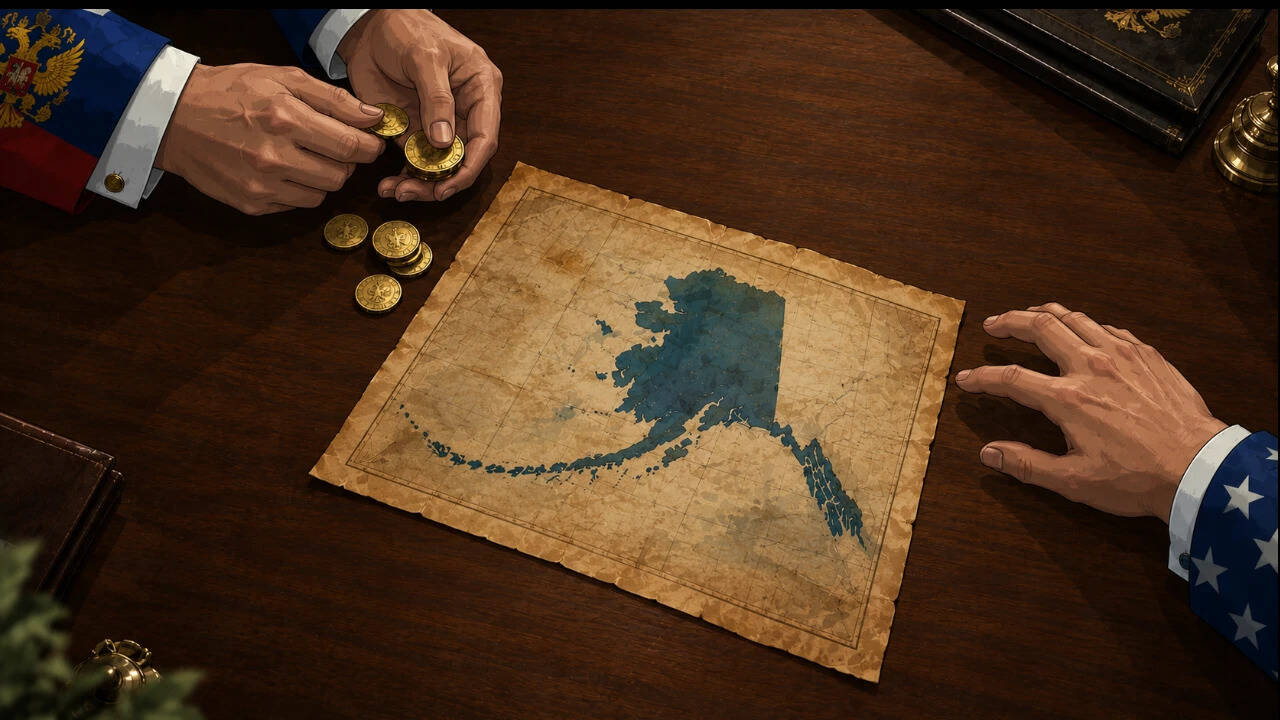
It is strange to think that all of this—the interceptors waiting in the frozen earth, the long-range radar domes scanning the Arctic sky, the sprawling airfields where fighters scramble toward unidentified bombers—once belonged to the tsars. In 1867, the Russian Empire sold Alaska to the United States for $7.2 million. Roughly two cents an acre. At the time, plenty of Americans thought Secretary of State William H. Seward had lost his mind. Critics called it "Seward's Folly" and "Walrussia," mocking the purchase of half a million square miles of icebergs, muskeg, and polar bears while the country was still stitching itself back together after the Civil War.
History has a wry sense of humor. What looked like a frozen attic in the nineteenth century became the front porch of continental defense in the twentieth—and a critical tripwire in the twenty-first.
Why a Cash-Strapped Tsar Walked Away
To understand how an empire gives up a territory nearly three times the size of France for two cents an acre, you have to look at Russia's balance sheet in the 1850s and 1860s. The Crimean War had drained the treasury and exposed how vulnerable Russia's far-flung holdings were to British naval power. St. Petersburg looked at Russian America—a vast, thinly populated stretch of coast and interior managed largely by the Russian-American Company for fur pelts—and saw a liability rather than an asset.
Tsar Alexander II and his advisors worried about two things at once. First, they were broke. Second, they feared Britain might simply seize Alaska in a future conflict, leaving Russia with nothing to show for it. Selling the territory to the United States offered a neat solution: quick cash, an end to an expensive, hard-to-defend outpost, and a buffer against British Canada.
Imagine Eduard de Stoeckl, Russia's minister in Washington, sitting across from Seward in the early hours of March 30, 1867, signing the treaty that would transfer the land. Stoeckl was not an idiot. Nobody in that room had a crystal ball capable of showing Prudhoe Bay's oil fields pumping millions of barrels a day or radar systems tracking ballistic trajectories over the North Pole. Both men were solving the problems in front of them. Seward wanted strategic room and Pacific reach. Stoeckl wanted solvency and security from a rival empire.
Even then, the deal barely squeaked through the U.S. Senate by a single vote—37 to 2—after months of lobbying and a famous speech by Senator Charles Sumner laying out the territory's resources and strategic value. Critics sneered that the government had bought a glacier garden. They missed the point, just as people who call any remote borderland "flyover" or "frozen" often miss what sits beneath the snow.
The Short Road Over the Top of the World
When you look at a flat wall map of the world, Alaska looks like a far-off corner tucked into the upper-left edge. Flat maps lie about distance and direction near the poles.
Drop a string on a globe from Moscow to Washington, D.C., or from a Russian bomber base in the Far East to the American Midwest. That string does not arch lazily across the Atlantic or Pacific oceans. It cuts straight up over the Arctic Ocean and down through Alaska and Canada. That arc is the great-circle route—the shortest path between two points on a sphere.
For military planners, geography is unforgiving. A missile or bomber taking the shortest route from Eurasia toward North America passes right through the neighborhood Alaska guards. When the Cold War turned nuclear in the 1950s, that geometry transformed a forgotten territory into a vital line of defense.
To make that strategic reality concrete, consider a hypothetical officer—let's call him Major Elena Vance, standing inside a radar operations center on a clear winter night. Outside, the temperature sits at minus thirty degrees Fahrenheit, and the aurora borealis shimmers like green silk above the spruce trees. Inside, Elena isn't looking at the sky; she is looking at returns bouncing off the upper atmosphere. Long-range early warning radars like those at Clear Space Force Station and Eareckson Air Station are built to spot objects moving thousands of miles per hour long before they come anywhere near American cities.
A metaphor helps here, though every metaphor has limits. Think of Alaska as a glass porch light left on at the edge of a dark yard. Turning on a porch light doesn't stop an intruder by itself—you still need locks on the doors and people awake inside—but it ruins the element of surprise. Without sensors and bases positioned far north, warning times shrink and uncertainty grows. A real defense network is far more complex than a single light bulb, of course, involving satellites, submarines, aircraft, and command centers across an entire continent, yet the basic logic holds: seeing farther north buys precious minutes and deters gambles that depend on going unnoticed.
From Fur Posts to Fortresses
I still remember the first time I stood near a Cold War relic in Alaska and felt the sheer scale of what had been built in the middle of nowhere. The wind howled across flat tundra where nothing taller than scrub brush survived, while towering structures rose out of the frost like ribs of a stranded whale. You don't build infrastructure like that in places like that for fun. You build it because the alternative feels worse.
Over decades, the U.S. military turned Alaska into a layered defense hub. Joint Base Elmendorf-Richardson near Anchorage anchors air dominance and rapid response in the Pacific and Arctic. Eielson Air Force Base near Fairbanks hosts advanced fighter squadrons trained for extreme cold, where hydraulic fluid thickens, metal contracts, and a simple maintenance mistake can ground a jet. Fort Greely houses ground-based interceptors designed to engage incoming long-range ballistic missiles mid-course.
None of this came cheap, and none of it was easy. Building airfields, pipelines, and radar sites on permafrost is a constant battle against physics. Thawing ground buckles runways and tilts foundations; winter darkness stretches for months; supply lines run thousands of miles over water, rail, and two-lane highways that freeze into glare ice.
Yet every investment reinforced the same irony. The very territory Russia sold to raise money and shed a distant headache became a permanent check on Russian military freedom of movement in the North. Russian aircraft testing air defense zones near Alaska routinely meet American and Canadian fighters scrambled to intercept and escort them away. Submarines slip beneath the ice, shadowed by acoustic sensors and patrol aircraft. What was once a fur-trading frontier became a place where two rival powers measure each other's reach in knots, altitude, and reaction time.
What People Usually Get Wrong About This Story
Whenever people hear that Russia sold Alaska for two cents an acre, two myths tend to pop up right away. Both deserve a closer look because they flatten a rich piece of history into a cartoon.
The first myth is that Russia "made a stupid mistake" and the U.S. "pulled off a masterstroke." That view looks back with 150 years of hindsight and pretends 1867 looked like today. In 1867, Alaska's vast oil wealth was still undiscovered, modern long-range missiles didn't exist, and governing a remote territory across an ocean without reliable telegraph or radio links was a genuine headache. For St. Petersburg, cashing out made strategic sense given its debts and European priorities. Calling it pure stupidity misses how empires actually weigh risks in real time.
The second myth is that Alaska by itself is an impenetrable shield that makes everything else optional. It isn't. Geography gives you position, not magic. Protecting a continent takes constant upkeep, alliances, intelligence, and credible deterrence—plus diplomacy to keep tensions from spiraling out of control. Even the best-placed radar or interceptor is only one piece of a much larger chessboard.
I have to admit, looking at modern Arctic headlines can make a person uneasy. When you read about melting sea ice opening new shipping lanes, new military bases reviving old Cold War names, and rival powers jockeying for influence in the high north, it is easy to feel a quiet knot in your stomach. The Arctic used to feel remote, almost mythical—a place of sled dogs and gold rushes, far removed from daily life. Now it feels closer than it should. That unease is honest. Ignoring geopolitical friction doesn't make it go away, and exaggerating every patrol into an imminent crisis doesn't help either.
The Quiet Weight of Two Cents an Acre
If you drive the Richardson Highway in winter, the silence out there has weight to it. Mile after mile of white forest and jagged peaks slips past the windshield, broken only by power lines, snowplows, and military signs reminding you that this quiet wilderness is also a working frontier. A local bush pilot or a radar operator grabbing coffee at four in the morning doesn't walk around reciting treaty dates. They just do their job in the dark and the cold so the rest of the country can sleep without thinking about northern approaches.
Sometimes the biggest shifts in history don't arrive with a bang. They arrive on a piece of parchment signed for seven million dollars by men who thought they were closing a small chapter—only to hand their descendants a permanent sentinel standing watch across the ice.
Out on the frozen runway, a jet's engines spool up with a high, piercing whine that echoes off the snow, cutting cleanly through the Arctic stillness before lifting into the pale northern sky.