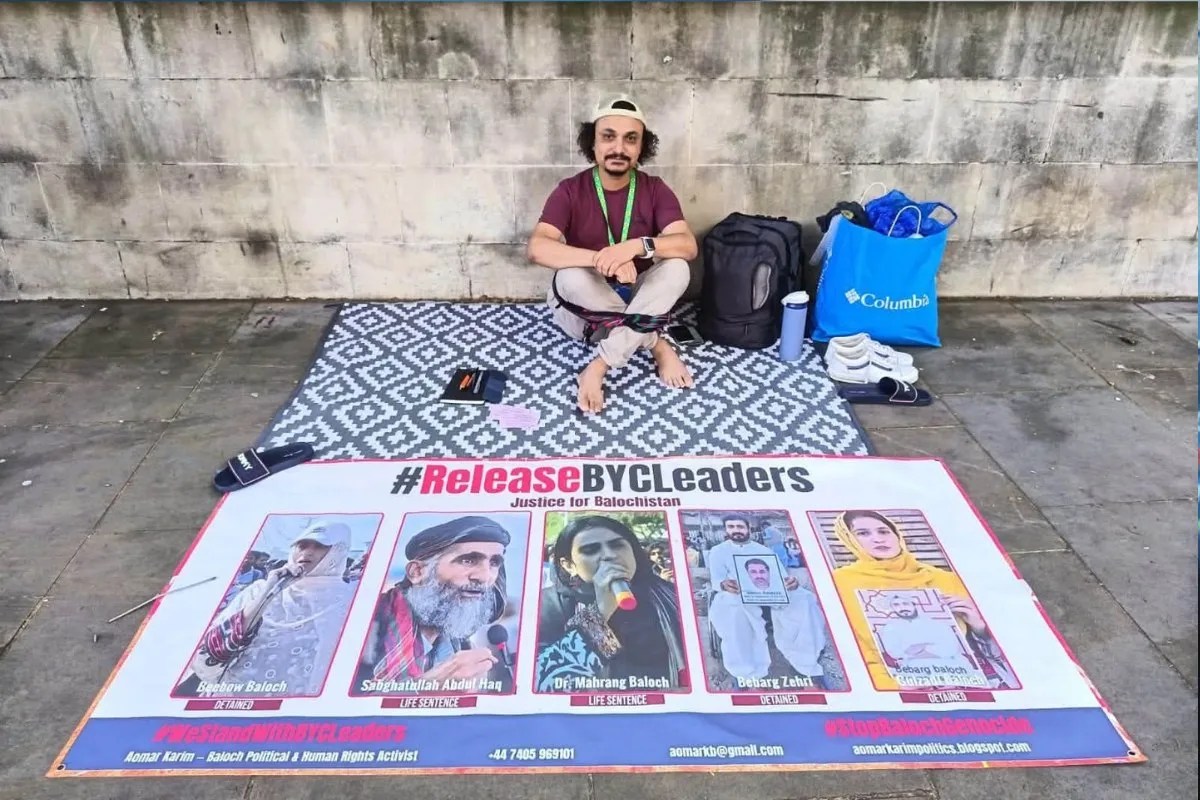
You don't usually see a man starving himself on purpose on the streets of London unless something is deeply broken back home. Right now, a quiet but desperate drama is unfolding directly outside the gates of 10 Downing Street. Aomar Karim, a Baloch human rights activist, has set up a peaceful hunger strike right under the nose of the British Prime Minister.
He isn't asking for policy tweaks or economic aid. He is demanding immediate international intervention in Balochistan. Meanwhile, you can explore related stories here: Inside the Traditionalist Rupture the Vatican Could Not Avoid.
If you aren't familiar with the geopolitics of South Asia, the name Balochistan might sound distant. But the crisis there is bleeding into western capitals. Karim's strike, which moves between the Prime Minister's residence and the Foreign, Commonwealth and Development Office (FCDO), is a direct challenge to the British government's long-standing diplomatic silence on Pakistan's internal crackdowns.
The Spark Behind the Hunger Strike
Why now? The immediate trigger for this extreme protest is a wave of harsh judicial actions back in Pakistan. Recently, Pakistani courts handed down life sentences to prominent Baloch rights leaders Mahrang Baloch and Sibghatullah Shahji. To the diaspora and human rights watchers, these sentences are purely political theater designed to crush dissent. To understand the complete picture, check out the detailed analysis by Reuters.
It doesn't stop with life sentences. The list of detained activists keeps growing. Names like Beebow Baloch, Bebarg Zehri, and Gulzadi Baloch are heavily cited by protestors outside Downing Street. Karim and his supporters argue that these individuals aren't militants; they're human rights defenders who spoke up against a brutal system.
When the legal channels inside a country become a weapon used by the state, activists are forced to look outside. That's why London has become the global stage for this struggle.
Enforced Disappearances and the Culture of Fear
To understand why someone would refuse food in the cold London air, you have to understand the terrifying reality of enforced disappearances in Balochistan. It's a systematic pattern of state behavior. Security forces pick up political activists, students, and journalists. No warrants. No court appearances. They just vanish.
- Some victims return months later, deeply traumatized.
- Others are found dead by the side of the road, victims of what locals call "kill-and-dump" operations.
- A growing number simply never reappear, leaving families in a permanent state of grief and limbo.
The Baloch National Movement (BNM) and other diaspora groups have repeatedly gathered in London to scream into the wind about this crisis. They're highlighting a particularly disturbing trend: the rising abduction of Baloch women, young girls, and children. It's a calculated strategy to break the spirit of the local population by targeting the community's core.
Why Target the British Government?
You might wonder why a protest over events in southwest Asia is happening in the UK. The answer is historical leverage and global responsibility.
The UK holds massive diplomatic sway with Pakistan. Activists like Karim believe that British silence equals complicity. By staging a hunger strike at 10 Downing Street, the protest forces British lawmakers, journalists, and the public to confront a harsh truth: while western nations preach human rights on the global stage, they frequently look the other way when strategic allies violate them.
Karim is publicly calling on the FCDO to issue an immediate statement condemning the life sentences of Mahrang Baloch and Sibghatullah Shahji. He wants democratic governments to stop treating Balochistan as an internal Pakistani issue and start viewing it as a humanitarian emergency.
Beyond the Silence
The situation in Balochistan isn't improving; it's destabilizing fast. The total lack of accountability from state institutions, including the military and the judiciary, has destroyed any remaining public trust. When people lose faith in courts and cops, the ground becomes fertile for much worse instability.
If you care about global human rights, you can't ignore what's happening outside Downing Street. The protest wraps up with a major rally at the FCDO, aimed at forcing British MPs to finally take a stand. It's time to pay attention to the hunger strike and amplify the voices of those who are risking their lives just to be heard. Raise awareness on social platforms, tag your local representatives, and demand that foreign offices question the blatant abuse of human rights in Balochistan. Silence is no longer an option.