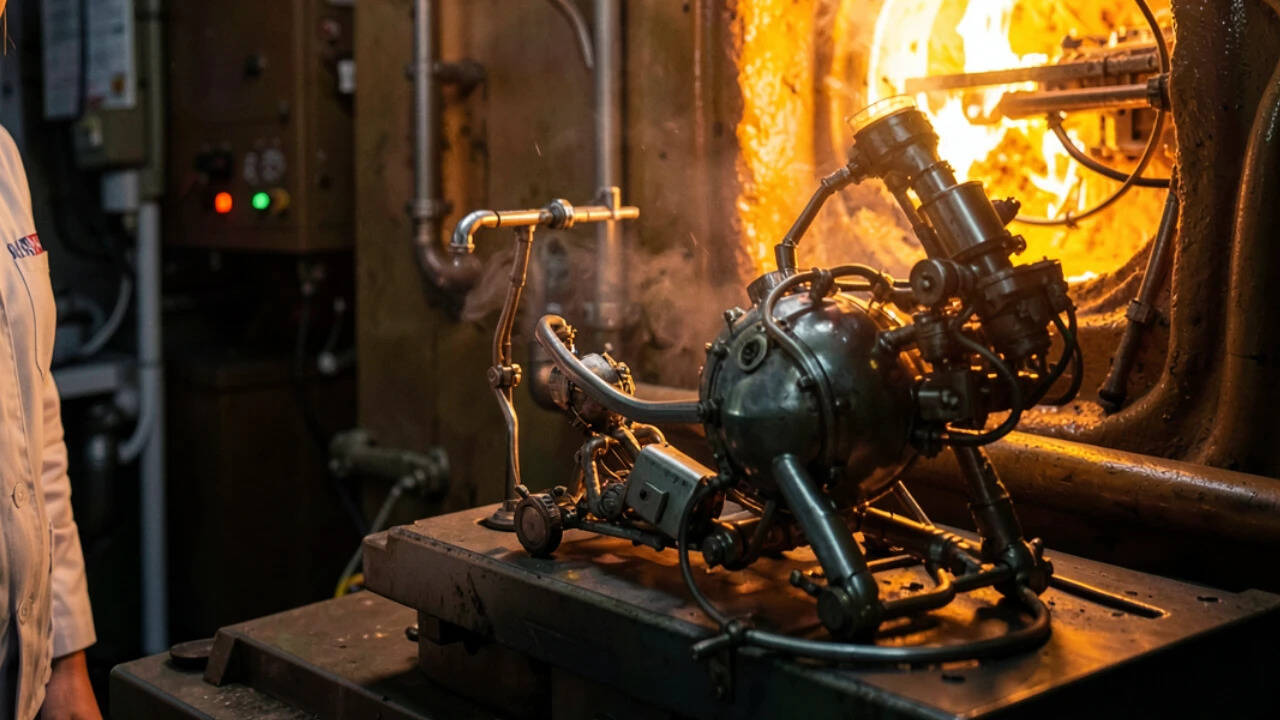
Testing a Venus probe model six times at 869 degrees Fahrenheit in a Pennsylvania furnace sounds like an exercise in brute-force engineering, yet it exposes a much deeper problem in planetary exploration. Surface conditions on Venus average roughly 869 degrees Fahrenheit alongside crushing atmospheric pressure near 90 times Earth sea level and corrosive sulfuric acid clouds. Repeated thermal cycling in a furnace helps engineers observe how materials, joints, and enclosures behave under extreme heat before committing flight hardware to a mission. Still, a hot furnace in Pennsylvania cannot replicate the full chemical, mechanical, and operational reality of the Venusian surface.
I have watched aerospace programs burn through budgets chasing test-like-you-fly certainty for decades, and Venus remains one of the most unforgiving classrooms in spaceflight. When an agency cycles a model six times at near-surface temperatures, the headline focuses on heat endurance. Inside the engineering bay, the real question is far more stubborn. Which failure modes show up during repeated heat-ups and cool-downs, and which fatal flaws only appear when high pressure, chemical reactivity, and active electronics collide all at once?
What Six Furnace Cycles Actually Prove
Thermal soak and thermal cycling are foundational tools in hardware development. Heating a Venus probe model to 869 degrees Fahrenheit and bringing it back down stresses dissimilar metals, welds, fasteners, coatings, and seal interfaces through differential expansion. In theory, six cycles provide more data points than a single burn. They let engineers look for cumulative creep, warpage, oxidation, or loosening hardware that might survive one excursion to peak temperature but fail on a second or third.
In practice, six cycles represent a compromise between rigor and schedule. Running a large test article up to 869 degrees Fahrenheit takes hours of controlled ramp-up, stabilization at soak temperature, and gradual cooling so thermal shock does not distort the test itself. Multiply that by six runs, add post-test inspections, teardown checks, and instrumentation calibration, and a single furnace campaign can consume weeks of facility time and engineering labor.
Repeated cycling also tests repeatability. Aerospace engineers worry deeply about margin and scatter. If a structural assembly or protective housing behaves slightly differently on cycle four than on cycle one, that drift tells you something important about grain growth, residual stress relief, or surface oxidation. Yet six cycles is still a small sample size when you are betting a multi-hundred-million-dollar or billion-dollar mission on survival. Reliability statistics demand large numbers, while flight hardware testing almost always deals in small batches and one-off prototypes.
Why Pennsylvania Furnaces Are Only Half the Equation
Choosing an industrial or test furnace in Pennsylvania reflects practical aerospace geography rather than planetary romance. The eastern United States has a dense ecosystem of specialized manufacturers, metallurgy labs, materials suppliers, and thermal test facilities capable of hitting high temperatures with tight control. Moving a Venus probe model to an existing furnace facility is often faster and cheaper than building bespoke high-temperature chamber infrastructure from scratch.
Heat alone, however, is only part of what makes Venus brutal. On Earth, 869 degrees Fahrenheit in air or a controlled furnace atmosphere tests thermal degradation and oxidation. On Venus, a spacecraft faces a dense carbon dioxide atmosphere at roughly 90 bar, supercritical or near-critical fluid behavior near the surface, trace corrosive gases, and sulfuric acid aerosols higher up. Heat softens materials and accelerates chemical reactions, while high pressure forces gases into microscopic gaps and changes convective heat transfer.
Consider a hypothetical example to see how single-variable testing can mislead a design team. Suppose a structural bracket made from a specialty alloy survives six cycles at 869 degrees Fahrenheit in a dry furnace with zero measurable distortion. That result clears a major thermal hurdle. If the same bracket on Venus is clamped against a mating flange under intense external pressure while exposed to reactive trace species, creep or galvanic/chemical interaction could still compromise the joint over time. Passing the furnace test proves thermal durability under those specific conditions, not total immunity to the Venusian environment.
The Electronics Bottleneck Behind Every Hot Probe
Whenever the public hears about a Venus probe model enduring 869 degrees Fahrenheit, the natural assumption is that engineers have solved high-temperature electronics. That assumption usually overreaches. Standard silicon microelectronics begin to fail well below 869 degrees Fahrenheit because thermal agitation increases leakage currents and destroys transistor junctions. Cooling systems, phase-change materials, and insulated pressure vessels have long been the standard workarounds for short-lived landers or descent probes.
Wide-bandgap semiconductors such as silicon carbide and specialized packaging techniques have pushed high-temperature electronics much further than older generations could manage. Researchers have demonstrated circuits operating at Venus surface temperatures for extended stretches in laboratory settings. Even so, building a complete, reliable spacecraft avionics suite that survives 869 degrees Fahrenheit is vastly harder than keeping a simple test circuit alive on a lab bench.
Every subsystem adds complexity and failure points. Sensors, connectors, solder or brazed joints, wire insulation, optical windows, and power distribution all face different thermal limits. A probe might keep its outer shell intact through six furnace runs while an internal sensor cable or connector pair degrades silently. That is why ground testing on a model or engineering unit is so valuable. It exposes the weak links before flight hardware is ever assembled.
Why Venus Keeps Punishing Optimistic Timelines
Space exploration has a long history of underestimating harsh planetary environments. Mars looks benign on paper until thin-atmosphere entry, dust, and temperature swings bite hardware. Europa and the outer ice giants present extreme radiation and cryogenic challenges. Venus sits in a category of its own because its surface combines extreme heat and extreme pressure in a way no other terrestrial planet in our solar system matches.
Historically, surface missions to Venus have been brief precisely because keeping systems alive at roughly 869 degrees Fahrenheit and 90 atmospheres is extraordinarily difficult. Extending operational life from minutes or a couple of hours to days, weeks, or longer requires breakthroughs in materials, thermal management, and fault tolerance. Every incremental test campaign—like running a probe model through six furnace cycles—is one brick in a very tall wall.
There is also a budget and risk dynamic that outsiders often miss. Planetary science competes for finite funding across destinations, instruments, and launch vehicles. Agencies face constant pressure to retire risk early using ground tests before committing to expensive flight hardware. A furnace test in Pennsylvania is relatively inexpensive compared to a launch failure or a premature mission loss. It is a pragmatic way to buy down technical risk without pretending a furnace equals Venus.
What Critics and Engineers Argue Over Ground Testing
Inside the engineering community, debates over ground test campaigns like six-cycle furnace runs tend to be sharp and practical rather than ideological. One camp argues that high-temperature ground testing is essential discipline that forces teams to confront physical reality early. If a design cannot survive six trips to 869 degrees Fahrenheit in a controlled facility, it has no business approaching Venus.
Another camp counters that over-focusing on a narrow test regime can create false confidence. If a test article is simplified—lacking active power, internal heat generation, realistic pressure loads, or representative chemical exposure—passing six cycles might lull stakeholders into thinking the hardest problem is solved. Worse, overly conservative thermal margins driven by test limitations can add mass and complexity that squeeze out scientific instruments.
Both sides have a point because engineering is always a trade-off among mass, cost, schedule, and risk. Ground testing does not replace high-fidelity modeling, materials characterization, or integrated environmental testing. It works best when engineers treat each test result as a bounded clue rather than a final verdict.
Key Factors That Shape High-Temperature Probe Testing
- Thermal cycling count: Six cycles test repeated expansion, contraction, and cumulative stress, though statistical confidence still requires complementary analysis and component testing.
- Pressure and chemistry gaps: A furnace at 869 degrees Fahrenheit addresses heat, while Venus adds roughly 90 bar of pressure and a corrosive atmosphere.
- Subsystem disparity: Structural housings, coatings, and electronics degrade at very different rates and temperatures.
- Facility pragmatism: Using established industrial or test furnaces in places like Pennsylvania speeds up hardware validation and controls costs.
How to Read Headlines About Extreme Space Testing
When a headline announces that a Venus probe model went into a Pennsylvania furnace six times at 869 degrees Fahrenheit, read past the drama to the engineering intent. The number six tells you engineers were looking for repeatability and cumulative thermal effects, not just a one-time peak temperature survival check. The 869-degree figure tells you they were targeting realistic Venus surface heat. The location tells you they leaned on existing domestic test capacity to move quickly.
What the headline cannot tell you is what was inside the model, what failed or nearly failed during those six runs, or how the team plans to bridge the gap between hot dry heat and the crushing, chemically aggressive reality of Venus. Real aerospace progress rarely looks like a Hollywood breakthrough. It looks like patient, repetitive, sometimes humbling testing where engineers learn exactly where their assumptions break.
Look closely at the test parameters and subsystem boundaries whenever the next round of data comes out, because the real story of surviving Venus is written in the margins between what a furnace can simulate and what the planet actually delivers.