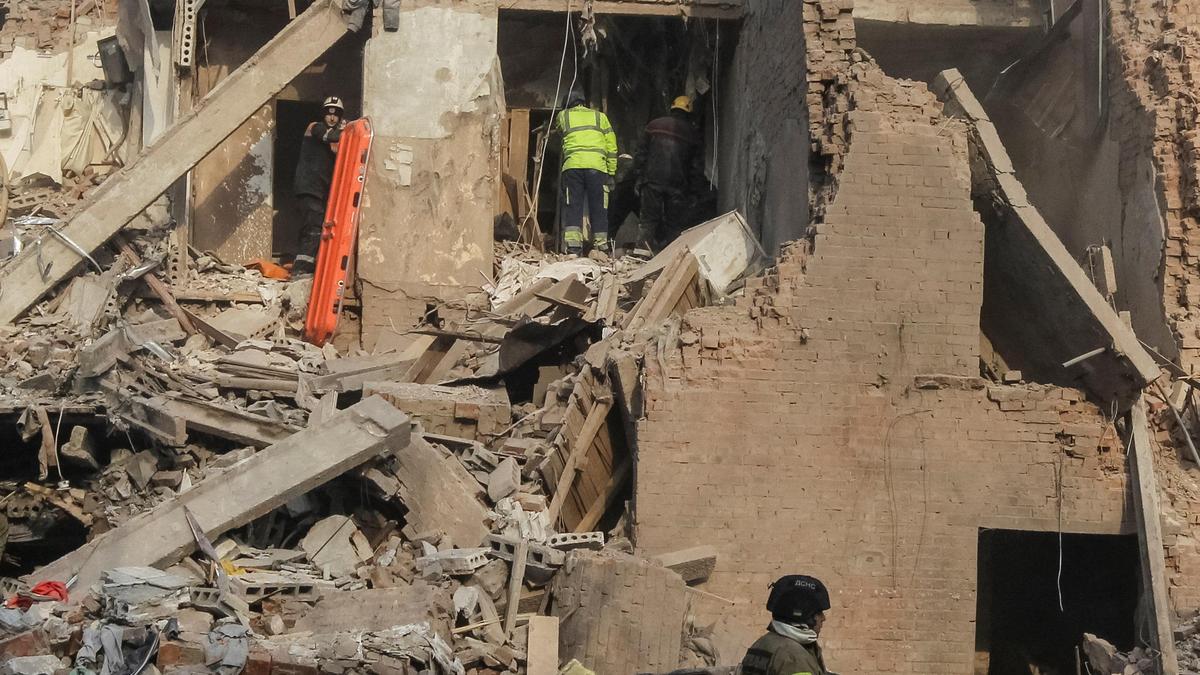
Media outlets are currently obsessed with the scoreboard of tragedy. Every time a Russian missile barrage hits Kyiv, Kharkiv, or Dnipro, the headlines follow a predictable, weary script: count the casualties, quantify the rubble, and scream for more air defense. They treat war like a box score. Four dead. Dozens wounded. Another power plant smoldering.
This focus is not just lazy; it is fundamentally distracting.
The "lazy consensus" suggests that these strikes are a sign of Russian desperation or a simple terror tactic aimed at breaking Ukrainian morale. That narrative is a comfort blanket for Western analysts who don't want to admit we are witnessing the birth of a new, terrifyingly efficient doctrine. These strikes aren't just about killing people or breaking glass. They are high-velocity data collection events designed to map the limits of Western integrated air defense systems (IADS).
If you’re watching the smoke, you’re missing the signal.
The Decoy Economy and the Math of Exhaustion
Standard reporting views a shot-down missile as a win for the defender. In reality, a $50,000 Shahed drone forcing the launch of a $2 million Patriot interceptor is a catastrophic economic defeat for the West. We are celebrating "successful" interceptions that are actually draining our strategic reserves faster than we can refill them.
I have watched defense contractors hand-wave this math for years, but the reality on the ground in Ukraine has exposed the rot. We have built an exquisite, hyper-expensive shield that is being dismantled by a cheap, mass-produced sword.
Russian strikes utilize a "layered saturation" approach. They mix high-end cruise missiles with low-cost decoys and thermal-emitting drones. The goal isn't always to hit the target on the first try. The goal is to force the Ukrainian radars to turn on, ping their locations, and exhaust their magazine depth.
- The Bait: Cheap drones designed to look like cruise missiles on radar.
- The Hook: Forcing the engagement. Every interceptor fired is one less available for the next, more lethal wave.
- The Kill: The subsequent use of hypersonic or ballistic assets once the defense grid is saturated or reloading.
Why Morale Is the Wrong Metric
Stop asking if these attacks will break the Ukrainian spirit. History proves that strategic bombing—from the Blitz to Hanoi—almost never breaks civilian resolve. In fact, it usually hardens it. The Russian command knows this. They aren't trying to win a popularity contest or even a psychological war of attrition in the classic sense.
They are conducting a functional degradation of the state's ability to exist as a modern entity.
When a missile hits a residential building, the "human interest" story dominates the news cycle. But the real strategic blow is often the damage to the substation three blocks away that didn't make the front page. By targeting "dual-use" infrastructure—power, heat, and transit—they are creating a massive logistical tax on the Ukrainian military. Every soldier who has to help clear rubble or guard a generator is a soldier not at the zero line. Every dollar spent on humanitarian repair is a dollar not spent on offensive weaponry.
The Intelligence Loop Nobody Is Talking About
The most dangerous part of these strikes isn't the explosion. It's the "Battle Damage Assessment" (BDA) that follows.
In the minutes following a strike, Russian intelligence isn't just looking at satellite imagery. They are scraping social media, monitoring live feeds, and tracking the electronic signatures of the emergency response. They are learning exactly how long it takes for a specific grid segment to fail and how the Ukrainian command reroutes power.
This is a real-time stress test of a nation-state. Most analysts talk about "missile stocks" as if war is a game of Tetris. It’s actually more like a game of Go. Russia is placing stones to see how the board reacts.
The Failure of the Western "Shield" Narrative
We’ve been told for decades that Western technology is an impenetrable wall. The recent strikes prove that a wall is useless if it costs more than the ladder the enemy is using to climb over it.
The dirty secret of the defense industry is that we aren't equipped for a high-intensity, long-duration kinetic war. Our production lines for interceptors are boutique operations. We produce dozens per year; Russia and its partners are firing hundreds per month.
Imagine a scenario where a major city's entire defense budget is liquidated in a single weekend because of a swarm of plywood drones. That isn't a hypothetical. It is the current operational reality.
The Technical Reality of "Interception Rates"
Government spokespeople love to cite "80% interception rates." These numbers are often functionally meaningless.
If you fire ten missiles and eight are shot down, but the remaining two destroy the primary transformer for a regional capital, the mission was a 100% success for the attacker. The "interception rate" is a vanity metric used to keep the public calm and the funding flowing.
Furthermore, we rarely talk about the "lethality of the debris." A shot-down missile doesn't just vanish. Thousands of pounds of high-grade explosives and fuel fall somewhere. In many cases, the "interception" occurs at an altitude where the kinetic energy of the falling debris causes more widespread, unpredictable damage to civilian centers than a direct hit on a hardened military target would have.
The Actionable Pivot: Resilience Over Interception
The obsession with "stopping" every strike is a losing game. It is a reactive posture that cedes the initiative to the aggressor.
True strategic dominance in this era doesn't come from a better shield. It comes from "distributed resilience." Instead of massive, centralized power plants that make easy targets, the focus should be on micro-grids. Instead of concentrated command centers, the focus must be on decentralized, mobile infrastructure.
The West is still thinking in terms of the Cold War—big targets, big shields, big budgets. Russia has pivoted to a "distributed chaos" model. They are betting that they can generate more chaos than we can afford to manage.
The Brutal Truth About Casualty Figures
Four dead is a tragedy. But in the cold calculus of modern conflict, it is a statistical anomaly. The real casualty of these attacks is the Western illusion of safety.
We have spent trillions on stealth fighters and aircraft carriers that are effectively useless in a conflict defined by $500 FPV drones and massed cruise missile barrages against civilian infrastructure. We are bringing a scalpel to a sledgehammer fight.
Every time we focus on the "outrage" of a strike, we fall into the trap. The outrage is the intended product. It drives frantic, emotional policy decisions rather than cold, calculated military responses. It forces the deployment of air defense assets to protect "high-visibility" civilian areas, leaving the actual military front lines exposed to devastating close-air support.
Russia isn't trying to kill four people. They are trying to move your queen into a corner. And based on the current media and political reaction, it's working.
Stop counting the bodies and start counting the capacitors. Stop looking at the fire and start looking at the grid. The war isn't happening in the headlines; it’s happening in the quiet, systemic failure of a nation's ability to remain "plugged in."
The era of the "safe" rear-guard is over. Either we learn to build systems that survive being hit, or we continue to go bankrupt trying to stop the unstoppable.