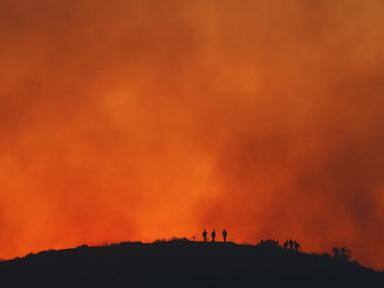
The sky above the American West used to tell a story of triumph. For fifty years, it was a data-driven, hard-fought victory. You could look at the horizon in cities like Los Angeles, Salt Lake City, or Denver and actually see the progress. The choking, yellow-brown smog of the 1970s had been systematically dismantled by policy, catalytic converters, and industrial regulations. The Clean Air Act worked. It saved hundreds of thousands of lives.
Then, the smell changed.
It starts not with a roar, but with a faint, sweet scent of campfire that feels misplaced in a suburban living room. Next comes the visual shift. The sun turns an ominous, bruised shade of magenta. By day three, the horizon vanishes entirely, swallowed by a ghostly, featureless gray.
Consider Sarah. She is a composite of a dozen people I know in Colorado, but let’s place her in a typical suburban neighborhood just outside Boulder. She doesn't track environmental policy. She tracks her eight-year-old son’s inhaler. For a decade, his asthma was manageable, a minor footnote in their daily routine. Now, she checks an app on her phone every morning just to decide if he can play in the backyard. The app relies on the Air Quality Index (AQI), a metric that used to hover comfortably in the green "good" zone. Lately, the numbers are spiking into the deep, angry purples of the "hazardous" range.
What Sarah is breathing isn't just smoke. It is a chemical time machine, dragging American air quality back by decades and erasing a generation of public health victories.
The Illusion of Control
For a long time, we believed air pollution was a math problem we had solved. If you reduce factory emissions by a certain percentage and mandate cleaner vehicles, the air gets cleaner. The equation was elegant. It gave us a sense of total agency over the environment.
But nature does not negotiate with policy.
A landmark study analyzing atmospheric data across the United States has revealed a terrifying trend: the steady, downward trajectory of American air pollution has officially reversed. The culprit is not a secret network of coal plants or a sudden rollback of vehicle emission standards. The villain is the wildfire.
When millions of acres of pine, fir, and underbrush burn across California, Canada, and the Pacific Northwest, they don't just produce ash. They create massive, airborne chemical reactors. As the smoke travels thousands of miles, baking in the summer sun, it undergoes a toxic transformation. Sunlight cooks the volatile organic compounds and nitrogen oxides in the smoke, creating ground-level ozone.
Ozone. It is a word we usually associate with protection when it is high up in the stratosphere. But down here, where we live and breathe, it is effectively bleach for the lungs.
The data shows that the fine particulate matter, known as PM2.5, has surged to levels unseen since the late twentieth century. These particles are microscopic, less than 2.5 micrometers in diameter. To understand that scale, imagine a single strand of human hair. You could line up thirty of these particles across its width. They are so small that they bypass the body's natural filtration systems entirely. They don't just stay in your lungs; they cross into your bloodstream.
The Invisible Stakes
This is where the abstract science turns intensely human. When these particles enter the bloodstream, the body treats them as a foreign invader. An inflammatory response triggers. Blood vessels constrict.
Doctors in emergency rooms across the country are seeing the immediate fallout. On days when the smoke rolls in, hospital admissions for heart attacks, strokes, and respiratory distress skyrocket. The correlation is not loose; it is tight, predictable, and devastating.
But the real problem lies elsewhere, hidden in the long-term prognosis of an entire generation.
We used to think of wildfire smoke as a acute seasonal nuisance. You stay indoors for a week, you buy an air purifier, you wait for the wind to shift, and life goes on. That assumption is dead. The fire seasons are longer now, stretching from early spring into late autumn. The smoke is no longer a temporary visitor; it is a seasonal resident.
What happens to a child's developing lungs when they spend three months of every year breathing the equivalent of a campfire?
We are beginning to find out, and the answers are chilling. Researchers are noting permanent reductions in lung capacity among children raised in high-smoke regions. We are looking at a future where a generation of adults will grow up with compromised respiratory health, regardless of whether they ever picked up a cigarette.
The Geography of Smoke
There is an unfair geographical sorting happening across the continent. The smoke does not care about state lines, property values, or political demographics. It is a highly democratic poison, but its consequences are deeply unequal.
Imagine two families in the same smoke-choked city.
The first family lives in a modern home with central air conditioning and a multi-stage HEPA filtration system. They work white-collar jobs from home, shielding their lungs behind triple-paned windows. Their exposure is minimal, mitigated by wealth and infrastructure.
The second family lives in an older apartment complex with window units that draw in the outside air. The parents work in construction, landscaping, or agricultural logistics. They cannot opt out of the atmosphere. For eight to ten hours a day, their lungs do the heavy lifting of filtering the continent's burning forests.
The recent atmospheric studies confirm that this isn't just a West Coast crisis anymore. The jet stream acts as a massive conveyor belt, carrying the particulate matter across the Great Plains, over the Midwest, and dumping it directly into the densely populated corridors of the East Coast.
In recent summers, New York City, Washington D.C., and Boston have all experienced days where their skylines were eclipsed by a thick, orange haze, registering some of the worst air quality on the planet. The realization was sudden and jarring for millions of people: no one is safe from the burning West. You cannot build a wall high enough to keep out the sky.
The Flaw in the Matrix
The terrifying truth underlying the current research is that our regulatory framework is utterly unequipped for this new reality.
The Clean Air Act was designed to regulate human industry. It punishes factory owners who violate emission caps. It fines corporations that dump toxins into the ecosystem. It relies on the assumption that pollution has a specific source, a legal entity that can be subpoenaed, fined, and forced to comply.
How do you sue a lightning strike? How do you fine a million acres of wilderness?
Because wildfire smoke is classified as an "exceptional event" under current environmental laws, local governments are often allowed to strip these smoky days from their official air quality metrics when reporting compliance to federal agencies. It is a massive bureaucratic loophole. On paper, a city might look like it is meeting its clean air goals. But the lungs of the people living in that city do not care about legal exemptions. They don't get to erase the exceptional events from their biology.
This creates a dangerous disconnect between political rhetoric and physical reality. Leaders can point to charts showing declining industrial emissions and claim victory, while out the window, the sun is a dull crimson ball hanging in a gray shroud.
The Cost of the New Normal
We are forced to redefine our relationship with the outdoors. The open-air freedom that defined the American identity for over a century is quietly being rationed.
I remember a afternoon last August. The local high school football team was practicing under a sky that looked like the surface of Mars. The coaches had their eyes glued to their phones, monitoring the AQI. At 151—the threshold where the air becomes officially unhealthy for everyone—the whistle blew. The teenagers tramped inside to practice in a cramped, concrete gymnasium.
It was a small moment, but it felt like a profound surrender.
We are retreating indoors. We are sealing ourselves away in filtered boxes, terrified of the very air that sustains us. The psychological toll of this retreat is immense, a slow-burning anxiety that colors every summer plans, every outdoor vacation, every childhood memory being formed right now.
The solutions being proposed are massive, expensive, and painfully slow. They involve a complete overhaul of forest management policies, decades of controlled burns to undo a century of aggressive fire suppression, and a radical reduction in the global greenhouse gas emissions that are turning our forests into tinderboxes.
But those solutions are measured in decades. The smoke is here now.
Tomorrow morning, Sarah will wake up, walk to her kitchen, and look out the window toward the mountains. If they are gone, vanished behind that familiar, suffocating veil, she will reach for her phone. She will check the number. She will make the decision that thousands of parents now make daily: whether to let her child breathe the world outside.
The progress we celebrated for fifty years wasn't permanent. It was a temporary truce with an environment we thought we had mastered, and right now, that truce is burning to the ground.